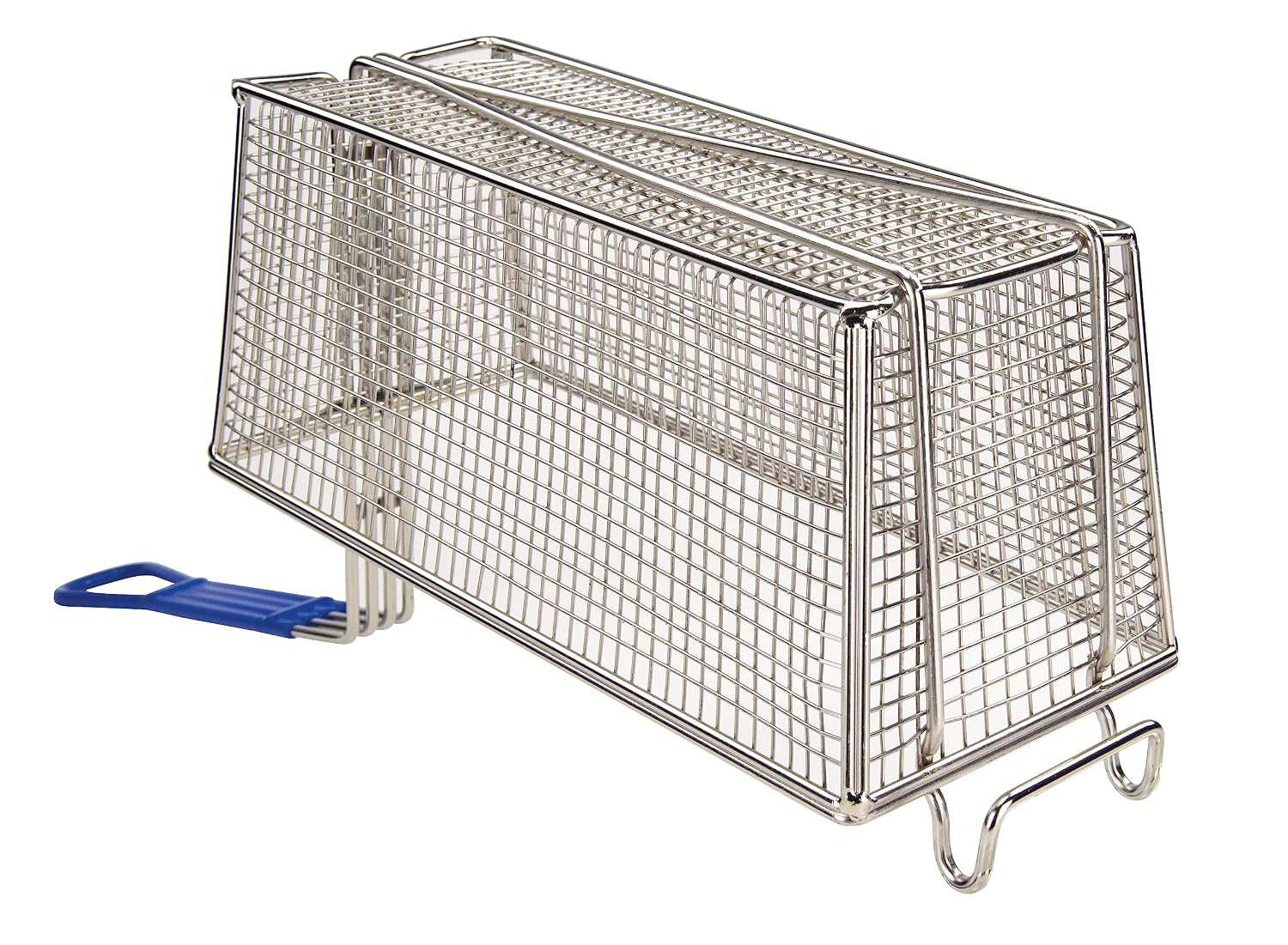
If your fry basket just gave out — the handle snapped, the wire mesh buckled under a load of wings, or you finally admitted it never fit the fryer right in the first place — Winco is probably one of the first names you’ll see when you search for a replacement. Winco USA is a foodservice equipment supplier that manufactures and distributes a wide range of commercial kitchen smallwares, including one of the more extensive aftermarket fry basket catalogs on the market. A fry basket is simply the metal mesh container you lower food into hot oil and lift back out — the part that takes the most abuse in a commercial fryer. Winco sells baskets in a range of sizes, wire gauges (the thickness of the metal wires that form the mesh), and handle colors. That last detail — handle color — turns out to be more than cosmetic. It’s a station-management and food-safety coding system. This guide maps the Winco lineup to real fryer dimensions, explains which specs matter for which workloads, and gives you a clear decision rule for matching basket to fryer before you spend $25–$80 per unit on something that won’t fit.
| EDITOR'S PICKWinco FB-40 Fry Basket with Yel… | Mid-tierWinco Culinary Basket | Budget pickWinco FB-20 Fry Basket with Blu… | |
|---|---|---|---|
| Dimensions | 17" x 8.5" x 6" | 10" dia | 13 1/4" x 5 5/8" x 5 5/8" |
| Mesh | — | Coarse | — |
| Handle color | Yellow | — | Blue |
| Diameter | — | 10" | — |
| Price | $34.42 | $18.18 | $17.99 |
| See on Amazon → | See on Amazon → | See on Amazon → |
How Winco Organizes Its Basket Catalog (And Why It Matters)
Winco’s fry basket lineup isn’t random. The SKUs follow a loose but consistent logic: basket footprint (exterior length × width, measured in inches), depth, wire gauge, and handle style. Once you can read a Winco model number, you stop ordering by guesswork.
The core residential-to-light-commercial range covers baskets roughly 8–9 inches wide and 4–5 inches deep, designed to drop into the standard fryer pot found on countertop units like the Waring WDF1500D or mid-tier Cuisinart Pro models. The full commercial range scales up to baskets in the 11–13 inch width zone for floor-standing fryers from Pitco, Frymaster, and Vulcan — the 14-inch and 18-inch pot fryers that are the backbone of any high-volume kitchen.
The measurement that actually governs fit is the interior pot dimension of your fryer, not the exterior cabinet width. A Pitco SG14 has a pot interior of approximately 14 × 14 inches; a Frymaster MJ45 runs a similar footprint. Winco’s larger baskets — the BFST and BFSD series — are spec’d to work inside those pot dimensions with the clearance needed for oil circulation. Per the Katom Restaurant Supply blog’s commercial fryer buying guide, inadequate clearance between basket and pot wall restricts oil flow and causes uneven cooking, which is the functional reason “close enough” is not good enough when sizing.
By the numbers:
- Winco catalog lists 20+ distinct fry basket SKUs as of May 2026
- Wire gauges across the range: 3.5 mm (heavy commercial), 3.0 mm (standard commercial), 2.5 mm (light/consumer)
- Handle color options: yellow, green, red, blue — each corresponding to a recommended food-safety use category
- Price range across full catalog: approximately $18–$85 per unit at standard distributor pricing
Wire Gauge and Mesh Pattern: The Specs That Actually Govern Performance
Most buyers focus on footprint and ignore wire gauge. That’s the most common mistake in aftermarket basket procurement, and it’s how operators end up replacing baskets every six months instead of every two to three years.
Wire gauge determines load capacity and longevity under thermal cycling — the repeated stress of going from room temperature into 375°F oil and back. Winco’s heavier commercial baskets use approximately 3.5 mm wire, which operators in long-run reviews on WebstaurantStore consistently describe as holding dimensional stability through sustained service. The lighter gauge (2.5 mm) baskets — the ones at the $18–$25 price point — are appropriate for home fryers running intermittent loads, but operators in volume service report deformation at the basket corners within months.
Mesh pattern is the second spec. Winco offers both standard square-mesh and fine-mesh variants. The practical breakdown:
- Standard mesh (approximately 12 × 12 mm openings): suited for chicken pieces, fish fillets, onion rings, and anything with a breaded exterior. Crumbs pass through; product doesn’t. This is the default for most commercial applications.
- Fine mesh (approximately 6–8 mm openings): suited for smaller product — shrimp, small cut fries, breaded mushrooms, and any application where smaller pieces would fall through standard mesh. Fine mesh costs slightly more and is harder to clean thoroughly; the trade-off is product retention.
The Winco BFST-series baskets use standard mesh and are the workhorses the catalog is built around. The fine-mesh variants carry different suffix designations — check the “mesh opening” spec field, not just the basket name, before ordering. Per Foodservice Equipment Reports’ coverage of aftermarket parts compatibility, aftermarket suppliers including Winco publish mesh dimension specs in their catalog PDFs; if you’re sourcing through a distributor that doesn’t surface those specs in the listing, ask for the catalog page.
A note on the 201 vs. 304 stainless question: Winco’s commercial-tier baskets are published as 304 stainless steel in the product specs — the same alloy used in most OEM baskets from Pitco and Vulcan. Some lower-priced Winco baskets in the consumer range do not specify grade explicitly. If the listing doesn’t say “304” or “18/8,” treat it as unverified and price accordingly. The WebstaurantStore blog’s fryer equipment overview notes that 201 stainless — a lower-nickel alloy sometimes sold as “commercial grade” — is meaningfully less corrosion-resistant in an oil and salt environment, and operators report early pitting and discoloration that doesn’t occur with 304.
Handle Colors: The Station-Management System You Should Be Using
Winco’s colored plastic handle inserts aren’t a marketing decision — they map to the foodservice industry’s standard color-coding system for allergen and cross-contamination control. Per NSF International’s food safety guidance documentation, color-coded equipment is a recognized operational control for managing allergen separation in shared kitchen environments.
The conventional mapping, which Winco’s catalog reflects:
| Handle Color | Conventional Use Category |
|---|---|
| Yellow | Poultry |
| Red | Beef / pork |
| Green | Produce / vegetarian |
| Blue | Fish / seafood |
In a ghost kitchen or food-truck operation running multiple protein types through a shared fryer, handle color is one of the fastest visual checks a line cook has during service. If you’re running a single-protein operation, the color system matters less — but it costs nothing to adopt and becomes critical the moment you add a second protein or take on an allergen-conscious client.
Winco sells replacement handle inserts separately from the baskets, which matters when a handle cracks (as they do, eventually, under repeated thermal stress) without basket damage. Ordering a replacement insert instead of a full basket is the correct call; the insert is a fraction of the cost.
Matching Winco Baskets to Common Fryer Models
This is where the research pays off. The table below reflects published basket and fryer pot dimensions from Winco’s catalog and manufacturer spec sheets — not field measurements from this publication.
For countertop fryers (home and prosumer): Waring WDF1500D, Cuisinart CDF-200, and comparable units typically run a 4-liter pot with interior dimensions around 8–8.5 inches wide. Winco’s smaller baskets — the BFB series — are designed to fit this class. Verify interior pot width against published spec before ordering; manufacturers vary.
For light commercial floor fryers (35–40 lb. oil capacity): Pitco SG14, Frymaster MJCF, and Vulcan 1VK45A-1 fall in this tier with pot interiors in the 12–14 inch range. Winco’s BFST-1414 and similarly dimensioned baskets in the commercial range are the target matches. At this tier, operators in aggregated distributor reviews consistently note that Winco baskets fit correctly as aftermarket replacements when pot interior dimensions are verified first.
For high-volume floor fryers (50 lb.+ oil capacity): Pitco SG18, Frymaster GF14 SD, and Manitowoc’s larger commercial fryers run pot interiors at 18 inches or wider. Winco does produce baskets in this footprint, but availability through standard distribution is thinner than the mid-range. For this tier, OEM sourcing from the fryer manufacturer is worth pricing before committing to aftermarket — per Foodservice Equipment Reports’ aftermarket parts coverage, the price gap between OEM and quality aftermarket narrows significantly above the 18-inch pot class because aftermarket demand is lower and fewer suppliers tool for it.
The two measurements you must pull before ordering any basket:
- Interior pot width (left-to-right)
- Interior pot depth (front-to-back)
Published fryer specs often list exterior dimensions and oil capacity but bury the interior pot dimensions in the installation manual rather than the marketing spec sheet. The installation manual is always the right source.
The Decision Rule
Here’s the if/then frame for anyone with a procurement decision pending:
If you’re running a countertop or prosumer fryer (Waring, Cuisinart Pro, comparable) and need a replacement basket in the $20–$40 range: Winco’s BFB-series standard-mesh basket in the matching footprint is a defensible choice. Confirm pot interior dimensions from your fryer’s manual, not the cabinet width on the product listing. At this price point, Winco is among the more consistent aftermarket options based on aggregated reviewer feedback.
If you’re running a mid-range commercial floor fryer (Pitco SG14 class, Frymaster MJ45 class) and evaluating whether to pay OEM pricing ($120–$180 per basket) versus Winco aftermarket ($55–$80): The math favors aftermarket if the pot dimensions match exactly and you confirm 304 stainless in the spec. The gap narrows if your operation logs more than two fryer cycles per day — at that volume, per-unit longevity is the variable, and operator reviews at that cycle rate are thinner for aftermarket than for OEM.
If you’re running an 18-inch-plus high-volume fryer and sourcing multiple baskets for a commissary or multi-unit operation: Price OEM first. The aftermarket price advantage is smaller at this size, and fryer downtime from an ill-fitting basket costs more per hour than the per-unit savings.
On handle color: Order to the allergen-control system from day one, even if it feels like overkill for a single-protein operation today. The Winco catalog makes it easy; there’s no reason not to.
The Winco lineup earns its place in the aftermarket conversation because the specs are published, the sizing logic is learnable, and the price-to-durability ratio at the mid-commercial tier is well-documented by operators in long-run distributor reviews. Do the dimensional homework, confirm the stainless grade, and the buying decision is straightforward.