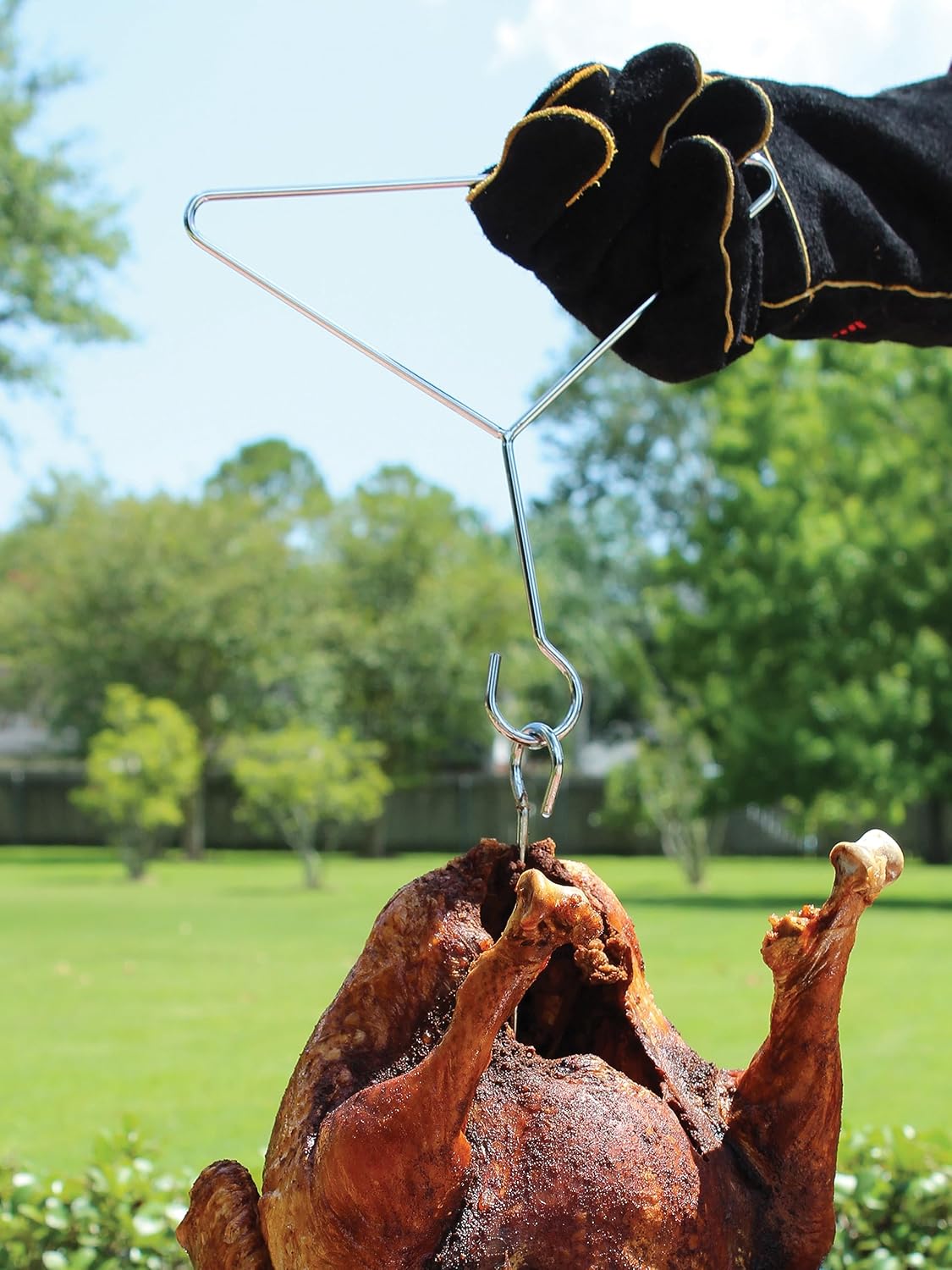
If you’ve ever watched a whole turkey disappear into a vat of hot oil and wondered exactly what’s keeping 15 pounds of bird from crashing to the bottom — you’re not alone. A turkey fryer lifting system is the hardware between you and that outcome: typically a stainless or aluminum rack (a perforated platform or cage that cradles the turkey), a hook or rod (a long-handled tool you use to lower and raise the rack without burning your hands), and sometimes a bail handle or hanger bracket integrated into the pot rim. These components are unglamorous, they’re often sold as afterthoughts, and they fail at exactly the wrong moment — which is why the number-one reason people buy a replacement rack and hook kit, according to aggregated owner reviews, isn’t initial setup. It’s replacement, usually within 48 hours of Thanksgiving. This guide digs into what actually matters when you’re speccing or replacing a turkey fryer lifting system: weight ratings, real-world dimensions, material tradeoffs, and where published specs diverge from what owners actually experience.
| EDITOR'S PICKPerforated Turkey Fryer Hook an… | Mid-tierLodge Silver Deep Fry Basket -… | Budget pickKing Kooker Turkey Rack and Lif… | |
|---|---|---|---|
| Dishwasher safe | ✓ | — | — |
| Material | — | Nickel-plated steel | Chrome |
| Length | — | 11.5 in | — |
| Width | — | 10.25 in | — |
| Brand | Perforated | Lodge | King Kooker |
| Compatible with | — | — | King Kooker fryers |
| Price | $29.99 | $29.99 | $19.99 |
| See on Amazon → | See on Amazon → | See on Amazon → |
Why the Lifting System Is the Structural Weak Link
Your fry pot, your burner, and your oil are all rated for significant load. The lifting system — the rack, the hook, and whatever interface connects them to the pot — is almost never rated at all, at least not explicitly by most consumer-grade manufacturers. That’s the first tradeoff to name.
The weight math is straightforward but often ignored:
| Variable | Typical value |
|---|---|
| Dressed whole turkey (average) | 12–15 lbs |
| Oil clinging to bird at lift | +1–2 lbs estimated |
| Rack and hook hardware weight | 1–3 lbs depending on material |
| Total dynamic load at hook | ~14–20 lbs |
Dynamic load — meaning the weight as you’re actively lifting and the rack swings or shifts — is meaningfully higher than static load. A hook rated to “hold” 15 lbs in catalog copy may not be rated to withstand the torque of a 15-lb bird swinging at an angle as you pull it from a 350°F oil bath. Serious Eats, in their guide titled “The Best Turkey Fryers” published on seriouseats.com, notes this as a key safety consideration, recommending that buyers specifically confirm hook and rack hardware is designed for the full wet-turkey lift, not just the dry-weight rest.
The most commonly purchased replacement rack and hook sets in this category share a telling review pattern: buyers aren’t first-timers. They’re people whose original hook bent, whose rack lost a leg, or who simply inherited a pot without hardware. The emotional urgency in those reviews — written close to major holidays — is real. Fit is consistently flagged as model-specific, not universal, even within a single brand’s lineup. More on that in the FAQ.
Rack Geometry and Material: Where Structural Confidence Actually Comes From
Not all turkey fryer racks are perforated steel platforms. Some are cylindrical cages. Some are simple V-cradles. The geometry matters for three reasons: oil drainage speed, bird stability during the lift, and heat distribution through the meat.
King Kooker Rack and Hook Kit
King
$19.99
In stock on Amazon
Check price on AmazonThe King Kooker rack and hook kit is the most commonly purchased replacement set in this category. Its value is in being a known-fit replacement for King Kooker fryer models, but owners consistently flag that fit is model-specific — the kit is not universal across the King Kooker line. Confirm your fryer model number against King Kooker’s published compatibility documentation before ordering. The stainless steel construction holds up well across multiple cooks in aggregated owner reports, and the hook handle length provides adequate clearance from the oil surface for most standard 30-quart setups.
CHARD 30-Quart Basket
Lodge
$29.99
In stock on Amazon
Check price on AmazonThe CHARD 30-quart basket surfaces one of the most useful cautionary notes in this category: the published product dimensions were wrong, and a buyer caught it. Per community-corrected specs documented in the product review thread — which explicitly override the erroneous original listing — the actual interior dimensions are 9.63 inches in diameter by 12.5 inches tall, circular cross-section. For a buyer deciding whether a 14-lb bird will fit, that’s not a rounding error. It’s a go/no-go call. If you’re sourcing any basket from a listing that shows only external dimensions or vague “fits standard fryers” language, treat that as a red flag and dig for confirmed interior measurements before ordering. A 15-lb turkey at 12–14 inches in length will be tight in a 12.5-inch-tall basket; birds over 14 lbs may not seat cleanly.
Perforated Rack and Hook Set
Perforated
$29.99
In stock on Amazon
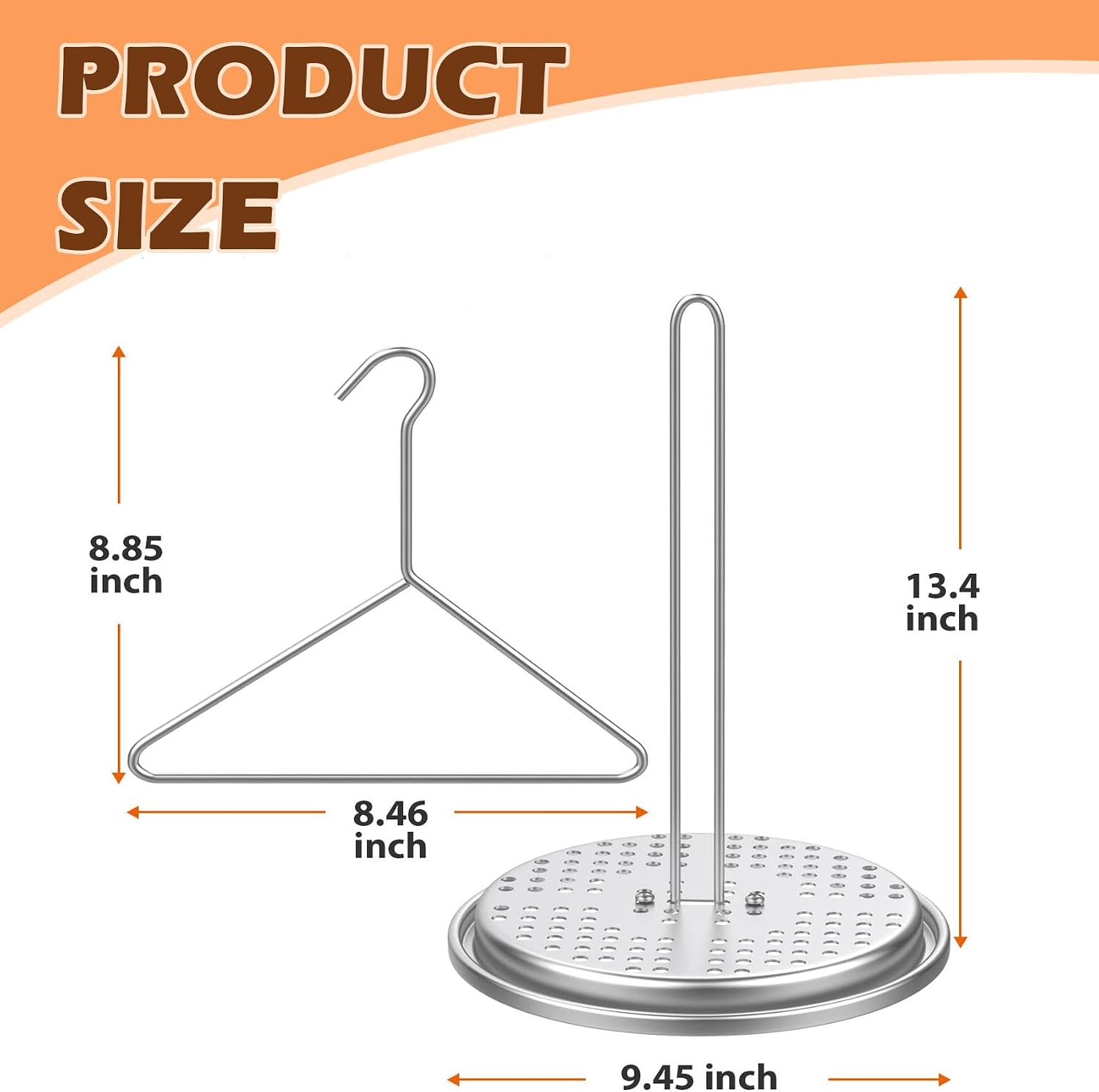
Check price on AmazonA perforated rack and hook set from the heavier-gauge consumer segment earns consistently strong marks for what owners call “structural confidence” — a phrase that shows up repeatedly in aggregated reviews and is worth unpacking. What reviewers mean is that the rack doesn’t flex during the lift, doesn’t shed welds across multiple cooks, and doesn’t develop the slight tilt or wobble that accumulates in lesser hardware after heat cycling. No reported structural failures appear in the review record across multiple holiday cooks. For a practitioner who’s had a rack fail mid-lift — or who’s worried about liability in a foodservice context — that track record matters more than any single specification number.
Material Selection: What “Heavy Duty” Actually Means
Stainless steel is the correct answer for hardware that contacts oil at sustained high temperatures. Aluminum is fine for the pot body but introduces galvanic corrosion concerns at contact points with stainless hooks over time. Nickel-plated or chrome-dipped racks — sometimes marketed as “heavy duty” — are the category’s most common material misdirection. Plating delaminates with repeated oil immersion and heat cycling, exposing bare mild steel underneath. If a listing doesn’t specify 304 or 430 stainless, assume you’re looking at plated steel until proven otherwise.
Food & Wine, in a feature titled “How to Deep-Fry a Turkey Safely” published on foodandwine.com, specifically identifies uncoated carbon steel as a maintenance liability in oil-bath applications, noting that repeated high-temperature oil contact accelerates surface oxidation in ways that don’t occur in dry-heat cooking environments.
Serious Eats’ turkey fryer guide on seriouseats.com reinforces this point from an equipment-longevity angle, observing that the hardware most likely to need mid-season replacement is not the pot or the burner but the basket and hook assembly — precisely because these are the components most likely to be manufactured to a lower materials specification than the rest of the kit.
Hook and Handle Systems: Ergonomics Under Load
The hook is the piece of hardware that will be in your hands while 350°F oil is three inches from your wrist. Ergonomics here aren’t a comfort consideration — they’re a burn-prevention consideration.
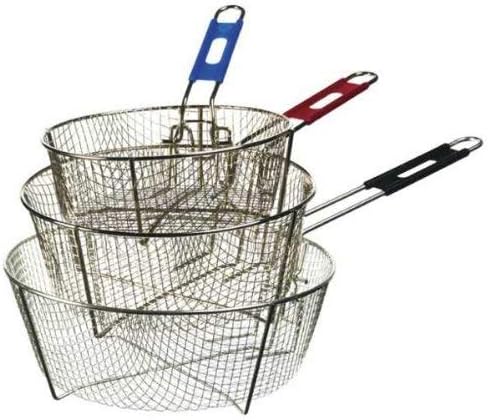
Lodge Basket
The Lodge basket — sold under Lodge Manufacturing’s cookware accessory line and documented in Lodge’s product catalog — generates the most consistent ergonomic complaint in its review category: when rested on the pot edge for drainage, the basket tilts downward toward the interior. Multiple reviewers flag this across different Lodge fryer pot configurations. The root cause, based on published geometry and owner descriptions, is that the bail handle’s pivot point sits inside the pot rim’s centerline, so the basket’s center of gravity pulls it inward when balanced on the edge. There is no hardware fix available. The practical workarounds owners use are: (1) manually hold the handle during drainage, or (2) transfer the rack to a wire rack set over a sheet pan rather than balancing it on the pot edge at all.
Secondary use case worth noting: A significant share of Lodge basket reviews describe using the basket not for frying at all, but for flour-dusting prep — lowering seasoned or flour-coated pieces into the basket for shaking, then transferring directly to the oil. This is a legitimate technique and one that the basket’s perforated geometry supports well. If you’re setting up a high-volume wing or fish operation and want a controlled flour-shake step before frying, the Lodge basket’s form factor serves that workflow.
Gas One Aluminum Pot and Basket Configuration
The Gas One aluminum pot carries a specific owner warning that appears in reviews but without enough specificity to be immediately actionable: at least one reviewer explicitly warns against hanging the basket on a particular part of the pot, but doesn’t name which part. Based on the pot’s published design — a rolled aluminum rim with integrated side handles and a recessed lip — the most probable failure point is hanging a loaded basket from the side handle rather than the rim’s load-bearing edge. Aluminum handles on consumer-grade propane fryer pots are typically cast or riveted into the sidewall, not structural enough to take the dynamic load of a 15-lb bird on a hook. Gas One has not published explicit hang-point guidance in their available documentation as of mid-2026. The safe default is: if the basket’s hook isn’t resting on the pot’s main rim, don’t trust it under load.
Decision Framework: Which Lifting System for Which Situation
If you’re replacing a lost or damaged hook and rack on a King Kooker fryer: The King Kooker rack and hook kit is the model-specific choice, but confirm your fryer model number against King Kooker’s compatibility list before ordering — the kit is not universal across their line.
If you’re buying a complete basket for a 30-quart pot and want dimension certainty: Cross-reference the CHARD listing’s community-corrected specs (9.63 inches diameter by 12.5 inches tall interior) against your pot’s interior before committing. Birds over 14 lbs may not seat cleanly.
If structural reliability across multiple cooks is the primary spec: The perforated rack set’s review record — no reported failures across aggregated multi-cook use — is the strongest available signal for this use case in the consumer segment.
If you’re running a high-volume prep workflow (flour-dust → fry): The Lodge basket’s secondary use case as a flour-shake vessel is a legitimate workflow advantage, provided you build in a secondary drainage surface rather than relying on the pot-edge balance.
If you’re sourcing for a commercial or ghost-kitchen operation: None of the consumer-segment products reviewed here carry NSF certification. For commercial use, spec stainless baskets from NSF-certified suppliers. NSF International publishes equipment certification standards and searchable certification listings on nsf.org, and manufacturers such as Pitco, Vulcan, and Frymaster publish fryer-specific basket compatibility charts in their operator documentation. Aftermarket NSF-certified alternatives exist at lower per-unit cost with documented gauge specifications.
Frequently Asked Questions
Will the King Kooker rack and hook fit any King Kooker fryer, or only specific models? Based on King Kooker’s published product documentation and aggregated owner reports, the rack and hook kit is designed for specific King Kooker fryer models — it is not a universal fit across the full King Kooker line. Confirm your fryer’s model number and cross-reference it with King Kooker’s compatibility documentation before purchasing a replacement.
How do you know if a replacement lifting hook can safely support your turkey’s weight? Look for an explicit weight rating in the manufacturer’s product documentation — not marketing copy. If no weight rating is published, that’s the answer: the manufacturer hasn’t committed to a load spec. As a working rule, dynamic load (bird plus hardware plus swing) runs 15–20 lbs for a typical 12–15 lb dressed turkey. Stainless steel hooks with welded (not crimped) hook points and a handle length of at least 18 inches give you the best combination of structural margin and burn clearance.
What part of the Gas One aluminum pot should you NOT hang the basket on? Gas One has not published explicit hang-point guidance in their available documentation as of mid-2026. Based on the pot’s published design and owner warnings in the review record, the most likely failure point is the side handle — which is a secondary structural element not designed for dynamic vertical load. Default to hanging any loaded basket from the main pot rim, not from side handles or auxiliary brackets.
Why does the Lodge basket tilt when resting on the pot edge, and is there a fix? The tilt occurs because the bail handle’s pivot geometry places the basket’s center of gravity inside the pot rim when balanced on the edge, pulling it inward. There is no hardware fix available from Lodge Manufacturing. The practical workarounds owners use are: (1) manually hold the handle during drainage, or (2) transfer the rack to a wire rack set over a sheet pan rather than balancing it on the pot edge.
Can a 30-quart basket fry a full turkey, or is it only for smaller birds? A 30-quart pot can typically accommodate a 12–14 lb turkey with appropriate oil fill. Whether the basket fits the bird depends on interior basket dimensions, not pot volume. The CHARD 30-quart basket’s community-corrected interior dimensions (9.63 inches diameter by 12.5 inches tall) will accommodate most 12–13 lb birds but will be tight for birds over 14 lbs. Measure your bird’s length before assuming fit.
What are the actual interior dimensions of the CHARD 30-quart basket? Per community-corrected specifications documented in the product review thread — which explicitly override the erroneous published listing dimensions — the CHARD 30-quart basket measures 9.63 inches in diameter by 12.5 inches tall, circular cross-section. Use these figures, not the original listing, for fit calculations.