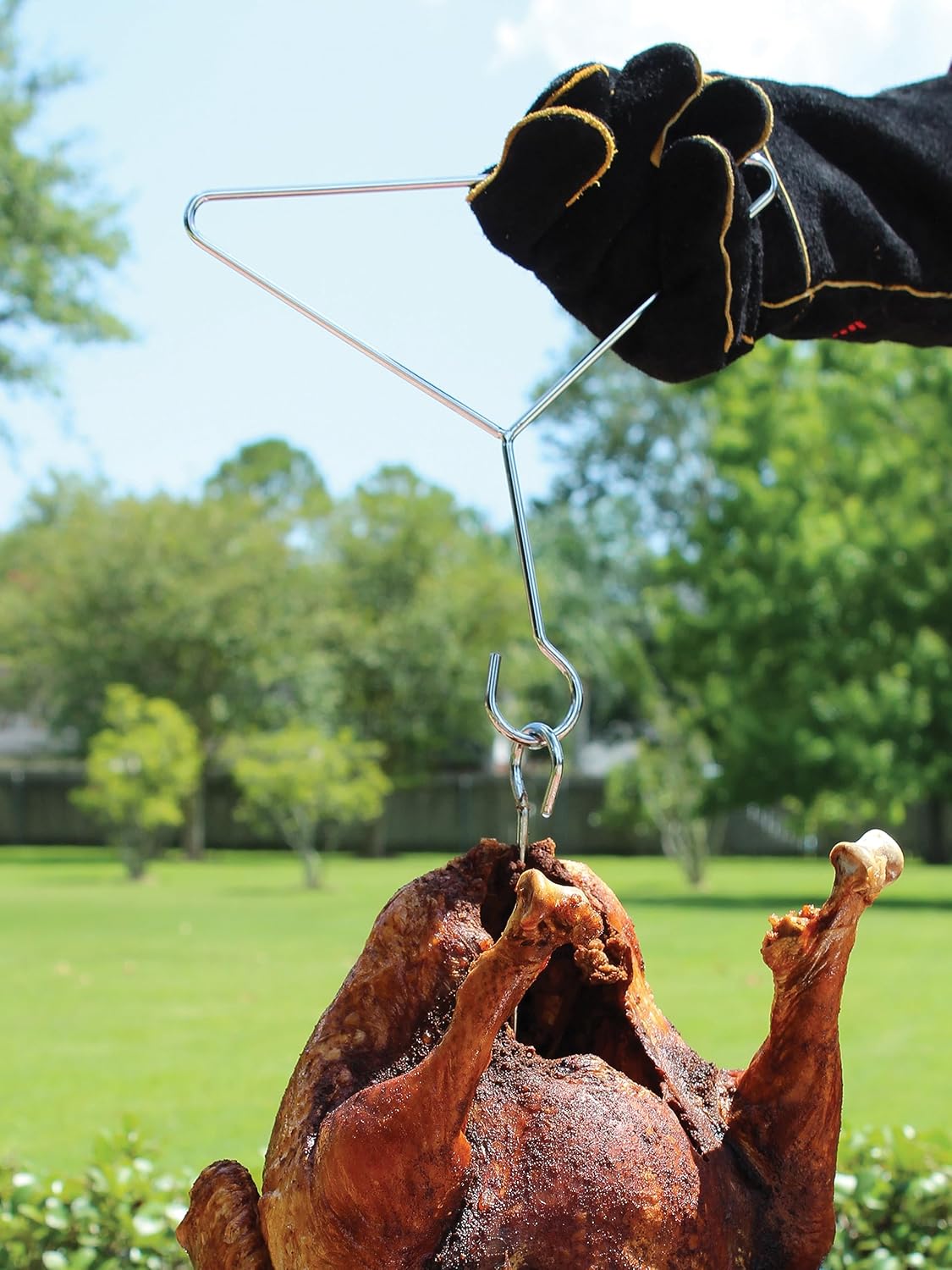
If you’ve ever watched someone lower a whole turkey into a pot of 350°F oil using nothing but a bent wire hook and a prayer, you already understand why lifting systems are the most under-discussed part of turkey frying. The hook, the rack, the basket, the stand — these are the components that physically control a 12-to-20-pound bird as it descends into several gallons of scalding oil. Get it right and you get the crispiest skin of the year. Get it wrong and you’re dealing with an oil fire, a burn, or both. This guide breaks down every major lifting system type — traditional hook-and-rod setups, perforated vertical stands, and large-capacity perimeter baskets — explains the construction details that actually matter, and gives you a clear decision framework so you know which format fits your bird, your pot, and your risk tolerance.
This is especially relevant if you’re replacing a part rather than buying a complete kit. The “lost during a move, Thanksgiving is three weeks away” replacement scenario shows up repeatedly in verified purchaser reviews, and the buyer making that purchase is not browsing casually — they need the right thing, fast, with confidence.
| EDITOR'S PICKFireRiot 18QT Aluminum Deep Fry… | Mid-tierCHARD AFB-30 Aluminum Frying Ba… | Budget pickKing Kooker Turkey Rack and Lif… | |
|---|---|---|---|
| Material | Aluminum | Aluminum | Chrome |
| Capacity | 18 qt | 30 qt | — |
| Handle type | Silicone | — | — |
| Basket shape | Rectangular | — | — |
| Lifting hook | — | — | ✓ |
| Rack included | — | — | ✓ |
| Price | $72.97 | $29.66 | $19.99 |
| See on Amazon → | See on Amazon → | See on Amazon → |
The Three Main Lifting Formats and What Each Actually Does
Hook-and-Rod Systems
The classic turkey fryer hook is a metal rod — typically steel — with a hook or J-bend at one end that threads through the turkey’s cavity and a handle or grip at the other for the cook to hold. The bird hangs vertically from the hook as it’s lowered into the oil. Simple in concept, but the construction details vary enormously.
The King Kooker lifting hook is one of the most reviewed products in this category, and what makes it stand out is a detail that almost no other product description highlights: the hook connects to the rod via a threaded nut, not a weld. Verified purchasers on the King Kooker product listing specifically call this out as an advantage — the nut can be loosened, the hook folded flat, and the whole assembly stored compactly between uses. But the structural benefit goes further than storage. A weld joint is a single fixed point of stress concentration; a properly torqued threaded connection distributes load across the thread engagement and allows the joint to be inspected and retightened over time. Reviewers note this detail as a genuine engineering preference, not just a convenience feature.
King Kooker’s published product documentation rates the hook for use with whole turkeys in standard outdoor fryer configurations. Aggregated reviewer commentary does not report weight-limit failures, but published specifications do not list an explicit maximum bird weight — a point worth noting for anyone frying birds above 20 pounds.
Vertical Perforated Stands
A vertical perforated stand looks roughly like a short, wide cylinder made of heavy-gauge wire or perforated stainless sheet, open at the top, with a central rod or handle that extends upward. The turkey sits inside the stand rather than hanging from a hook — neck down or cavity down, depending on the design — and the entire stand-plus-bird assembly is lowered into the oil together.
This format is less familiar to most home cooks, but reviewers who’ve used it rate it highly. The format currently holds a 4.9-star aggregate rating across verified purchasers in available review pools, with multiple reviewers confirming it holds full-sized birds securely and produces evenly fried results. The physics here are meaningfully different from a hook system: the bird’s weight is distributed across the stand’s base rather than concentrated at a single hook point through the cavity. That distribution reduces the chance of the bird shifting or rotating during the critical lowering phase.
The tradeoff is size and fit. A vertical stand adds diameter to the bird’s footprint in the pot, which means you need to verify that your specific pot’s interior diameter accommodates the stand plus the bird plus adequate oil clearance. Reviewers consistently recommend measuring your pot before ordering.
Large-Capacity Perimeter Baskets
Products like the CHARD 30QT turkey fryer basket occupy a hybrid category. These are wide, deep perimeter baskets — think of a mesh cylinder with a lifting handle — originally designed for seafood and crawfish boils but used interchangeably by reviewers for turkey frying. The CHARD 30QT in particular draws verified purchaser commentary noting it performs double duty across boils and fry applications.
The key distinction: a perimeter basket cradles the bird rather than threading through it or standing it up. The turkey rests against the basket’s interior walls and base. This is arguably the gentlest lowering method for a wet or brined bird — less risk of the cavity tearing during hook insertion — but it introduces a different challenge. Handle heat resistance becomes critical. When a wet bird takes longer to lower safely (because you’re going slow, correctly, to avoid splatter), the handle heats up. Reviewers of basket-style systems for turkey applications consistently flag handle insulation as a make-or-break feature. Cook’s Illustrated’s guidance on whole-bird frying emphasizes the slow, controlled descent — roughly 60 to 90 seconds for a large bird — which means sustained handle contact under heat stress.
Construction Details That Separate Safe from Risky
Gauge and material: For hook-and-rod systems, the rod diameter determines flex under load. A thin-gauge rod that bends mid-descent is a genuine hazard. Published specs rarely list rod diameter in millimeters, so reviewing owner commentary for flex reports is the best available signal. For baskets and stands, 304 stainless is the preferred material — corrosion-resistant, food-safe, and mechanically superior to nickel-plated steel or 201 stainless, which can corrode with repeated oil and moisture exposure. NSF International’s food equipment standards (published at nsf.org) specify material requirements for commercial frying equipment; while most home turkey fryer accessories don’t carry NSF certification, those standards are a useful benchmark for evaluating material claims.
Threaded vs. welded connections: As noted in the King Kooker context above, threaded connections at stress points allow inspection and re-tightening. Welded joints are permanent and can develop invisible micro-fractures under repeated thermal cycling. For any component that hangs a 15-to-20-pound bird over open flame, this distinction is not academic.
Handle design and heat path: Longer handles keep hands farther from the oil surface. Handles with silicone or wood insulation reduce heat transfer. Basket-style systems with bail handles (the arching handle that swings up from two side attachment points) distribute grip load and tend to be more stable during a slow descent than single-rod handles.
By the Numbers
| System Type | Weight Distribution | Pot Size Requirement | Key Risk Factor |
|---|---|---|---|
| Hook-and-rod | Single cavity point | Standard (30–32 qt) | Hook slip / bird rotation |
| Vertical perforated stand | Base of stand | Larger interior diameter needed | Pot fit; stand must clear walls |
| Perimeter basket | Full perimeter cradle | Widest footprint | Handle heat buildup on slow descent |
Decision Framework: If X, Then Y
This is where the practitioner reader can stop triangulating and make the call.
If you’re replacing a lost or broken hook before Thanksgiving: King Kooker’s threaded-rod hook is the most defensible direct replacement for standard hook-based systems. The threaded connection is a documented construction advantage, reviewers confirm it holds full birds, and the flat-storage feature means you won’t lose it again. This is the replacement scenario the reviewer base describes explicitly.
If you’ve had a hook slip or a bird rotate during lowering: Switch to a vertical perforated stand. The seated, cradled bird position eliminates the rotation problem at its source. Verify your pot’s interior diameter before ordering — this is the one spec that kills an otherwise good purchase.
If you’re frying large birds (18+ pounds) or doing multiple birds in sequence: The perimeter basket approach — like the CHARD 30QT configuration — distributes load most broadly and minimizes stress on any single connection point. Prioritize handle insulation and bail-handle geometry. Budget extra time for the descent and plan for handle heat.
If you’re operating a food-truck or ghost-kitchen setup with a commercial outdoor fryer: None of the consumer-tier lifting accessories discussed here carry NSF certification. For commercial applications, sourcing NSF-listed lifting components from your fryer’s OEM (or an NSF-certified aftermarket supplier) is the appropriate path. NSF International’s certified equipment database is the reference point, not product listing copy.
Food and Wine’s safety guidance on turkey frying and Serious Eats’ detailed frying methodology both emphasize that the descent phase — not the frying time itself — is where most accidents originate. The lifting system is the intervention point.
Frequently Asked Questions
Is a rack-and-hook system or a vertical stand safer for lowering a whole turkey into hot oil?
Based on the mechanics and aggregated reviewer experience, a vertical perforated stand is generally safer because it distributes the bird’s weight across the stand’s base and eliminates the single-point hook connection through the cavity. The bird cannot rotate or slip off during descent. Hook systems work reliably when the hook is properly sized and the connection is sound — but they introduce a single failure point that stands don’t.
Can I use the basket that came with my outdoor fry pot to lift and lower a turkey, or do I need a dedicated rack?
It depends on the basket. Large-capacity perimeter baskets like the CHARD 30QT are used successfully for turkey lifting by reviewers, and they provide stable, distributed support. Smaller or shallower baskets that came with standard crawfish pots may not have the depth or interior clearance to cradle a whole bird securely. Check the basket’s interior depth against your bird’s height before committing.
What is the weight limit for the King Kooker lifting hook?
King Kooker’s published product documentation does not specify an explicit maximum bird weight in the listings reviewed for this article. Reviewers report successful use with standard whole turkeys in the 12–18 pound range. If you’re frying a bird above 18 pounds, the absence of a published weight rating is a meaningful data gap — consider a stand or basket system for larger birds as the more conservative choice.
Why is a threaded-rod hook connection better than a welded one for turkey fryers?
A threaded connection allows the joint to be inspected visually, retightened if it loosens over time, and disassembled for flat storage. A weld is permanent and cannot be inspected internally — thermal cycling (repeated heating and cooling) can develop micro-fractures in welds that are invisible until failure. Multiple King Kooker reviewers call out the threaded connection explicitly as both a safety and a convenience advantage. For a component under dynamic load over a pot of hot oil, inspectability is a real benefit.
How do I safely lower a 15-pound bird into a pot of 350°F oil alone?
Slow and controlled is the governing principle — Cook’s Illustrated and Food and Wine’s frying guidance both emphasize a 60-to-90-second descent for a bird this size, pausing whenever bubbling intensifies to avoid boilover. Use the longest-handled system your pot accommodates. If using a basket, confirm handle insulation before you start the descent, not partway through. Position yourself to the side of the pot, not directly over it. Lower the bird into the oil before lighting the burner at full temperature whenever possible — some operators prefer the cold-start method described in Serious Eats’ turkey frying methodology, which eliminates the hot-oil descent entirely.