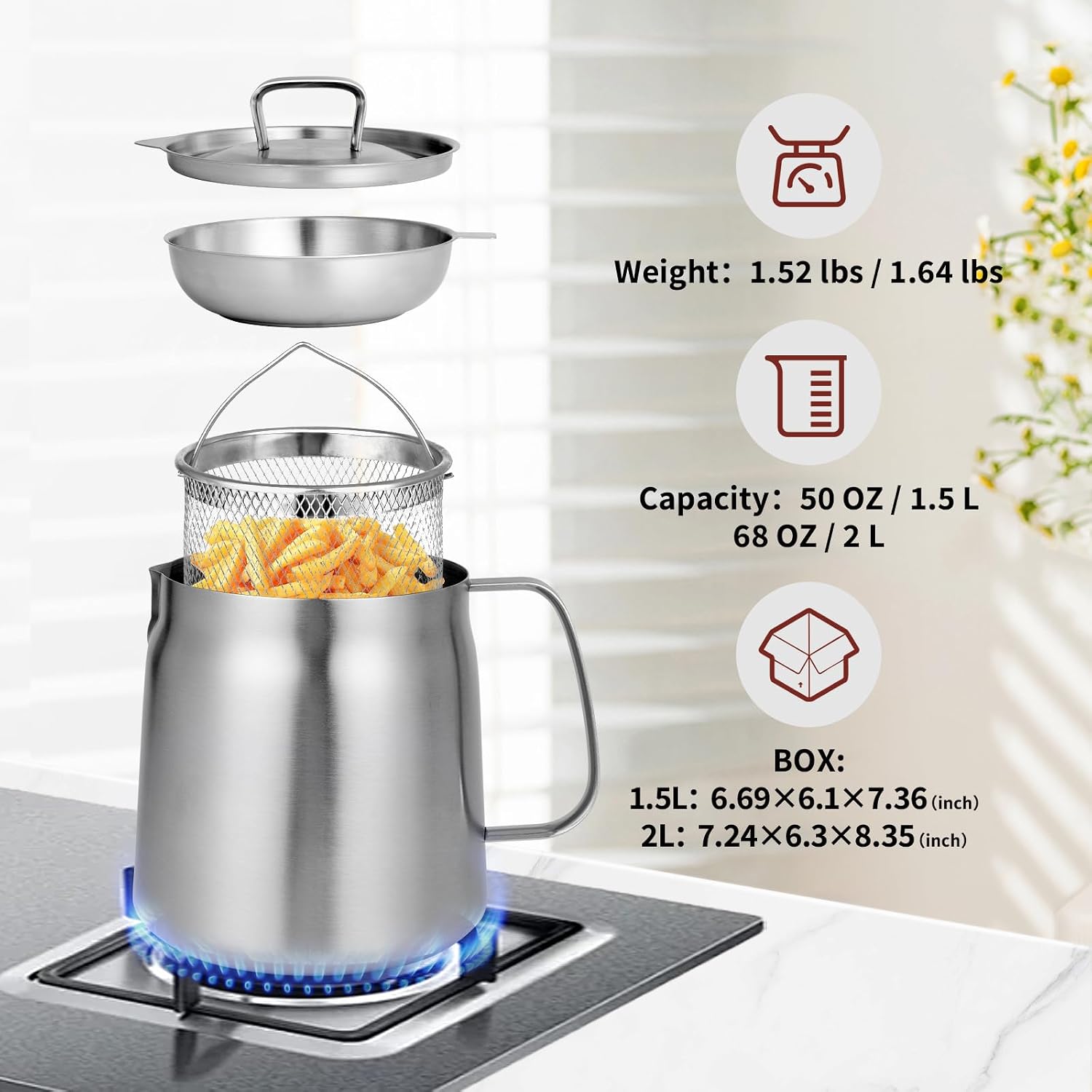
If your countertop electric fryer has been sitting in the cabinet for three months because hauling it out, filling it with a half-gallon of oil, and cleaning the basket afterward just isn’t worth it for two chicken thighs — you’re not alone. A stovetop fry pot (a dedicated pot, usually 2–4 liters, that comes with a fitted wire basket and a lid, designed to sit on your range burner just like any saucepan) has become the quiet workaround for small-batch cooks who want real fried food without the production. The appeal is specific and consistent: a small oil footprint, a contained workflow, and the ability to strain the oil back into the same vessel and slide the whole thing into the fridge. This guide breaks down the two dominant size tiers — roughly 68 oz and 119 oz — explains the tradeoffs the product pages won’t tell you, and gives you a clear decision rule at the end.
| EDITOR'S PICKDeep Fryer Basket | Mid-tier68oz 304 Stainless Steel Deep F… | Budget pickDeep Fryer Pot with Basket | |
|---|---|---|---|
| Material | — | 304 Stainless Steel | 304 Stainless Steel |
| Capacity | — | 68oz | 2.8L |
| Dishwasher Safe | — | ✓ | — |
| Pack Size | 4-pack | — | — |
| Price | $89.99 | $23.99 | $19.89 |
| See on Amazon → | See on Amazon → | See on Amazon → |
The Core Trade You’re Making (And Why It’s a Good One for Small Batches)
The stovetop fry pot format is essentially a bargain: you give up volume and speed-of-heat in exchange for radically simplified oil management and storage. That trade is excellent if you’re cooking for one or two people three or four times a week. It starts to work against you the moment you’re serving four or more people or trying to fry in continuous batches.
Wirecutter’s deep fryer guide consistently flags oil management as the primary friction point that causes home cooks to abandon their electric fryers entirely. The stovetop fry pot addresses this directly: the design assumes you will store oil in the pot between uses — that is the whole workflow, not an afterthought.
By the numbers:
| Format | Approx. Oil Volume | Typical Batch (fries) | Heat Source |
|---|---|---|---|
| 68 oz stovetop pot | ~1.5–1.8 L oil | 1 medium serving | Gas, electric, induction (varies) |
| 119 oz stovetop pot | ~2.8–3.2 L oil | 2–3 servings | Gas, electric, induction (varies) |
| Standard countertop electric fryer | 3–4 L oil | 2–4 servings | Electric element only |
The numbers clarify something the marketing copy doesn’t say plainly: the 68 oz (roughly 2 L total capacity) pot is a one-person fryer in practice. You’re fitting a single serving of fries or four to six chicken wings, depending on their size. The 119 oz (roughly 3.5 L) version is genuinely a two-person setup — two servings of fries, eight to ten wings, or a reasonable batch of nuggets. If you’ve been sizing by total pot volume rather than usable oil volume, this is where the “it was smaller than I expected” reviews originate. The measurements are accurate; the mental model of what 2.8 liters of frying headroom looks like is not.
What the Basket and Mesh Are Actually Good For — And Where They Fall Short
The included basket in this category is typically a coarse stainless wire mesh with a long handle, designed to lower food into oil and lift it out cleanly. For standard frying — bone-in wings, skin-on fries, fish fillets cut to fit, donuts — the basket does its job without complaint.
The recurring gap in this format, flagged consistently across owner reviews, is mesh coarseness. The wire spacing on most baskets in this category is generous — optimized for large pieces, not small ones. Reviewers using achiote oil (which releases small seeds during frying) specifically note that the seeds fall straight through the primary basket mesh. The same limitation applies to lightly breaded shrimp with loose coating, small falafel, or any item under roughly half an inch in diameter: pieces either fall through or get trapped in the mesh and tear on extraction.
Most 68 oz and 119 oz stovetop fry pots in this category include a secondary fine-mesh strainer — a separate disk or cone insert — intended for filtering oil after the session. This fine-mesh insert works as a partial workaround for small foods: you can place it inside or below the primary basket to catch fallthrough pieces. It is a functional fix, not a seamless one. If you’re primarily frying small foods, this format asks you to adapt your workflow around a hardware limitation, which is worth knowing before you buy.
A separate construction note worth naming: at least one technically detailed owner review on the 68 oz Opifex-style fry pot specifically calls out sharp wire points at the seam where the basket mesh meets the lower retaining ring. This is a finishing detail that doesn’t appear in any marketing copy. It doesn’t affect cooking performance, but it’s a hand-contact surface during cleaning. Reviewers who noticed it described deburring the seam themselves with a fine file. If you’re handling the basket barehanded during washing, it’s worth a close look before first use.
Serious Eats’ deep-frying technique coverage notes that basket mesh gauge and opening size are the two variables most home cooks don’t think to check before buying — they matter most at the extremes of what you’re frying.
Vertical vs. Horizontal Pot Design: The Tradeoff Nobody Explains
Stovetop fry pots come in two basic geometries: tall and narrow (vertical) or wide and shallow (horizontal/squat). This choice has real functional consequences that almost no product listing explains in plain terms.
Vertical pots heat the oil more slowly because there’s less surface area in contact with the burner. However, the depth creates a column of oil that enables a cooking method you simply can’t replicate in a countertop fryer: skewer frying. One reviewer on a vertical-format pot specifically described making shrimp tempura on a bamboo skewer — threading the shrimp, lowering the skewer vertically into the oil — something the pot’s depth made possible. If you fry items on skewers, do churro-style batters, or cook long fish pieces you don’t want to bend, the vertical geometry is a meaningful functional advantage.
Horizontal/squat pots heat faster because the wider base maximizes burner contact. They’re also easier to see into and stir around, which matters for items that need repositioning mid-fry. The tradeoff is that oil depth is shallower, which limits what you can submerge fully and eliminates the skewer use case.
Cook’s Illustrated’s deep-frying guidance consistently identifies oil depth as a key variable in even cooking — insufficient depth causes food to fry unevenly, with the submerged portion cooking faster than the portion above the oil line. In a shallow horizontal pot, portion size relative to oil depth matters more than it does in a deeper vessel.
For a couple frying standard foods — wings, fries, fish, occasional donuts — the horizontal format’s faster heat recovery will feel more convenient on a weeknight. For anyone whose repertoire includes tall or skewered items, vertical is worth the slower preheat.
Induction Compatibility, Fridge Storage, and the Other Questions Owners Actually Ask
Frequently Asked Questions
Can I store the oil in the pot and put the whole thing in the fridge? Yes — and this is the primary workflow advantage of the format. Most stovetop fry pots in this category are designed with lids explicitly for this purpose. Oil stored covered in a cool, dark fridge after filtering can be reused multiple times; Food & Wine’s frying guidance notes that oil stored this way typically lasts for three to five frying sessions before flavor degradation becomes noticeable, depending on what you fried (fish oil degrades faster than neutral-food oil). The caveat: check that your fridge has clearance for the pot height, particularly with vertical-format units. A tall vertical pot with a handle that doesn’t fold flat can be awkward to fit.
Is the basket mesh fine enough for small foods like seeds or breaded shrimp? No — not reliably. As described above, the primary basket mesh on pots in this category has wire spacing optimized for larger pieces. Small seeds fall through. Lightly breaded shrimp can lose their coating in the gaps. The secondary fine-mesh strainer included with most kits partially addresses this, but it requires adapting your loading workflow. If small-format frying is a significant part of what you cook, a dedicated fine-mesh basket or spider strainer used alongside the pot is the cleaner solution.
Does this work on an induction cooktop? It depends on the specific pot’s base material, not the format generally. Induction requires a ferromagnetic base (18/0 stainless or carbon steel will work; 18/10 stainless and aluminum will not). Most product listings specify induction compatibility, but verify against the manufacturer’s spec sheet rather than relying on category-level claims. Owners of induction cooktops who bought without checking this detail are the source of most one-star reviews in this category — the pot is fine; it just doesn’t work on their cooktop.
How many servings of french fries or nuggets actually fit? The 68 oz format reliably produces one medium serving of fries (roughly equivalent to a fast-casual restaurant portion) or four to six nuggets per batch. The 119 oz format doubles that: two medium servings of fries or eight to twelve nuggets, depending on size. These are per-batch figures — you can fry multiple batches consecutively, but oil recovery time between batches matters. Aggregate owner reviews suggest two to three minute rest periods between batches maintain consistent results at home cook oil volumes.
Is the included strainer fine enough to filter oil for reuse? The secondary fine-mesh insert removes most particulate — breading crumbs, batter fragments, sediment — well enough for practical reuse. It is not equivalent to a commercial-grade filtration system; very fine carbon particles from high-heat frying sessions will pass through. For home use at these oil volumes, reviewers consistently describe the included strainer as adequate for three to five reuse cycles before oil color and odor drive a change anyway.
What is the difference between the 68 oz and 119 oz versions in practice? The 68 oz is a solo-cook format that happens to work for a couple if you’re comfortable with back-to-back batches and don’t mind one person eating while the other’s food finishes. The 119 oz is the genuine two-person format — both servings finish close enough together that the meal is shared simultaneously. If you’re cooking for two and batch-cooking isn’t your preference, the size difference is meaningful enough to pay the premium for the 119 oz.
The Decision Rule
If you’re cooking for one or two people, frying standard-sized foods (wings, fries, fish, donuts), and the primary friction with your current setup is oil volume and storage — the stovetop fry pot format directly solves your problem. The 119 oz size is the right call for two people who want to eat at the same time. The 68 oz is honest about its limits and works well for solo cooks or couples who don’t mind staggered batches.
If you fry small foods frequently (breaded shrimp, falafel, seed-seasoned preparations) or need to serve four or more people in a single session — the format will frustrate you. A countertop electric fryer with a larger basket and finer mesh will serve you better, even accounting for the oil-management tradeoff.
The wire finish on the basket seam and the mesh coarseness limitation are the two hardware realities this category undersells. Neither is a dealbreaker for the primary use case; both matter if you’re at the edge of the format’s range. Go in knowing them, and the stovetop fry pot delivers exactly what the best reviews say it does: simple, low-mess, genuinely good fried food for a small household, stored in the same pot it cooked in.