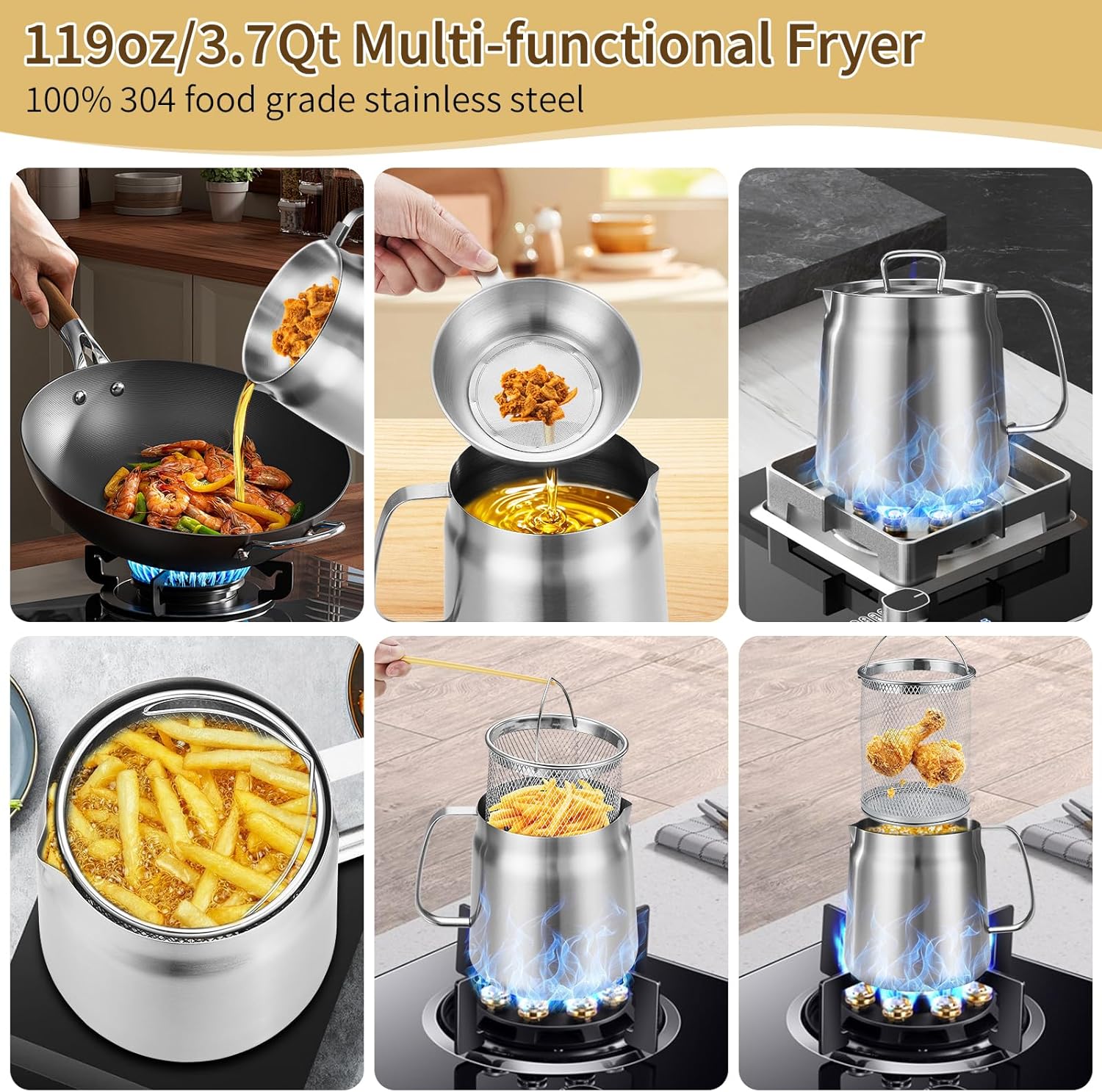
If you’ve ever finished a batch of fried chicken and stared at a pot of hot, used oil wondering what on earth to do with it — you’re not alone. The usual options aren’t great: pour it into a jar and hope the strainer doesn’t slip, funnel it into a milk carton, or just toss it and start fresh next time. Stovetop fry pots with integrated strain-and-store systems try to solve that whole problem in one vessel. The concept is simple: a tall, lidded pot (typically between 68 oz and 119 oz — roughly 2 to 3.5 liters) that includes a fitted mesh basket for frying and a lid that seals tightly enough to let you strain the oil, cap the pot, and slide it straight into the refrigerator. No decanting, no separate container, no funnel required. This guide digs into whether that promise holds up, where the design tradeoffs bite you, and which setup makes sense depending on your actual fry volume and cooking style.
What “Strain-and-Store” Actually Means in Practice
The core value proposition of these pots is workflow compression. Instead of a three-step post-fry sequence (strain → transfer → store), you do one step: lift the basket, let the oil drain back through the mesh, lid the pot, refrigerate. Reviewers across aggregated feedback consistently describe this as a genuine behavioral change — the kind of friction reduction that makes people actually reuse oil instead of dumping it out of laziness.
That workflow only works if the mesh is fine enough to catch meaningful particulate. Here’s where a real tension emerges: the standard basket mesh on most of these pots is calibrated for food, not filtration. It catches batter chunks and large debris well. It does not reliably catch fine spices, seeds, or achiote — a point that reviewers explicitly flag. Several product lines include a secondary fine-mesh screen (sometimes called a filter insert) as an accessory, and that secondary screen is what makes fine-ingredient cooking viable. If you’re frying with heavy spice rubs, tempura batter residue, or seed-based marinades, that secondary screen isn’t optional — treat it as a required component when evaluating any pot in this category.
The Serious Eats guide to frying oils makes a related point: particulate left in stored oil accelerates oxidation and off-flavor development. So fine filtration isn’t just about clearing the visual cloudiness — it’s directly tied to how many reuse cycles you get before the oil tastes burnt.
By the numbers:
- Standard mesh basket: typically 2–4mm aperture — catches solids ≥ 3mm reliably
- Fine-mesh filter insert: typically 0.5–1mm aperture — required for spice/seed filtration
- Oil reuse window (properly strained, refrigerated): Food and Wine’s guide to frying oil storage cites 8–10 uses or approximately 1–2 months refrigerated before noticeable flavor degradation begins
Geometry Tradeoffs: Why the Tall Pot Is Both a Feature and a Problem
Stovetop fry pots in this category are almost universally tall and narrow rather than wide and shallow. That’s not accidental — it’s the geometry that makes the strain-and-store workflow feasible. A wide, shallow pot would require more oil to achieve submersion depth, making the all-in-one approach wasteful. The tall profile minimizes oil volume while still allowing you to fully submerge most foods.
But Cook’s Illustrated’s analysis of fry vessel geometry is relevant here: tall, narrow pots trap steam more than wide ones, which can soften crusts. They also have less surface area, which means you can cook fewer pieces at a time before oil temperature drops significantly. The “low splatter” benefit reviewers mention is real — tall sidewalls contain oil spray effectively — but the tradeoff is slower recovery temperature between batches.
A secondary geometry issue is heat distribution. Wide, flat-bottomed pots distribute heat evenly across a large base. Tall pots concentrate heat at the center bottom, creating a temperature gradient from bottom to top. Owners of the Saltlas double-bottom design note this directly: the double-bottom layer (an additional insulating floor, similar in concept to a bain-marie base) slows initial heat-up noticeably but produces more even temperature across the oil column once it stabilizes. For batch frying where consistency matters more than speed, that tradeoff can favor the double-bottom. For quick single-serving fries where you want fast heat-up, it works against you.
The vertical geometry also has a genuine upside for certain foods: skewered items, corn dogs, churros, and anything on a stick can be submerged vertically without bending or curling. That’s not a minor point for operators doing any stick-fry format.
Size Confusion Is Real: The 68 oz vs. 119 oz Capacity Decision
This is the decision most buyers get wrong, and the error almost always goes the same direction: people underestimate how small the smaller pot is. A 68 oz pot holds approximately 2 liters total volume. Subtract the oil fill level (you typically fill to 60–70% capacity to allow for displacement and bubbling), and you’re working with roughly 1.2–1.4 liters of oil. That is a single-serving frying capacity under most conditions — enough for a small order of fries or two to three chicken tenders, not a shared plate.
The 119 oz format (approximately 3.5 liters) is the practical two-person household size. Even then, it’s a conservative two-person capacity — you’re cooking in batches, not all at once. Restaurant Business Online’s coverage of small-footprint ghost kitchen operations notes that compact frying setups in the 3–4 liter range are viable for single-item menu items (think one SKU of fried chicken) but require discipline about batch sequencing.
If X, then Y — sizing decision rule:
| If your use case is… | Then choose… |
|---|---|
| Single person, 1–2 items per session, storage is priority | 68 oz (2L) format |
| Two people OR variety frying OR occasional guests | 119 oz (3.5L) format |
| Small-batch commercial / ghost kitchen single-SKU | 119 oz minimum; evaluate commercial countertop if volume exceeds 2 batches/hour |
The centimeter-to-ounce conversion is where the confusion compounds. Manufacturers often list interior dimensions in centimeters, which doesn’t translate intuitively to capacity for American buyers used to ounces or quarts. A pot listed as “18cm diameter × 22cm depth” translates to roughly 5.6L theoretical volume — but usable oil volume at safe fill levels is closer to 3–3.5L. Do the math before you order.
Induction Compatibility and Material Honesty
Induction cooktops require a ferromagnetic base — the burner heats the pot directly via magnetic field rather than flame or radiant heat. Most stovetop fry pots in this category are made from stainless steel, but not all stainless is induction-compatible.
The key variable is the alloy grade. 304 stainless (18/8 — 18% chromium, 8% nickel) is the food-safe standard referenced in NSF International’s NSF/ANSI 2 equipment standard, but it has low magnetic permeability and typically does not work on induction. 430 stainless (17% chromium, no nickel) is magnetic and induction-compatible, but it’s less corrosion-resistant. Quality pots in this category solve the problem by using a clad or capsule base — a multi-layer bottom that bonds a magnetic steel layer to a 304 or 316 stainless body. Always check the product spec sheet for “induction compatible” confirmation and, if possible, verify whether the induction function is a full-base clad or a small magnetic disc insert (the disc approach works but concentrates heat unevenly).
This is also where the 201 stainless warning is relevant. Some budget stovetop pots are listed as stainless but built from 201 alloy (higher manganese, lower nickel), which is less corrosion-resistant and will show rust at weld points with repeated high-heat oil exposure and acidic food contact. For a pot that’s going in and out of the refrigerator repeatedly with hot-then-cold cycling, 201 alloy is a material choice that degrades noticeably faster. Owners on long-run reviews report discoloration and rust spotting on lower-grade pots within 6–12 months of regular use.
Oil Storage Longevity: What’s Realistic
The all-in-one strain-and-store pitch is compelling, but how long the stored oil actually stays usable depends on three variables working together: filtration quality, container seal, and refrigeration temperature.
Food and Wine’s guide to reusing frying oil puts the practical window at 8–10 fry sessions for well-filtered, refrigerated oil — with the caveat that fish and heavily spiced foods shorten that window considerably because flavor compounds transfer into the oil. A sealed pot lid reduces oxidation exposure between uses, which is a genuine advantage over storing oil in open or loosely capped containers. A tight-fitting lid matters more than most buyers realize.
Light is also a degradation factor. If your refrigerator has a bright internal light (most modern models do), stored oil in a clear-topped pot gets light exposure every time the door opens. Opaque lids or dark-colored pots have a minor but real advantage here for long-term oil quality.
The practical decision rule: strain immediately after frying while oil is still warm (filtration is more efficient at temperature), refrigerate within one hour of straining, and label the pot with the fry date. Discard if the oil smells rancid, has a noticeably dark color, or has been stored longer than 30 days regardless of use count.
Frequently Asked Questions
Can I refrigerate the oil right in the pot with the lid on? Yes — that’s the explicit design intent of these systems. Owners consistently describe this as the feature that makes them actually reuse oil. Confirm the lid seals adequately (not just rests) before purchasing; some budget lids fit loosely and allow odor transfer to adjacent refrigerator contents.
Will the standard mesh basket catch fine ingredients like spices or seeds? No, not reliably. Standard baskets are designed for food-sized solids, not spice filtration. Achiote seeds, whole spices, and fine batter sediment pass through standard mesh. Use the secondary fine-mesh filter insert if included — and if the pot you’re considering doesn’t include one, factor that accessory cost into your decision.
Does the 68 oz pot actually feed two people or is it really a single-serving size? Realistically, a 68 oz pot is a single-serving fryer for most foods. Two people eating a full portion each will need to cook in multiple batches, and the oil recovery time between batches extends the total cook time significantly. The 119 oz format is the practical two-person size.
Do these pots work on induction cooktops? Some do, some don’t — it depends on the base construction. Look for “induction compatible” in the spec sheet and verify it’s a full clad base rather than a small disc insert. If the listing doesn’t confirm induction compatibility explicitly, assume it doesn’t work until confirmed.
Is the vertical design harder to fry in than a wide shallow pot? It’s different, not strictly harder. You lose surface area and fry in smaller batches, but you gain containment (less splatter) and depth (submerging tall items without bending). Cook’s Illustrated’s geometry analysis suggests wide pots maintain oil temperature more evenly across a batch; tall pots are better for single-item or small-batch frying where even submersion matters more than throughput.
How long can strained oil be stored in these pots before it goes bad? Food and Wine’s frying oil guide puts the general window at 1–2 months refrigerated with proper filtration, or approximately 8–10 fry sessions — whichever comes first. Strongly flavored foods (fish, heavy spice rubs) shorten that window. When in doubt, smell the oil: rancidity is unmistakable and not a subtle off-note.