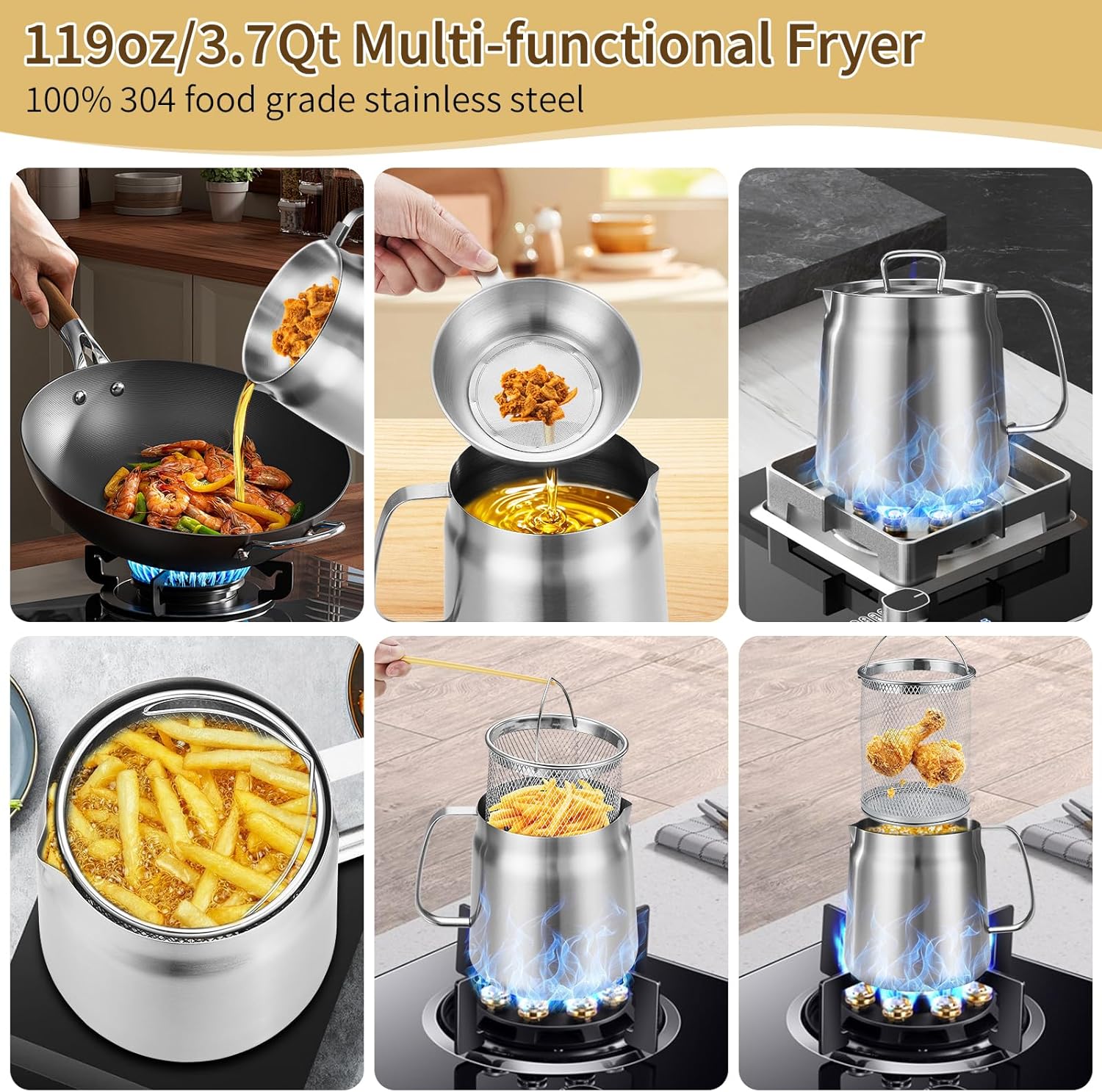
If you’ve ever deep-fried a batch of wings at home and then stood over a hot pot wondering what to do with two quarts of oil, you already understand the core problem this article solves. A stovetop fry pot is exactly what it sounds like: a deep, lidded pot designed to sit on a burner and hold enough oil to fully submerge food — typically between 68 and 119 fluid ounces of capacity. Unlike a countertop electric fryer, a stovetop pot is just a vessel; it has no heating element, no thermostat, and no built-in drain. What some of these pots do include — and what separates the thoughtful designs from the frustrating ones — is an integrated straining and storage system: a fine-mesh insert that lets you pour used oil through the basket, strain out food particles, seal the pot with a lid, and slide the whole thing into your refrigerator for next time. That system is either a genuine workflow win or a half-baked afterthought, depending on the specific product. This guide tells you which is which.
| EDITOR'S PICKSaltlas 304 Stainless Steel Dee… | Mid-tier68oz 304 Stainless Steel Deep F… | Budget pickDeep Fryer Pot with Basket | |
|---|---|---|---|
| Capacity | 2L | 68oz | 2.8L |
| Dishwasher safe | — | ✓ | — |
| Double bottom | ✓ | — | — |
| Stovetop type | — | — | All stovetops |
| Price | $38.97 | $23.99 | $19.89 |
| See on Amazon → | See on Amazon → | See on Amazon → |
Why Oil Storage Is the Real Differentiator in This Category
You can fry in almost any heavy pot. The reason buyers specifically seek out dedicated stovetop fry pots — and pay a premium for the Opifex 119oz or a comparable named design — is almost never the pot material alone. Across aggregated marketplace reviews, the pattern is consistent: the ability to strain and refrigerate oil without transferring it to a separate container is cited as the primary purchase driver. One reviewer quoted in aggregated review summaries puts it plainly: “I didn’t want to deal with all the oil” — and describes the integrated storage system as the deciding factor over a generic stockpot.
That framing matters for decision-making. If oil storage is the feature you’re buying, the evaluation criteria shift:
- Lid seal quality — does the lid hold reliably when the pot is horizontal or tilted in a refrigerator shelf?
- Mesh fineness — does the included strainer actually capture breading, spice particles, and fine sediment, or just large food chunks?
- Pot geometry — is the volume honest, and does the shape actually fit on a standard refrigerator shelf?
- Material grade — 304 stainless holds up to repeated oil contact and refrigeration cycling; 201 stainless and nickel-plated steel do not, and sellers do not always disclose which you’re getting.
Cook’s Illustrated’s technique feature on keeping frying oil notes that proper filtration — removing particles that would otherwise carbonize and degrade the oil — can extend usable oil life across four to six fry sessions when the oil is stored below 40°F between uses. That math makes the strainer quality a direct economic variable, not a convenience feature.
The 68oz vs. 119oz Decision: Size Up More Often Than You Think
This is where buyers consistently misjudge, and it’s worth naming the mechanism. Volumetric capacity listed in fluid ounces does not translate intuitively to how much food you can fry. You do not fill a fry pot to capacity with oil; standard practice is filling to roughly two-thirds depth to leave headroom for oil displacement when food is added. That means a 68oz pot holds functional frying oil of roughly 45oz — just under 1.4 liters of working oil depth.
By the numbers:
| Pot Size | Listed Capacity | Working Oil Volume (⅔ fill) | Practical Batch Size |
|---|---|---|---|
| 68oz (~2L) | 2.0L | ~1.35L | 1–2 servings (small batch) |
| 2.8L mini | 2.8L | ~1.9L | 1–2 servings (feels smaller than expected) |
| 119oz (~3.5L) | 3.5L | ~2.35L | 2–3 servings without feeling cramped |
The 2.8L category deserves a specific caution: multiple reviewers report the pot arriving and feeling “a lot smaller than expected” despite having read the listed dimensions correctly. This is a volumetric perception problem. 2.8 liters in a tall, narrow pot looks and feels smaller than 2.8 liters in a wide, low vessel. If you’re buying a 2.8L mini and picturing a pot that handles a generous batch of fries for two adults, recalibrate toward single-serving batches or accept a two-round workflow.
The Opifex 119oz earns consistent praise from owners precisely because it sits in the sweet spot: owners report it holds two to three servings of fries comfortably without feeling oversized on a standard home burner or taking up excessive refrigerator shelf space. For a household that fries two to four times per week and wants to cycle the same oil, the 119oz is the easier call. For solo cooks or single-dish applications — a quick tempura portion, a single serving of calamari — the 68oz is genuinely sufficient and easier to manage physically.
Mesh Fineness: Where Most Systems Fall Short
This is the pain point that shows up most reliably across owner feedback, and it is worth treating as a near-universal category limitation rather than a brand-specific flaw.
The primary basket mesh in most stovetop fry pot systems is engineered to hold food during frying — not to filter oil. Mesh that works for holding a chicken thigh or a fish fillet is typically in the 3mm to 6mm opening range, which is far too coarse to catch fine breading particles, small spice seeds, or herb fragments. One reviewer describing their experience frying with achiote seeds notes the seeds falling straight through the primary basket mesh and relying on a secondary fine screen that happened to be included with their pot. That “happened to be included” qualifier is critical: secondary fine-mesh strainer inserts are not universal across this category.
When evaluating any pot in this category for oil straining, the question to ask is:
- Does the system include a secondary fine-mesh insert, or is there only one mesh tier?
- What is the stated mesh opening size on the fine insert? Anything above 1mm will pass fine spice particles. Genuine fine filtration is in the 0.5mm to 0.8mm range.
- Is the fine insert rigid or floppy? A flexible fine-mesh screen that collapses under the weight of oil pouring through it defeats its own purpose.
Food and Wine’s editorial guide on reusing frying oil recommends straining through a fine-mesh sieve lined with cheesecloth as the gold standard for particle removal between sessions. That recommendation exists because most commercial and consumer strainer inserts — including the ones bundled with stovetop fry pots — do not achieve that level of filtration on their own. If extended oil life across multiple sessions is a firm goal, budget for a separate fine-mesh strainer or cheesecloth as a supplement to whatever the pot includes.
The Double-Bottom Design: Real Heating Benefit or Marketing Distinction?
The Saltlas double-bottom design occupies a specific niche in this category and draws a more nuanced owner response than the straightforward volume/strainer pots. A double-bottom construction (two layered metal bases with an air or material gap between them) is intended to distribute heat more evenly across the base, reducing hot spots. The practical tradeoff, as owners note, is that the additional thermal mass means the pot heats more slowly — you’re waiting longer to reach fry temperature, particularly at moderate burner settings.
Whether that tradeoff is favorable depends entirely on what you’re frying. Owners report the Saltlas vertical basket design — a geometry that differs from the standard horizontal drop-basket configuration — handles skewer frying (yakitori, satay, churros) better than horizontal designs, because food on skewers hangs vertically in the oil rather than requiring the skewer to rest against the basket walls. For skewer-specific applications, the slower heat ramp and vertical basket are genuine functional advantages. For standard batch frying — wings, fries, rings — the slower heat-up is a real cost in time and patience, and the advantage of the double bottom is less pronounced than it would be in a commercial flat-top application.
Restaurant Business Online’s coverage of small-footprint fry stations in ghost kitchen environments notes that heat distribution matters most in continuous high-volume service, where oil temperature recovery between batches is the binding constraint. At home frying volumes — two to four batches per session — a single-bottom heavy-gauge pot recovers temperature quickly enough that the double-bottom advantage is largely theoretical.
Induction Compatibility: Verify Before You Buy
A meaningful share of home cooks purchasing stovetop fry pots are doing so specifically because they have induction cooktops — surfaces that require magnetically responsive cookware and do not work with standard aluminum or non-magnetic stainless. NSF International’s material specifications for food equipment stainless note that 304 stainless is not inherently magnetic; induction compatibility requires either a magnetic base layer (18/0 stainless or a bonded magnetic disc) or a specific construction that adds induction responsiveness.
Not all stainless stovetop fry pots are induction-compatible. Product listings frequently omit this specification or bury it in a secondary features list. Before purchase, look for an explicit “induction compatible” or “works on all cooktops including induction” claim in the product description, and cross-reference with the base material specification. If the listing says only “stainless steel” with no cooktop compatibility callout, assume induction incompatibility until confirmed otherwise.
Frequently Asked Questions
Can I put the entire pot with oil directly in the refrigerator? Yes, provided the pot fits on your refrigerator shelf and the lid seals adequately — these are the two variables owners most frequently cite as friction points. Most pots in this category are designed with this use case in mind. Let oil cool to below 150°F before refrigerating; placing a hot pot in a refrigerator stresses the compressor and risks condensation inside the sealed pot.
Will the fine mesh strainer catch breading and small spices or just large food chunks? It depends on which mesh tier is catching the particles. The primary basket mesh is typically too coarse for fine particles — spice seeds, breadcrumbs, herb fragments will pass through. A secondary fine-mesh insert, if included, will catch more, but most bundled strainers do not achieve cheesecloth-level filtration. For extended oil life, supplementing with a standalone fine strainer is a reasonable practice, per Cook’s Illustrated guidance on oil maintenance.
Is the 68oz genuinely enough for two people or do I need the 119oz? For two people eating modest portions, the 68oz is workable but requires two frying rounds for anything beyond a light appetizer. Serious Eats’ fryer buying guide consistently notes that batch size is the variable home cooks most underestimate; for two adults eating fries as a main-side, the 119oz is the more comfortable call.
Does the double-bottom design actually make a measurable difference in heating evenness? It reduces hot spots at the base of the pot, but at the cost of slower initial heat-up. For skewer frying, owners report a genuine functional benefit from the vertical basket geometry. For standard drop-basket frying, the practical difference is modest at home cooking volumes.
Will these pots work on an induction cooktop? Only if the pot includes a magnetic base layer or explicit induction compatibility. Do not assume standard stainless construction is induction-ready — verify the listing or contact the seller directly before purchase.
Is the included strainer fine enough to extend oil life across multiple fry sessions? For lightly breaded or unbreaded foods, yes — removing large food particles meaningfully extends oil quality. For heavily seasoned or fine-breaded applications (spiced batters, achiote-rubbed foods, seasoned flour coatings), the included strainer alone is typically insufficient. Adding a secondary filtration step — cheesecloth, a fine-mesh coffee filter strainer, or a dedicated oil filter — is the more reliable approach if you’re targeting four or more sessions per oil charge.
The Decision Rule
If your primary goal is straining and refrigerating oil with minimal effort for two people frying two to four times per week, then the 119oz category is the call — the extra volume gives you genuine working headroom and the geometry fits standard refrigerator shelves without awkward maneuvering.
If you fry solo or in very small batches, and footprint or storage space is a constraint, then the 68oz is adequate with the understanding that batch size is genuinely limited.
If you fry skewered foods regularly and are willing to accept a slower heat ramp, then the Saltlas double-bottom vertical design addresses a real workflow need that horizontal baskets handle poorly.
If fine particle filtration matters — because you cook with spice-heavy marinades, delicate batters, or seeded coatings — then treat the included mesh as first-pass filtration only and budget for a supplementary fine-strainer step. No pot in this category ships with a mesh system that eliminates the need for it.