Your stovetop fry pot just arrived, and it’s smaller than the picture. You’re not imagining it, and you’re not alone. A stovetop fry pot is a dedicated pot designed for frying on a home or commercial burner — usually paired with a mesh basket and a lid that doubles as an oil strainer. Unlike a countertop electric fryer, there’s no thermostat or heating element; heat control is entirely up to you and your burner. The two capacity tiers that dominate this category right now — roughly 68 oz (2L) and 119 oz (3.5L) — look close on paper and feel worlds apart in a working kitchen. This article breaks down what those numbers actually mean for batch size, oil consumption, material quality, and whether the strainer-lid design is as useful as manufacturers claim. If you have a buying decision pending, you’ll leave with a clear if/then framework.
| EDITOR'S PICKSaltlas 304 Stainless Steel Dee… | Mid-tier68oz 304 Stainless Steel Deep F… | Budget pickDeep Fryer Pot with Basket | |
|---|---|---|---|
| Capacity | 2L | 68oz | 2.8L |
| Strainer included | ✓ | ✓ | — |
| Double bottom | ✓ | — | — |
| Dishwasher safe | — | ✓ | — |
| Price | $38.97 | $23.99 | $19.89 |
| See on Amazon → | See on Amazon → | See on Amazon → |
The Capacity Gap Is Bigger Than the Math Suggests
On paper, 68 oz versus 119 oz is a 75% volume difference. In practice, it’s the difference between frying for one person and frying for a small table — and that gap compounds when you factor in oil depth requirements.
Serious Eats, in its frying technique coverage titled “The Science of Frying: Oil Temperature, Batch Size, and Recovery,” notes that maintaining adequate oil depth is non-negotiable for consistent results: food submerged in too-shallow oil fries unevenly on the bottom, steams on top, and drops oil temperature faster. The practical rule for submersion frying is that food should be fully covered, which means your usable oil volume is a fraction of total pot capacity — typically 60–70% — because you need headspace to prevent boil-over.
The 68oz (2L) Tier — Solo Portions and Recipe Testing
At the smaller end of this category, batch limits are real and worth understanding before you buy.
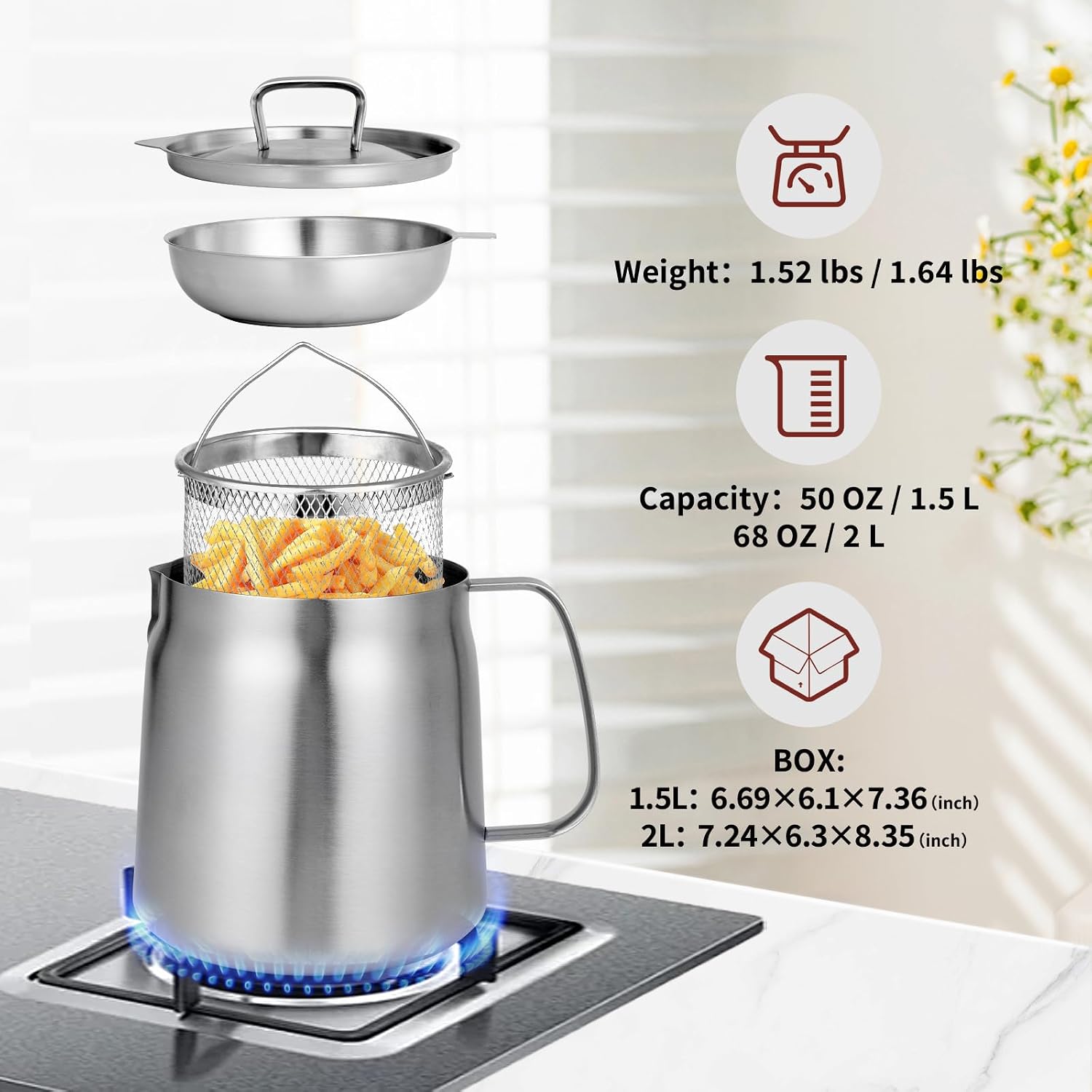
| Specification | 68oz / 2L Pot |
|---|---|
| Total capacity | ~8.5 cups oil |
| Usable oil at 70% fill | ~6 cups |
| Practical protein batch | 4–6 chicken wings |
| Practical starch batch | 1 serving fries |
Cook’s Illustrated, in its “Equipment Review: Stovetop Fry Pots and Oil Management,” consistently cites a 3:1 oil-to-food ratio by volume as the working minimum for home frying without severe temperature drop. At 6 usable cups, that math caps you at 2 cups of food per batch — which maps precisely to the single-serving estimates above.
Here is the real decision frame for this tier: if you’re frying solo portions or testing a new recipe in small batches, the 68oz pot is not a compromise — it’s genuinely better. Less oil means faster heat-up, less waste if the batch fails, and a vessel you can lift and pour without straining. Owners across marketplace reviews consistently describe this size as ideal for single-portion frying with minimal oil waste and easy post-session storage.
Deep
$19.89
In stock on Amazon
Check price on AmazonThe 119oz (3.5L) Tier — Household Meals and Small-Batch Prep
For anyone frying for two or more people, the jump to 3.5L changes the math entirely.
| Specification | 119oz / 3.5L Pot |
|---|---|
| Total capacity | ~14.8 cups oil |
| Usable oil at 70% fill | ~10 cups |
| Practical protein batch | 10–14 chicken wings |
| Practical starch batch | 2–3 servings fries |
For anyone feeding two or more people, running a prep-day fry session, or operating in a small-batch foodservice context, the 119oz tier is the minimum viable size. Running a 68oz pot at this scale means back-to-back batches with mandated rest time between them — in a professional context that is a throughput problem, not a minor inconvenience. Restaurant Business Online, in its piece “Small-Batch Frying in Ghost Kitchen Environments,” addresses this directly, noting that undersized fry vessels are one of the most common bottlenecks operators discover after launch rather than before.
68oz
$23.99
In stock on Amazon
Check price on AmazonThe Premium Double-Bottom Tier — Even Heat and Extended Oil Life
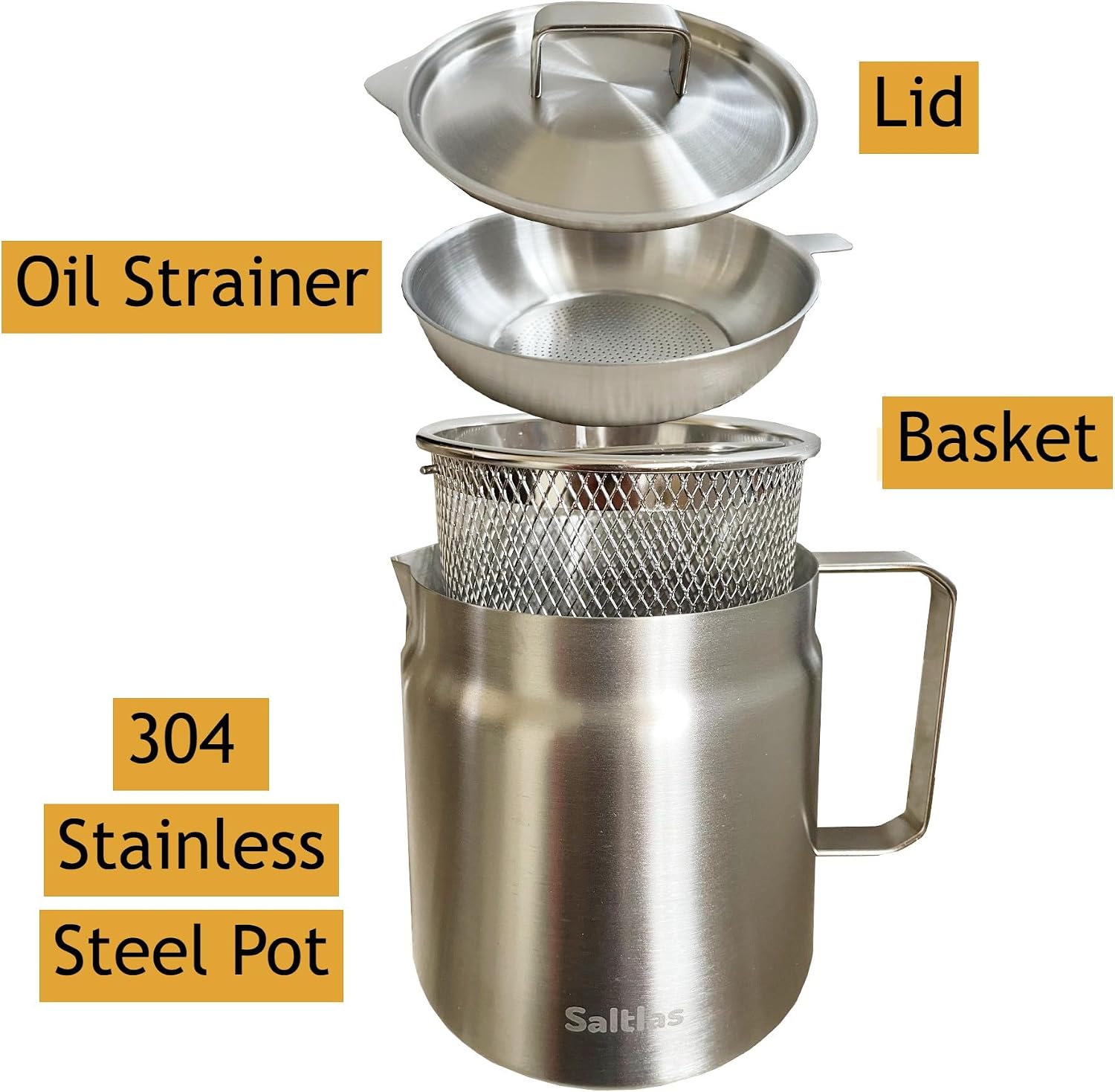
Some pots in both the 68oz and 119oz size ranges incorporate a double-bottom construction — a layered base with an insulating gap between inner and outer steel walls. This design produces more even heat distribution across the base, which reduces the hot spots that accelerate localized oil breakdown.
Foodservice Equipment Reports, in its coverage of stovetop cookware procurement for commercial kitchens, notes that even-base heat distribution also reduces the likelihood of burning food that sinks and contacts the pot floor during a fry cycle. For a stovetop fry vessel where you’re managing your own heat source without an electronic thermostat, double-bottom construction is a meaningful design advantage — not a luxury upsell. It directly reduces the most common failure modes of stovetop frying: scorched oil, hot-spot browning, and uneven cook on the underside of submerged food. If your fry sessions are frequent or your burner runs hot and uneven, this is the tier worth the price step.
Saltlas
$38.97
In stock on Amazon
Check price on AmazonThe Oil Reuse System: Underrated Feature or Marketing Fluff?
Nearly every stovetop fry pot in this category ships with a strainer-lid — a lid with a built-in fine mesh or perforated insert that lets you strain oil back into the pot after a fry session, then seal it for storage. The consensus across owner feedback is that this feature is genuinely useful in a way that paper filter cones or separate strainers are not: it’s integrated, waste-free, and fast.
Let’s be precise about what the strainer-lid does and doesn’t do.
Food and Wine, in its guide “How to Reuse Frying Oil Safely,” identifies the primary enemies of reusable frying oil as moisture, food particles, and heat degradation. A strainer-lid addresses the particle problem effectively — it catches breading crumbs and small food bits that accelerate oil breakdown. It does nothing about moisture (water from food steaming during the fry) or oxidation from repeated high-heat cycles. So the strainer-lid extends oil life compared to storing oil without straining it, but it doesn’t reset the clock entirely.
Practical reuse estimate: properly strained frying oil used at moderate temperatures (325–375°F) can reasonably be reused 3–5 times before flavor and smoke-point degradation become noticeable. That range aligns with guidance from both Serious Eats (“The Science of Frying: Oil Temperature, Batch Size, and Recovery”) and Cook’s Illustrated equipment testing methodology (“Equipment Review: Stovetop Fry Pots and Oil Management”). High-starch foods — donuts, battered fish — degrade oil faster than lower-starch proteins.
Strainer-lid vs. paper filter cones: The strainer lid is faster and produces no disposable waste — no cone to discard, no funnel to set up. Commercial paper filter cones, as used with high-volume commercial fryer filtration systems, do filter more finely, catching sub-visible particles that contribute to cumulative oil breakdown. For home use and small-batch foodservice, the strainer lid is adequate. For high-volume or extended oil reuse scenarios, supplementing with paper filtration will extend oil life further and is worth considering.
Material Reality Check: 304 Stainless vs. Chromed Carbon Steel
This section addresses one of the most common points of confusion — and in some cases misrepresentation — in this product category.
Some buyers have reported receiving baskets marketed as stainless steel that arrived as chromed carbon steel. This is not a trivial distinction: chromed carbon steel is not stainless steel, and representing it as such misrepresents the product’s performance profile.
304 stainless steel contains approximately 18% chromium and 8% nickel. The chromium creates a passive oxide layer that resists rust, acid, and repeated exposure to high-heat oil. NSF International, in its Certified Equipment Listings for the Cookware and Fry Vessels category, requires 300-series stainless steel for components in contact with food or frying media in commercial applications. When a manufacturer’s spec sheet explicitly calls out “304 stainless,” that is a verifiable material claim.
Chromed carbon steel — also marketed as chrome-plated or nickel-plated steel — is carbon steel with a thin electroplated surface coating. The coating provides initial corrosion resistance and a shiny appearance, but it is not uniform through the material thickness. The coating can chip over time, particularly in high-acid or high-heat environments. Once the coating is compromised, the underlying carbon steel corrodes. Restaurant Business Online’s procurement guidance in “Small-Batch Frying in Ghost Kitchen Environments” emphasizes verifying material claims on aftermarket baskets specifically because the replacement cycle cost outweighs any upfront savings on inferior materials.
The decision rule: if a product listing says “stainless steel” but the spec sheet doesn’t specify 304 or 316 grade, treat that claim as unverified. Chromed carbon steel baskets are not unsafe for occasional home use, but they are not the same durability proposition as true 304 stainless and should not be priced or sold as equivalent.
Basket Mesh and Small-Format Foods
If you’re frying shrimp, calamari rings, or any small-cut item, mesh aperture size on the included basket is a real constraint — and one that stovetop fry pot listings rarely specify numerically.
Across owner reviews for this product category, the pattern is consistent: most included baskets in the 68oz–119oz tier use a medium-gauge wire mesh that retains standard-size shrimp (16/20 count and larger) reliably. Small shrimp (26/30 count and above) and calamari rings with a narrow cross-section present a higher fall-through risk, particularly in baskets where weld-point spacing is inconsistent near the edges.
The honest answer: check the mesh aperture if small-format proteins are your primary use case. If the listing doesn’t specify mesh opening in millimeters, the included basket is a general-purpose tool. A separate fine-mesh spider or secondary insert solves this problem, but it’s an additional cost to factor into the purchase decision upfront.
Frequently Asked Questions
How much oil do these pots actually hold, and how does that translate to batch size?
The 68oz (2L) pot holds approximately 6 cups of usable frying oil at 70% fill — enough for 4–6 chicken wings or one serving of fries per batch. The 119oz (3.5L) pot holds approximately 10 cups at 70% fill, supporting 10–14 wings or 2–3 servings of fries. Cook’s Illustrated equipment testing, as documented in “Equipment Review: Stovetop Fry Pots and Oil Management,” supports a minimum 3:1 oil-to-food volume ratio for temperature stability during a fry cycle.
Are these pots induction compatible?
Induction compatibility requires a ferromagnetic base — a magnet must stick to the bottom. 304 stainless is generally not magnetic on its own, but pots marketed as induction-compatible typically use a bonded magnetic steel base plate. Verify this on the specific product’s spec sheet; “stainless steel pot” does not automatically mean induction compatible.
Can I reuse oil stored in these pots, and how many times?
Yes, with the strainer-lid, reuse is practical. Food and Wine, in “How to Reuse Frying Oil Safely,” and Serious Eats, in “The Science of Frying: Oil Temperature, Batch Size, and Recovery,” both support 3–5 reuse cycles for oil used at moderate temperatures with proper straining between sessions. High-starch foods degrade oil faster. Discard oil that smells rancid, smokes at normal frying temperatures, or has darkened significantly.
What is the practical difference between 304 stainless steel and chromed carbon steel for a fry basket?
304 stainless is corrosion-resistant through its full material thickness due to its chromium-nickel alloy composition. Chromed carbon steel has a thin surface coating over carbon steel — it resists rust initially but can chip and degrade with repeated high-heat exposure, exposing the base metal to corrosion. For a basket in repeated high-heat service, 304 stainless is the more durable long-term material. NSF International’s Certified Equipment Listings, Cookware and Fry Vessels category, require 300-series stainless for food-contact surface certification in commercial applications for exactly this reason.
Is the included basket fine enough to keep small shrimp or calamari from falling through?
For 16/20-count shrimp and larger, most included baskets perform adequately based on aggregated owner reports. For smaller shrimp (26/30 count and above) and narrow calamari rings, fall-through risk is real and mesh aperture should be verified before purchase. If the listing doesn’t specify mesh opening size in millimeters, assume the basket is optimized for standard-size proteins and plan accordingly.
The Decision Framework
If you are frying solo portions, testing recipes, or want a vessel that stores neatly and uses oil economically: the 68oz pot is the right call, not a compromise. The size objections in reviews come almost entirely from buyers who expected a larger vessel — not from solo users who are its actual target.
If you are frying for two or more people regularly, running any kind of small-batch foodservice operation, or want to reduce back-to-back batching: the 119oz pot is your minimum viable size. The throughput math doesn’t work at the smaller capacity once batch count per session increases beyond one or two runs.
If even heat distribution and extended oil life across high-frequency use are priorities: step into the double-bottom construction tier. The performance advantage is real on stovetop burners where you cannot rely on electronic temperature regulation to compensate for base hot spots.
In all tiers, verify material claims before purchase. If the listing says “stainless steel” but doesn’t specify 304 or 316 grade, that claim is unverified. If you’re frying small-format proteins — shrimp, calamari, anything narrow-cut — confirm mesh aperture or budget for a secondary fine-mesh insert. The strainer-lid is a genuinely useful feature across the board; the material grade and base construction are where the real durability decision lives.