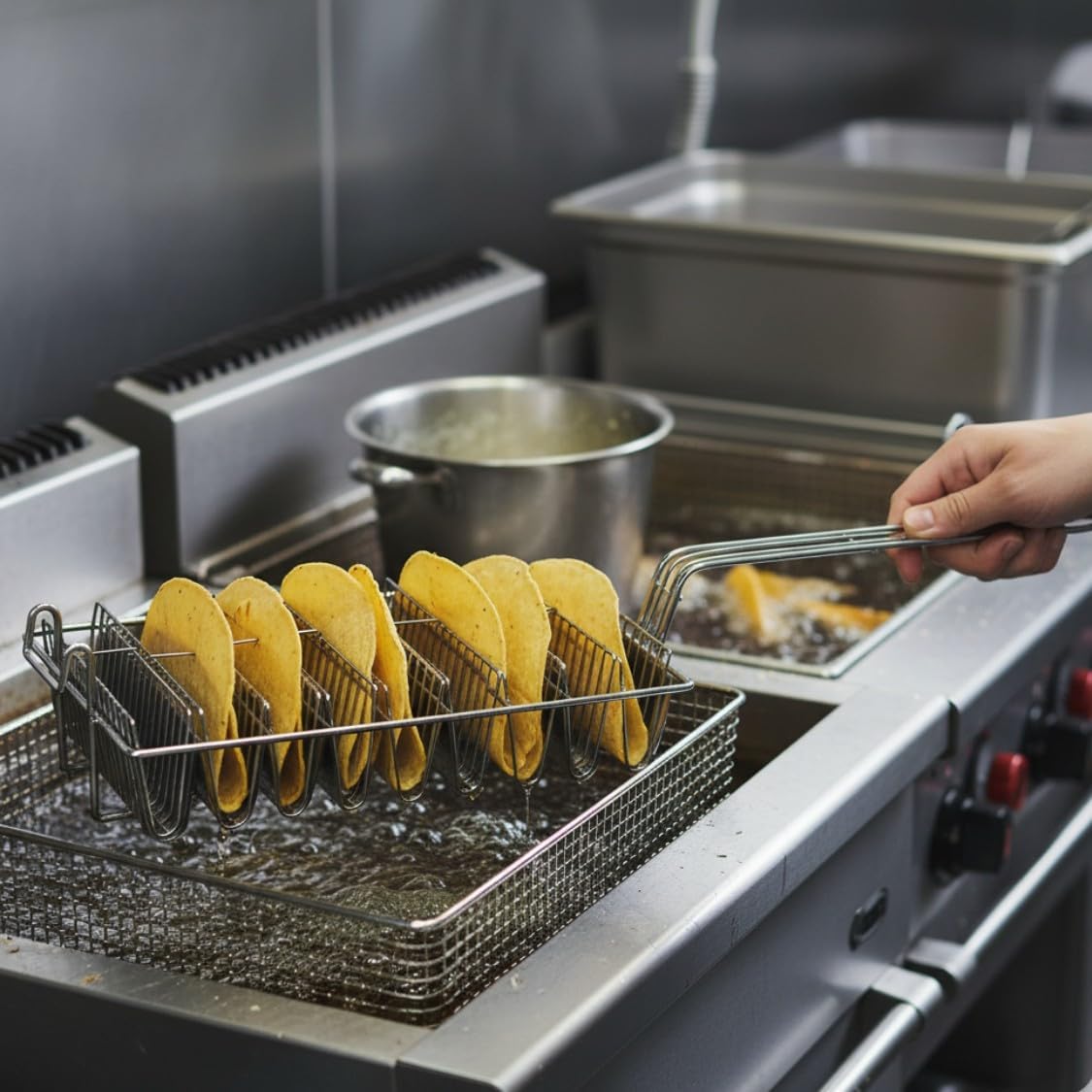
Specialty fry baskets — the wire-form molds that shape tortillas into taco shells, press burritos flat for even frying, or hold turnovers submerged while they cook — are a small but high-stakes corner of the commercial kitchen equipment market. Unlike a standard rectangular fryer basket, these tools do a structural job: they hold food in a specific shape under heat and oil pressure, cycle multiple times a service, and get yanked, scraped, and dunked dozens of times a day in a food-truck environment. The welds — the fused metal joints holding the basket’s wire frame together — are the single most common failure point in every category of specialty basket. If you’re sourcing these for commercial use, understanding where welds fail, which products have earned trust from operators who use them daily, and how to catch manufacturing defects before service day is the entire game. This guide compiles what operators and home cooks consistently report across the three most-purchased specialty basket types, and lays out a clear decision framework for each.
| EDITOR'S PICKPronto Turnover/Burrito Mesh Fr… | Mid-tierOCS Parts Pro Chef Series 2 Lev… | Budget pickTrueCraftware- Commercial Grade… | |
|---|---|---|---|
| Basket type | Turnover/burrito | Burrito/chimichanga | Taco shell |
| Dimensions | — | 12.5" x 6.6" x 4.6" | — |
| Material | — | Nickel-plated steel | — |
| Hook position | — | Front and left | — |
| Shell capacity | — | — | 8 |
| Handle | — | — | ✓ |
| Price | $100.93 | $58.99 | $49.99 |
| See on Amazon → | See on Amazon → | See on Amazon → |
Why Welds Fail: The Mechanics Behind the Failure Pattern
A standard rectangular fryer basket distributes stress relatively evenly across a welded grid. Specialty baskets don’t have that luxury. Taco baskets are essentially cylindrical cups — the wire frame must resist radial outward pressure from the tortilla expanding in hot oil, then the mechanical stress of being pulled out and inverted to release the shell. Burrito presses work on a hinge or press-plate mechanism that concentrates stress at two or three weld points every single cycle. Turnover baskets face repeated submersion and lifting loads at their handle welds, often with the basket holding food that shifts and pulls asymmetrically.
The failure mode across all three categories is nearly identical in operator accounts: welds crack at the joint between the frame wire and the handle attachment, or at the point where individual basket cups meet the main frame. Lower-gauge wire exacerbates this — thinner wire flexes more per cycle, and flex is the enemy of a static weld joint. Nickel-plated or 201-grade stainless baskets (a lower-nickel alloy common in budget products) tend to show corrosion at the weld point first, which weakens the joint before mechanical failure sets in.
Per NSF International’s NSF/ANSI 2 Food Equipment Standard, food-contact equipment must be constructed to resist the operational stresses of its intended use environment — a standard that aftermarket specialty baskets frequently cite in marketing but don’t always meet in practice, as operator reviews make clear.
The TrueCraftware Taco Basket: Where the Positive Data Lives
The TrueCraftware 8-slot taco basket is the most consistently praised taco basket in aggregated commercial operator reviews as of early 2026. The pattern worth noting: its praise comes specifically from buyers who did their homework before purchasing.
A verified food truck operator’s review — citing use in a 40-pound commercial fryer — reports that the basket fits correctly, cycles reliably through daily service, and hasn’t shown weld cracking after extended use. A separate home-cook review is notable because the buyer explicitly read the negative reviews first, confirmed the shell diameter against their fryer’s dimensions, and then reported a successful purchase. That’s not an accident — it’s a signal about how this product should be bought.
Shell diameter fit is the critical variable. The TrueCraftware 8-slot basket is designed for standard 6-inch flour or corn tortillas. Operators running larger tortillas (burrito-size, 10–12 inch) or smaller street-taco rounds (4.5 inch) report fit problems that have nothing to do with weld quality — the basket simply isn’t the right tool. Confirming your tortilla diameter against the basket’s cup dimensions before ordering is non-negotiable.
By the numbers — TrueCraftware 8-slot taco basket:
- Designed for: 6-inch tortilla diameter (standard taco shell size)
- Recommended fryer capacity: 40 lb oil capacity and above for commercial use
- Primary failure mode reported in negative reviews: tortilla size mismatch, not weld failure
- Operator verdict: reliable when matched correctly to tortilla size and fryer depth
The OCS Parts Pro Burrito Basket: A Manufacturing QC Problem
The OCS Parts Pro burrito basket sits in a different risk category than the TrueCraftware. The taco basket’s negative reviews are almost entirely about fit mismatch — a fixable research problem. The OCS Parts Pro has at least one documented manufacturing defect review: a 1-star Spanish-language account reporting that one of the two baskets in the set arrived without the pressing mechanism entirely. That’s not a weld failure. That’s a missing component at the factory level.
This distinction matters for procurement decisions. A weld failure is a durability problem — it tells you the product may not survive its intended service life. A missing component is a QC process problem — it tells you the manufacturer doesn’t have adequate outbound inspection, which means any unit you receive could be incomplete, regardless of how well-constructed the intact units appear to be.
For operators sourcing the OCS Parts Pro burrito basket, the practical implication is:
- Inspect both baskets in the set immediately upon receipt, before your first service day. Verify that both units have the press plate or clamp mechanism fully assembled and that hinge welds are intact.
- Twin commercial fryer compatibility: Per the product’s published specifications, the burrito basket is designed to operate in a single fryer vat. It is not a twin-slot spanning tool — each basket operates independently, and running one in each slot of a standard twin commercial fryer is operationally feasible but requires confirming vat width against basket dimensions individually for each slot.
The design concept — a hinged press basket for burritos — is sound and addresses a real production need. The QC execution is where the risk lives.
The Pronto Turnover Basket: Design-Sound, Execution-Fragile
The Pronto turnover basket has earned what might be the most instructive review in this entire product category: a 3-star account explicitly documenting weld failure at two months of daily use, with the reviewer framing it as a product that “would be great if it could hold up.” That framing is the signal. The reviewer isn’t saying the concept is wrong — they’re saying the build quality doesn’t match the demand.
Two months of daily use in a food-truck or ghost-kitchen environment represents roughly 400–600 service cycles, assuming two-to-three uses per service. That’s a low bar for a weld joint on a tool that costs what specialty baskets cost. Restaurant Business Online has noted in its small equipment procurement coverage that specialty basket welds should be expected to withstand a minimum of 1,000–1,500 cycles before showing structural fatigue in commercial applications — making a 400-cycle failure a significant underperformance.
Can it be rewelded? This is a real operator question and the answer is nuanced. The Pronto’s handle-to-frame welds are geometrically accessible for a skilled welder, and stainless TIG welding of this type of joint is technically straightforward. However, the food-contact safety question matters: any reweld must use food-grade stainless filler rod and the repaired unit should be re-passivated before returning to oil service. In practice, for a basket in the $30–$60 price range, most operators report that rewelding is economically marginal — the labor cost approaches or exceeds replacement cost. The decision math: if you have an in-house maintenance relationship with a certified welder who works in food-grade materials, a reweld is viable. If you don’t, replacement is the rational call.
Commercial Oil Filter Baskets: The Fit Problem Is the Product Problem
The commercial oil filter basket category — wire-mesh or perforated baskets that sit on the bottom of a commercial fryer vat to catch sediment during filtration — is where operators most consistently report fit failures that have nothing to do with weld quality or material grade. Reviewers return high-quality baskets because fryer-bottom dimensions vary significantly between commercial models, and “universal fit” language in product listings rarely holds up against actual vat measurements.
Per Foodservice Equipment Reports’ fryer maintenance guidance, fryer vat interior dimensions are not standardized across manufacturers. A Pitco SG14 and a Frymaster MJ35 with similar oil capacities have meaningfully different vat footprint dimensions. Before sourcing any commercial oil filter basket:
- Pull the vat interior dimensions from your fryer’s installation manual — not the marketing sheet, the installation or service manual, which includes toleranced interior measurements.
- Contact the basket manufacturer’s support line with those measurements before ordering. Reputable suppliers will confirm fit or tell you they can’t.
- Check OEM part numbers first. Pitco, Vulcan, Frymaster, and Manitowoc all publish OEM filter basket specs through their parts portals. If an aftermarket basket claims compatibility with your model, verify against those published OEM dimensions directly.
This is the category where the cost of a return shipment on a $150–$250 commercial basket most often catches operators off guard mid-procurement.
Frequently Asked Questions
How long do taco fry basket welds typically last under weekly home use vs. daily food truck use?
Operators in long-run reviews consistently report that well-constructed taco baskets (heavy-gauge stainless, fully welded frame joints) survive 12–18 months of daily food-truck use before showing any weld stress. Weekly home use, which represents roughly 1/7th the cycle count, should extend functional life to several years in normal conditions. Budget baskets with thinner wire gauge or visible weld gaps at purchase should be expected to fail sooner — operators report failures as early as 60–90 days in daily-use environments.
What shell diameter fits the TrueCraftware 8-slot taco basket?
The TrueCraftware 8-slot taco basket is designed for standard 6-inch tortillas. Buyers who confirm this diameter against their tortilla size before purchasing report consistent success. Buyers running larger or smaller tortillas report fit problems — the basket hasn’t failed; it’s simply the wrong tool for the shell size.
Does the OCS Parts Pro burrito basket work in both slots of a standard twin commercial fryer?
Each basket in the OCS Parts Pro set is designed to operate independently in a single vat. Running one basket per slot in a twin-vat fryer is operationally feasible, provided each vat’s interior dimensions accommodate the basket footprint. Measure each vat independently — twin fryers are not always perfectly symmetrical in interior dimension, and one slot may fit while the other does not.
How do I verify that a commercial oil filter basket will fit my specific fryer model before buying?
Pull your fryer’s service or installation manual for toleranced vat interior dimensions. Compare against the basket’s published external dimensions, leaving at least a half-inch of clearance on all sides for reliable operation and removal. Contact the supplier directly with your fryer model number and vat measurements before ordering. Check whether your fryer manufacturer publishes an OEM filter basket part number — that spec becomes your dimensional benchmark for any aftermarket comparison.
Can the Pronto turnover basket be rewelded if the welds break, or is the design not worth repairing?
Rewelding is technically feasible if you have access to a welder working in food-grade stainless with appropriate filler rod and passivation capability. The design concept is sound — the issue is execution quality, not geometry. However, the economics rarely favor repair at the basket’s price point unless you have an existing in-house or contracted maintenance relationship. Most operators in this situation report replacing the unit rather than repairing it.
Is there a specialty basket that holds up to daily use without weld failures?
Based on aggregated operator reviews through early 2026, the TrueCraftware taco basket is the closest to a reliable daily-use option in the taco category — when matched correctly to tortilla size and fryer capacity. The broader lesson across this product category is that no specialty basket at current market price points has earned universal durability praise in daily commercial use. Operators managing highest-volume programs increasingly report building 6-month replacement cycles into their supply budget rather than treating specialty baskets as durable equipment — a realistic posture given what the review record consistently shows.
Decision Framework: If X, Then Y
If you’re a food truck operator buying taco baskets for daily service: Source the TrueCraftware 8-slot, confirm your tortilla diameter is 6 inches, and confirm your fryer oil capacity is 40 lbs or above. Buy a spare set at the same time — the failure rate in daily use makes having a backup operationally necessary.
If you’re evaluating the OCS Parts Pro burrito basket for commercial use: Factor in incoming inspection time. Treat each unit as potentially defective until you’ve confirmed the press mechanism is present and all welds are intact. Keep packaging until inspection is complete.
If you’re looking at the Pronto turnover basket for daily volume: Price in a 6-month replacement cycle. The design works; the weld execution does not consistently survive heavy daily use. For weekly home use, the product is worth its price point.
If you’re sourcing commercial oil filter baskets: Stop before you order and measure your vat. Every return in this category traces back to skipping that step.