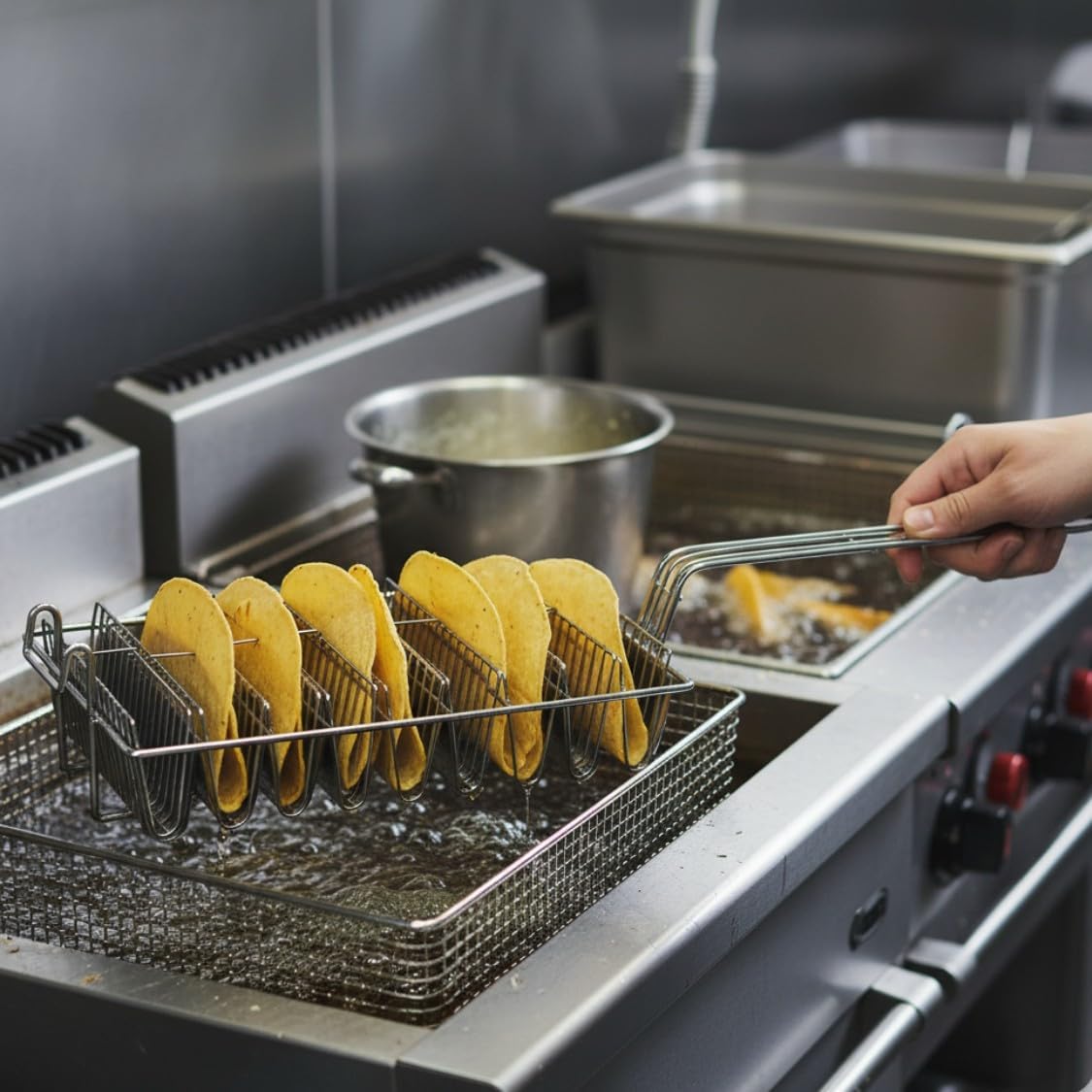
If you’ve ever bitten into a taco shell that came out of a fryer — that deep, blistered crunch that a baked shell can’t quite replicate — you already know the result is worth the effort. But getting there consistently means using the right piece of equipment: a specialty fry basket, which is a shaped wire or perforated metal form that holds food in a specific position while it cooks in hot oil. Unlike the flat rectangular basket that came with your countertop fryer, specialty baskets are engineered to cradle a tortilla into a taco shape, wrap a burrito in a tight bundle, or press a turnover flat so it fries evenly on both sides. If you’re running a food truck, ghost kitchen, or high-volume restaurant line and you’re still improvising with tongs and prayer, this guide will give you a decision framework for matching the right basket to the menu item — including the specs, tradeoffs, and math that matter at a commercial scale.
What “Specialty” Actually Means — And Why It Matters More Than You Think
The word “specialty” gets stretched thin in restaurant supply catalogs. In the context of fry baskets, it has a precise meaning: a basket whose geometry is the product. A standard rectangular fryer basket is neutral — it holds food in hot oil and that’s it. A specialty basket dictates shape, sometimes wall contact, and often simultaneous submersion of a food item that would otherwise float, tip, or deform.
For tacos, burritos, and turnovers, this matters for three converging reasons:
Consistency at volume. A cook using tongs to fold and hold a taco shell mid-fry can do it perfectly once. Doing it 200 times across a lunch rush, with three people on the line, is a different proposition. A taco basket locks the geometry so every shell comes out the same.
Oil management. Specialty baskets that fully submerge the food item reduce the hot-spot problem — the top surface sitting above the oil line, frying slower or not at all. Consistent submersion means consistent cook time means consistent product.
Labor math. WebstaurantStore’s blog notes that specialty baskets are among the most common “set and forget” additions foodservice operators recommend to each other, specifically because they convert a two-hand job into a one-step load-and-lower operation.
The tradeoff is SKU complexity: each basket style is specific to a food type, and often specific to a fryer model’s basket rail dimensions. Before you buy three dozen taco molds, you need to verify compatibility.
Taco Shell Baskets: Geometry, Gauge, and the Fit Problem
A taco shell basket — sometimes called a taco fry mold or taco bowl press — is a hinged or two-piece wire form that clamps around a raw tortilla and submerges it in oil in a folded-shell shape. The tortilla fries around the form, sets rigid, and releases when cooled slightly.
Shape variants matter
The two dominant shapes are the U-fold (classic taco shell, roughly 60-degree angle at the crease, wide enough for a 6-inch tortilla) and the bowl mold (round or oval form that produces a fried taco salad bowl). These are not interchangeable. A U-fold basket on an 8-inch tortilla produces a floppy, over-wide shell. A bowl mold on the same tortilla produces a bowl that’s too shallow. Match the basket size to the tortilla diameter you’re spec-ing — most commercial taco shell baskets are sized for 6-inch, 8-inch, or 10-inch rounds.
Gauge and material
At commercial volume, the KaTom Restaurant Supply Blog’s fryer basket overview identifies 304 stainless steel as the baseline expectation for food-contact wire forms in a commercial kitchen. Taco molds in particular are held in oil repeatedly throughout a service, and the hinge and weld points are the failure zone. Operators in long-run reviews consistently flag nickel-plated steel molds — often sold at a lower price point — as showing corrosion at the hinge within 90–120 days of daily use. The Foodservice Equipment Reports piece on fryer basket lifecycle puts the cost-per-use math clearly: a $14 nickel-plated mold replaced every three months costs more over 18 months than a $28 304-stainless mold that runs 18 months without failure.
The fryer-fit variable
Taco molds are dipped into the fryer by handle — they typically don’t mount to the fryer basket rail. This gives them more flexibility across fryer models, but it also means your fry oil depth matters. The NSF/ANSI 4 standard (NSF International) for commercial cooking equipment requires that oil-contact surfaces on food equipment be accessible and cleanable; deep taco molds with tight wire spacing can trap food particles in ways that make sanitation harder. Prioritize molds with wire spacing of at least 3/8 inch and hinges that open fully flat for cleaning.
Burrito and Chimichanga Baskets: The Submersion Problem
A chimichanga is a burrito that’s been deep-fried — and it’s one of the more mechanically annoying items to fry consistently without the right equipment. The problem is buoyancy: a wrapped burrito, especially one with air pockets or a tight foil-adjacent tortilla wrap, wants to float. The top surface stays above the oil and fries slowly and unevenly while the submerged portion overcooks.
Clamp baskets vs. standard submersion
The solution used in most commercial operations is a clamp-style submersion basket — a hinged rectangular cage that sandwiches the burrito and locks it below the oil surface. These baskets come in two configurations:
- Single-item clamp baskets (typically 5–6 inches wide, 8–10 inches long): designed to hold one large burrito or two smaller ones side by side. Used on food trucks and ghost kitchens doing moderate chimichanga volume.
- Multi-slot rack baskets: wider frames with dividers that hold 4–6 burritos simultaneously. These mount to the fryer basket rail like a standard basket and are the configuration most operators at 50+ covers/day are using.
Vulcan’s fryer accessories documentation lists compatible multi-slot chimichanga baskets for their VEF and 1VHD series fryers, with rail-width specs that must match your fryer opening. This is the critical fit check: measure your fryer basket opening width (most commercial 40–50 lb. vat fryers run 11.5–12.5 inches wide), and cross-reference with the basket’s listed rail-to-rail dimension before ordering.
A note on wire spacing for burritos
Burrito submersion baskets need closer wire spacing than taco molds — 1/4 to 5/16 inch — because the food item is dense and heavy and the basket is bearing that weight in oil. Operators who’ve used coarser wire spacing report the burrito sagging through the wires mid-cook, especially with heavier fillings (rice + beans + meat). Spec the wire gauge at 3/16 inch diameter or heavier for this application.
Turnover and Empanada Baskets: The Flat-Fry Challenge
Turnovers — whether savory empanadas, sweet fruit turnovers, or hand pies — present a different engineering problem. They’re flat, sealed items that need even contact with hot oil on both surfaces. The standard approach in high-volume operations is a flat press basket, essentially a hinged flat cage that sandwiches the turnover and submerges it. Think of it as a waffle-iron-meets-fryer-basket form factor.
By the Numbers
| Basket type | Typical wire gauge | Recommended oil temp | Approx. commercial price range (2026) |
|---|---|---|---|
| Taco shell mold (6-in, 304 SS) | 3/16 in | 350–375°F | $22–$45 per unit |
| Burrito clamp basket (single) | 3/16 in | 350–365°F | $35–$65 per unit |
| Multi-slot chimichanga rack | 1/4 in | 350–365°F | $80–$160 per rack |
| Flat press / turnover basket | 3/16 in | 340–360°F | $28–$55 per unit |
Price ranges sourced from WebstaurantStore and KaTom catalog listings, May 2026.
Even-contact is the whole game
The flat press basket’s value proposition is that it eliminates the flip. Without it, a turnover fries beautifully on the submerged side and unevenly on the top. The Frymaster OEM parts catalog identifies flat submersion clips as recommended accessories for turnover-forward menus, noting that even oil contact reduces cook time variance by preventing the operator from guessing when to flip.
For empanadas specifically — which are thicker at the crimped edge than at the center — look for flat press baskets with slightly flexible wire framing (as opposed to rigid welded grids) that can accommodate the height variation without cracking the seal. Operators in aggregated reviews consistently flag rigid flat press baskets as causing blow-outs on thick-edged empanadas because the frame applies uneven pressure at the crimp.
The Procurement Decision: OEM vs. Aftermarket for Specialty Baskets
This is where the math gets real. OEM specialty baskets from Vulcan, Frymaster, and Manitowoc are built to fit their specific fryer basket rail dimensions and are typically NSF-listed as part of the fryer assembly. The Foodservice Equipment Reports lifecycle analysis notes that NSF certification for accessories matters in health inspection contexts — an inspector can flag non-certified food-contact equipment in commercial kitchens even if the fryer itself is certified.
Aftermarket specialty baskets are widely available and often competitively spec’d. The key question is whether the basket has its own NSF/ANSI 4 listing (check NSF International’s certified equipment database — searchable by manufacturer and product category) or is riding on a listing it doesn’t actually hold. For taco molds and submersion baskets used in high-inspection environments (California, New York, Illinois all have active commercial kitchen inspection programs with accessory scrutiny), this matters more than the price delta.
The decision rule:
- If you’re operating in a high-inspection jurisdiction or running a franchise with brand-standard compliance requirements → pay for OEM or independently NSF-listed aftermarket. The $20–$40 premium per basket is lower than one failed inspection or one franchise compliance flag.
- If you’re on a food truck with less stringent accessory inspection, or running a ghost kitchen with a short menu test cycle → a well-spec’d 304 stainless aftermarket basket with verifiable gauge and weld quality is a defensible choice. Just source it from a supplier (WebstaurantStore, KaTom, restaurant supply houses) with a return policy and real product specs posted — not a drop-shipper listing.
- If you’re scaling from 1–2 specialty items to a dedicated station (chimichanga line, empanada program) → price the multi-slot rack against the single-unit clamp quantity. At 4 or more units, the multi-slot rack wins on labor and oil real estate every time.
The basket geometry is the product. Spec it like it is.