If you’ve ever ordered a “7-inch fry basket” for a “7-inch pot” and watched it drop straight through to the bottom — or worse, tilt at a 20-degree angle and dump your chicken — you already know the core problem. A round fry basket (a wire-mesh or perforated-metal bowl that you lower food into hot oil, then lift out to drain) sounds like a foolproof purchase: measure your pot, match the number, done. But pot diameter and basket diameter are measured differently, and basket walls are almost never straight — they taper, which means the labeled size is usually the top opening, not the resting width. That gap between marketing copy and geometry is what this guide closes. Whether you’re frying chicken thighs in a Lodge cast iron Dutch oven on a Tuesday night or running a pop-up that fries to order in enameled cookware, the fit question is the same. We’ll walk through the measurement math, call out confirmed pairings drawn from published specs and aggregated owner reviews, and give you a clear decision rule by the end.
| EDITOR'S PICKLodge Silver Deep Fry Basket -… | Mid-tierWinco Culinary Basket | Budget pickHIC Kitchen Fry Basket | |
|---|---|---|---|
| Diameter | 11.5 in | 12 in | 7 in |
| Material | Nickel-plated steel | — | 18/8 stainless steel |
| Mesh type | — | Fine mesh | Mesh |
| Brand | Lodge | Winco | HIC |
| Price | $29.99 | $20.22 | $14.99 |
| See on Amazon → | See on Amazon → | See on Amazon → |
Why “Listed Diameter” Is a Trap — and How to Measure Correctly
The mismatch problem has a mechanical cause that manufacturers rarely explain plainly. Most round fry baskets are formed from a flat sheet or coil of wire into a bowl shape. To release cleanly from the forming die, the sides angle outward from bottom to top — a taper of anywhere from 5° to 15°. The diameter stamped on the box almost always reflects the widest point, which is the rim. The resting diameter — the width of the basket at the point where it actually contacts the inside wall of your pot — is narrower.
HIC Kitchen’s 7-inch round basket illustrates this precisely. Aggregated buyer reviews of that product consistently identify the tapered-side geometry as the reason the basket either falls through a 7-inch pot (the resting width is too narrow) or sits cocked at an angle because the rim catches the pot lip unevenly. One reviewer notes that the hanging bracket on the HIC basket exacerbates the tilt: when the basket hangs on a single-point hook rather than resting level on a rim, any lateral imbalance becomes a pivot problem. That’s a design limitation worth knowing before you buy.
The correct measurement sequence:
- Measure your pot’s interior diameter at the oil line, not at the rim. Most Dutch ovens and deep skillets taper inward toward the base. Lodge Manufacturing publishes interior base and rim dimensions separately on its product pages — use the interior mid-depth measurement, approximately where oil will sit, for the most accurate fit reference.
- Subtract 0.5–0.75 inches from that measurement to find your target basket resting diameter. You want the basket to hang suspended in the oil, not rest on the pot bottom or jam against the walls.
- Check whether the listed basket size is rim or resting diameter. If the spec sheet doesn’t distinguish, treat it as rim diameter and apply the taper discount mentally.
By the numbers — published interior dimensions for common pots referenced in this guide:
| Pot | Labeled Size | Published Interior Diameter (approx.) |
|---|---|---|
| Lodge Cast Iron Deep Skillet | 10.25 in | ~8.75 in interior at rim |
| Le Creuset Round French Oven | 5.5 qt | ~8.25 in interior at rim |
| Lodge Cast Iron Dutch Oven | 6 qt | ~9.5 in interior at rim |
Sources: Lodge Manufacturing product pages; Le Creuset product pages (both plain-text references). Interior dimensions are approximate and should be confirmed against the specific production year of your cookware, as enameled interior coatings can reduce clearance by 1–3 mm.
Confirmed Pairings: What Actually Fits What
This is the section most buyers want first and almost never find in one place. What follows is drawn from published specs cross-referenced against aggregated owner reviews. The three pairings below represent the best-documented fits in this product category, organized from most accessible to most specialized.
Lodge Basket in a Lodge Cast Iron Dutch Oven

HIC
$14.99
In stock on Amazon
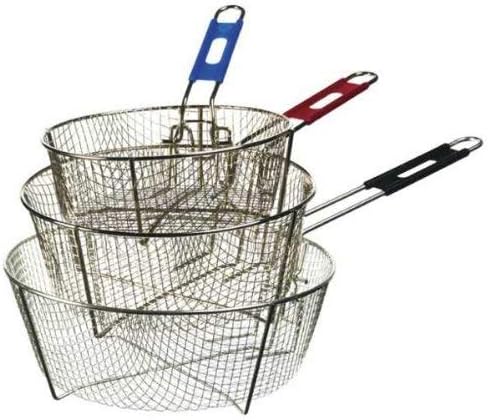
Check price on AmazonLodge sells a round fry basket explicitly sized for Lodge cast iron cookware, and buyer reviews of that basket consistently report a clean drop-fit into Lodge Dutch ovens, with the side hook functioning as designed: you hang the basket on the pot rim to drain, hands-free, without the basket tilting. This is the rare case where the brand-to-brand match is reliable because Lodge engineered the basket against its own interior dimensions, which Lodge Manufacturing documents on its product pages.
The side hook is worth explaining for buyers who haven’t used one. It hangs the basket on the pot rim after lifting it from the oil, letting excess oil drain back into the pot hands-free — a meaningful ergonomic and safety advantage over holding a hot, oil-dripping basket while you look for somewhere to set it down. Lodge’s hook is designed to work with Lodge’s specific rim profile, which is why reviewers report it “functions as intended” in Lodge pots and only in Lodge pots — the geometry is pot-specific.
If you own Lodge cast iron and want the path of least resistance, staying within the Lodge ecosystem is the decision that holds up under scrutiny. The confirmed drop-fit and functional side hook are worth the brand-aligned purchase.
HIC
$14.99
In stock on Amazon
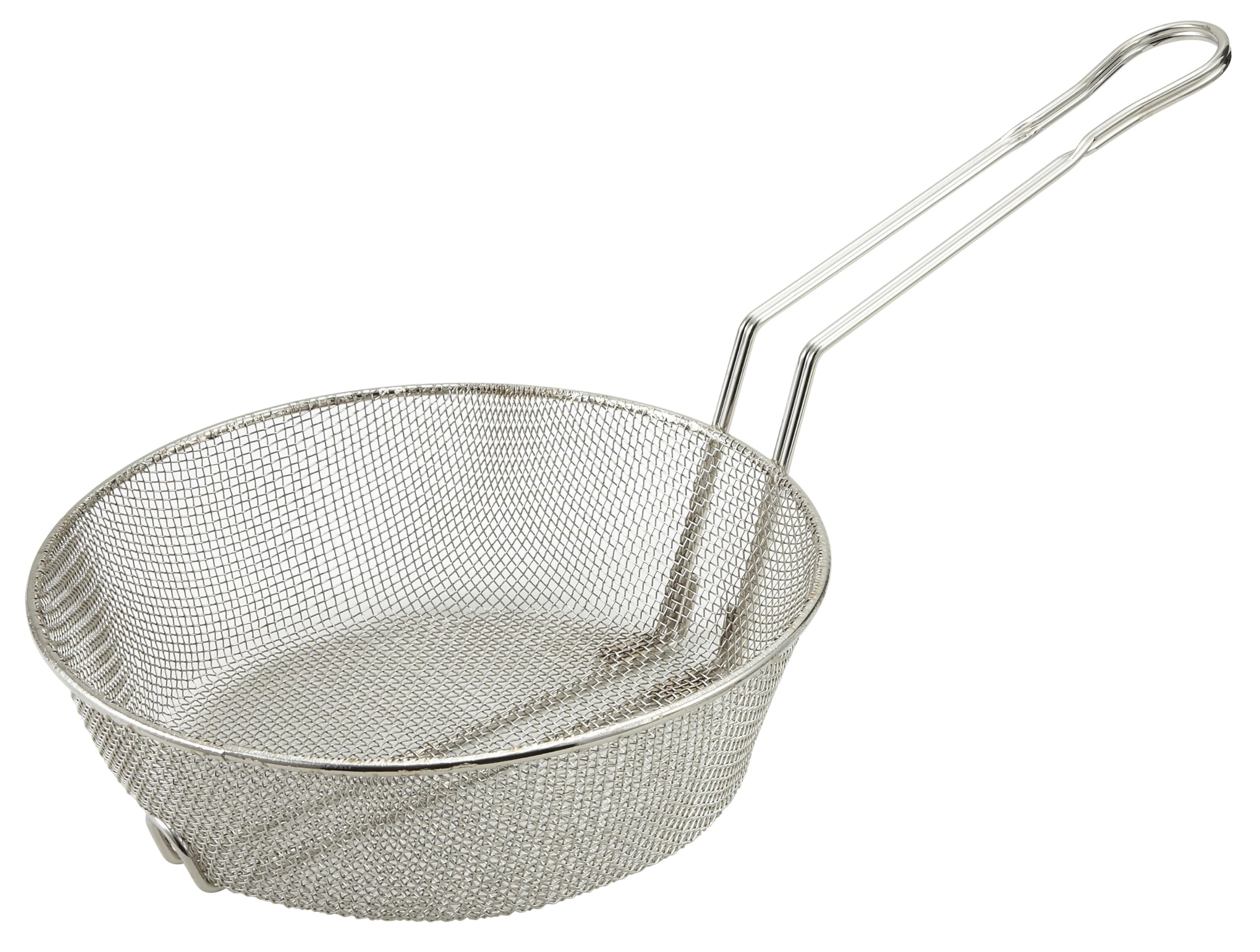
Check price on AmazonWinco BSKT-12F Fine-Mesh Basket in the Lodge 10.25-Inch Deep Skillet
Winco
$20.22
In stock on Amazon
Check price on AmazonThis pairing shows up in buyer reviews with a specificity that’s genuinely useful. Reviewers of the Winco BSKT-12F — a 12-inch nominal fine-mesh round basket from Winco’s foodservice line, with specs published in the Winco product catalog — report that it fits the Lodge 10.25-inch cast iron deep skillet with minimal clearance. “Minimal clearance” is worth unpacking: it means the basket rests just inside the rim with little room to spare, which is actually ideal for a frying application. The basket is stable, it doesn’t rattle, and the mesh sits well below the oil line.
The BSKT-12F’s fine mesh gauge is the right call for flour-dredged items. Coarse mesh (typically 3/8-inch to 1/2-inch openings) allows breading fragments and fine flour particles to fall through the basket and settle in the oil, where they burn and degrade oil quality faster. Serious Eats, in its home deep-frying technique overview published at seriouseats.com, consistently emphasizes clean oil as a quality lever — fine-mesh baskets support that directly by keeping the basket floor clean enough that breaded items don’t lose their crust to the mesh.
The Winco BSKT-12F is a foodservice-grade product, which means it was designed for repeated commercial use rather than optimized for home-kitchen aesthetics. That’s a feature, not a bug, for buyers who fry frequently.
Winco
$20.22
In stock on Amazon
Check price on Amazon9-Inch Detachable-Handle Stainless Basket in a Le Creuset 5.5-Quart Round French Oven
Lodge
$29.99
In stock on Amazon
Check price on AmazonA buyer reviewing a 9-inch stainless detachable-handle round basket specifically identifies a 5.5-quart Le Creuset as the target pot — one of the rare confirmed pairings in this product category that names both the basket and the vessel. Le Creuset product pages put the interior diameter of the 5.5-quart Round French Oven at approximately 8.25 inches at the rim. A 9-inch nominal basket with typical taper will have a resting diameter in the 8–8.25-inch range, which aligns with a snug but functional fit in that pot.
The detachable handle is a genuine safety feature at Le Creuset’s typical wall height, where a fixed handle can be difficult to clear without tilting the basket. The mechanism connecting the detachable handle to the basket is the failure point to evaluate before buying: verify that the handle attachment uses a pinch-clamp or locking ring, not a friction fit. Buyer reviews of the 9-inch detachable-handle basket in this configuration don’t flag handle-separation failures in normal use, but it’s worth confirming on the specific product you choose.
Le Creuset’s enameled interior adds a consideration specific to this pairing: enamel finish is vulnerable to impact from metal basket edges if the basket is dropped or lowered roughly. Lower the basket slowly and avoid letting the basket rim drag against the enamel walls.
Lodge
$29.99
In stock on Amazon
Check price on AmazonMesh Choice and Material Honesty: Two Decisions Buyers Underweight
Coarse vs. Fine Mesh by Food Type
Mesh selection is the second decision point that buyers underweight. For cast iron and enameled Dutch oven frying — where the cooking environment tends toward home-cook and small-batch foodservice rather than high-volume commercial — the food type determines mesh gauge.
Flour-dredged chicken, fish, pork cutlets: Fine mesh. Coarse mesh allows breading fragments to fall through, settle in the oil, and burn — degrading oil quality and introducing off-flavors. The Winco BSKT-12F’s fine mesh gets called out in reviews specifically in the context of fried foods. Serious Eats’ home deep-frying technique overview, available at seriouseats.com, makes clean oil a central quality lever; fine-mesh baskets are one of the tools that support it.
Whole pieces, fries, vegetables: Coarse mesh is acceptable and drains faster. For high-heat frying where speed of oil drainage matters — outdoor propane burner setups, for instance — coarser mesh reduces the brief re-submersion risk from slow-draining fine mesh.
Material Claims and What to Verify
Round baskets in this segment get marketed aggressively as “heavy-duty stainless.” Some are. Many are 201-grade stainless — a lower-nickel alloy that resists corrosion less effectively than 304-grade and will show surface oxidation faster in repeated high-heat oil cycling. Check whether a spec sheet explicitly states 304-grade. If it doesn’t specify, treat the material claim with appropriate skepticism.
NSF International’s NSF/ANSI 2 Food Equipment standard, published by NSF International at nsf.org, addresses material requirements for food-contact surfaces. NSF-listed baskets have cleared that bar, which is a meaningful floor for anyone using a basket in a commercial or semi-commercial context. NSF listing confirms material safety for food contact — it does not specifically address structural load under outdoor burner exposure, so evaluate handle mechanisms on their own merits regardless of NSF status.
Using a Round Basket on an Outdoor Propane Burner
The detachable-handle basket format is the one that makes outdoor propane burner use genuinely practical. At least one buyer explicitly uses a round basket configuration over an outdoor burner for large-batch frying — whole birds, large fish, batch donuts — where the pot size and BTU output exceed what a home range can support. A few considerations:
- Stability first: On a propane burner stand, pot-to-basket clearance matters more, not less. A basket that tilts in the pot can cause uncontrolled splatter when lowered. The Lodge-to-Lodge ecosystem’s confirmed stable fit makes it a safer default in outdoor high-heat contexts.
- Detachable handles in high-heat environments: Outdoor burner temperatures can exceed typical home-fryer parameters. Verify that the handle attachment is a pinch-clamp or locking ring, not a friction fit — this is the same check recommended for the Le Creuset pairing above.
- NSF listing scope: NSF/ANSI 2, published by NSF International, covers food-contact material standards, not structural performance under outdoor BTU exposure. Evaluate handle mechanisms independently.
Frequently Asked Questions
How do I measure my pot correctly to find a round basket that actually fits? Measure the interior diameter of your pot at the depth where oil will sit — not at the rim, not at the base. Subtract 0.5 to 0.75 inches from that measurement to find your target basket resting diameter. Confirm whether the basket’s listed size is its rim diameter or its resting diameter before ordering.
Why does a basket listed as 7 inches not fit my 7-inch pot? Because basket manufacturers typically label the rim (widest point), while pot diameters are usually the interior measurement at mid-depth. Tapered basket walls mean the resting diameter is smaller than the rim diameter. A 7-inch basket in a 7-inch pot either falls through or sits cocked because the resting width is too narrow. Size down by 0.5–0.75 inches from your measured interior diameter to find the right basket.
Do Lodge fry baskets only work in Lodge cast iron, or will they fit other brands? Lodge baskets are sized against Lodge’s own interior dimensions, so the fit is most reliable within the Lodge system. In other brands with similar interior profiles, the fit may work, but you’d need to verify interior dimensions against Lodge’s published basket resting diameter. No confirmed cross-brand fit data surfaces in aggregated reviews with the same consistency as the Lodge-to-Lodge pairing.
Should I choose coarse or fine mesh for frying flour-dredged chicken in a Dutch oven? Fine mesh. Coarse mesh allows breading particles and flour to pass through into the oil, where they burn and accelerate oil degradation. Fine mesh keeps the basket floor clean, supports breaded crust integrity, and is the documented choice in aggregated reviews of baskets used for this application. Serious Eats’ deep-frying technique coverage at seriouseats.com reinforces clean oil as a core quality variable.
Can a detachable-handle basket be used safely over an outdoor propane burner? The detachable-handle format is the most practical option for outdoor use because it clears the high walls of a large pot more easily than a fixed handle. Verify that the handle attachment uses a locking mechanism rather than a friction fit, and ensure the basket is stable in your pot before the oil reaches temperature.
The Decision Rule
If you own Lodge cast iron: buy the Lodge round fry basket. The confirmed drop-fit and functional side hook are worth the brand-aligned purchase — the geometry is engineered to match, and buyer reviews back it up consistently.
If you own a Le Creuset 5.5-quart Round French Oven: the 9-inch stainless detachable-handle basket is the confirmed pairing. Verify the handle locking mechanism before use, and lower the basket carefully to protect the enamel interior.
If you own a Lodge 10.25-inch deep skillet and need fine mesh for breaded items: the Winco BSKT-12F is the documented fit with minimal clearance — which is the right amount of clearance for stability.
If you’re matching a basket to any other pot: measure interior diameter at oil depth, subtract 0.75 inches, treat all listed basket sizes as rim diameters, and prioritize products that publish resting-diameter specs. When in doubt, size down rather than up — a slightly small basket that hangs stably beats a rim-wide basket that tilts.