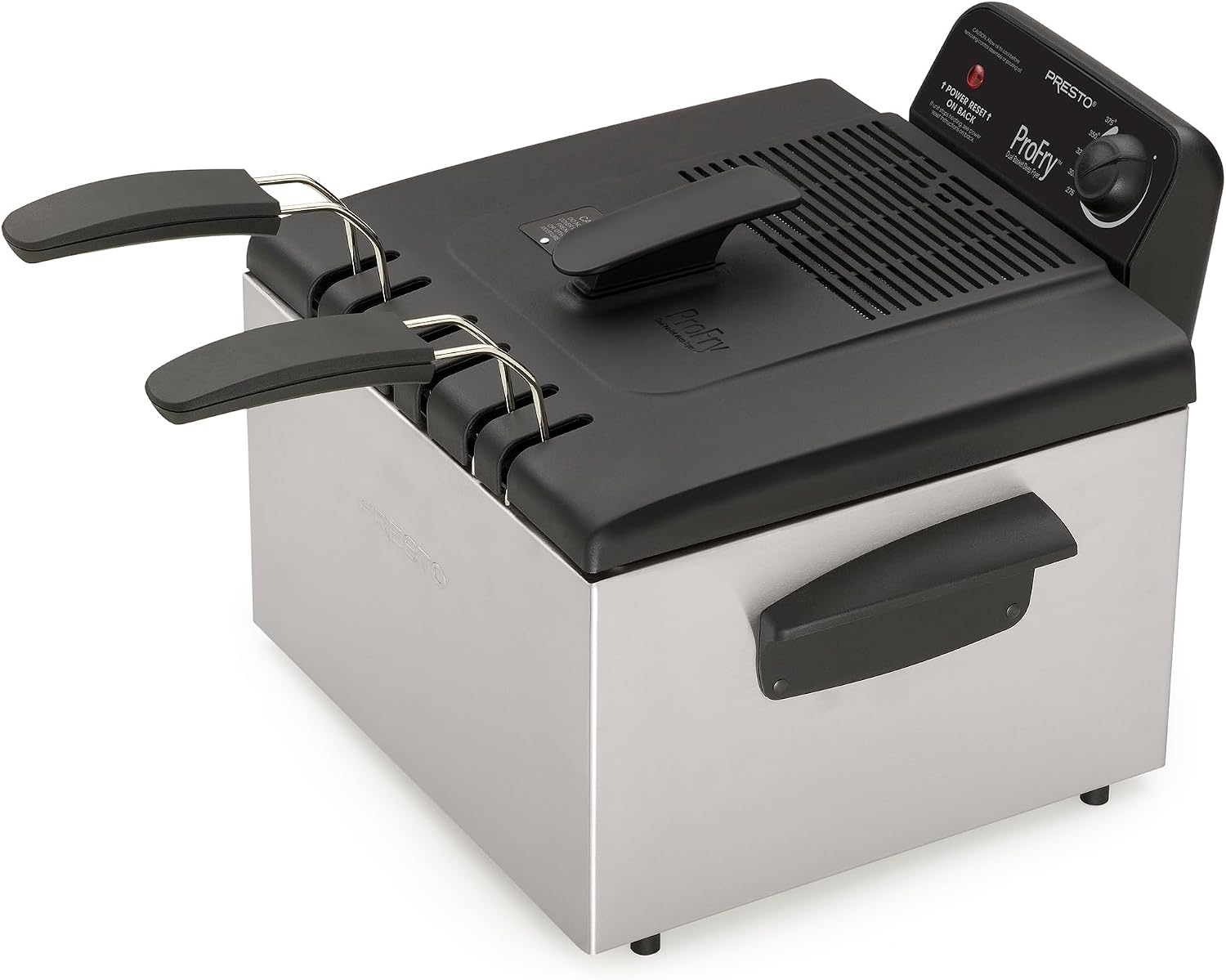
If your Presto fryer basket just fell apart mid-cook — mesh sagging, welds gone, handle snapped off at the hinge — you’re in the frustrating middle ground between “it’s just a basket” and “why is this so hard to replace?” A deep-fryer basket is the wire or mesh cage (usually stainless steel or nickel-plated steel) that holds food in hot oil, then lets you lift everything out cleanly. It sounds simple. The problem with Presto specifically is that the company publishes almost no public compatibility data linking replacement baskets to model numbers, so buyers are largely working from crowd-sourced measurements and trial-and-error. This guide cuts through that. You’ll learn how to measure your own tank correctly, what the “Jumbo ProFry” size actually means in inches, when a handle-only replacement is worth the spend, and when you’re better off walking away from the repair entirely.
Why Presto’s Compatibility Gap Is Worse Than It Looks
Most fryer manufacturers at least publish a parts diagram with part numbers tied to model numbers. Presto’s consumer-facing documentation is notably thin on this front. The owner’s manual for the ProFry Immersion Element series (per National Presto Industries’ published manual) lists general maintenance steps but does not provide a cross-reference table matching replacement basket SKUs to specific tank dimensions or model numbers.
This documentation gap has a measurable downstream effect: buyers on retail platforms fill the void themselves. A particularly useful pattern — documented repeatedly in aggregated owner reviews for the Presto Jumbo ProFry basket listing — involves reviewers photographing their fryer’s model-number sticker and physically measuring their tank before posting, explicitly to help other buyers. One reviewer in the verified purchase pool records their tank at 11.25 × 10.4375 inches and confirms fit (or non-fit) against that specific measurement. That kind of community-generated spec sheet is the closest thing to official compatibility data available for these products. It also means review star ratings are nearly useless as a compatibility signal.
Here’s the specific distortion: aggregated owner reviews show a documented pattern where buyers rate a basket 5 stars even when it doesn’t fit their fryer, because the basket itself arrived undamaged and looks well-made. The fit failure gets buried in the body text; the star rating reads as an endorsement. If you’re using aggregate ratings to shortcut your compatibility research on Presto baskets, you are working with corrupted data.
How to Measure Your Presto Tank Before Buying Anything
This is the step that removes most of the guesswork. You need two measurements, taken inside the oil tank (not the outer housing):
Inside length × inside width, measured at the top lip of the basket channel — not at the bottom, because many Presto tanks taper slightly. A basket that fits at the top will hang correctly; a basket sized to the bottom dimension may not seat properly.
Also measure depth from the top lip to the bottom of the tank. This matters for two reasons: an undersized basket (shallower than the tank) means food drops below the basket’s reach during the lift; an oversized basket (deeper than your tank) won’t seat and will tip.
Quick measurement checklist:
- Inside length (top lip): ______
- Inside width (top lip): ______
- Inside depth (top to bottom): ______
- Handle attachment style: wire loop / bolt / clip
The 11.25 × 10.4375-inch tank measurement documented in aggregated Presto ProFry reviews is your primary reference point for the standard full-size ProFry lineup. The Jumbo ProFry basket is sized larger — designed for the Presto 05461 and related large-capacity models with bigger oil reservoirs. These are not interchangeable across the standard and Jumbo lines, despite both carrying the “ProFry” name.
ProFry vs. Jumbo ProFry: The Sizing Decision in Plain Numbers
| Model Line | Nominal Tank (L × W) | Basket Target | Oil Capacity |
|---|---|---|---|
| Standard ProFry (e.g., 05420) | ~11.25 × 10.4 in | Standard ProFry basket | ~6 cups |
| Jumbo ProFry (e.g., 05461) | Larger — measure before buying | Jumbo ProFry basket | ~12 cups |
| Dual Basket ProFry (05466) | Dual-channel configuration | Two half-width baskets | ~12 cups |
Dimensions compiled from National Presto Industries published manuals and aggregated owner measurement reports. Always verify against your own tank.
The 05466 Dual Basket ProFry generates its own separate replacement question because it uses two half-width baskets side by side rather than one full-width basket. Owners in the verified purchase pool consistently note that replacement baskets for this model must match the half-width channel dimension, not the full tank width — a detail that catches buyers who measure the total tank interior and then order a full-width basket that can’t physically split into the dual channels.
One reviewer in the aggregated pool for the 05466 explicitly compares the fryer to equipment used at a bar, flagging the immersion element design — where the heating coil is submerged directly in oil rather than heating from beneath — as the performance differentiator that makes it run closer to commercial behavior than typical consumer countertop fryers. That’s accurate in principle: immersion-element designs recover temperature faster after cold food is dropped in, which is why commercial fryers (Pitco, Frymaster, Vulcan) all use immersion-style elements. For replacement basket sourcing, it also means you need a basket that clears the element without catching on it during insertion or removal.
The Handle Replacement Decision: OEM vs. Aftermarket Logic
Presto sells a handle replacement part that, per a 4-star owner review in the verified purchase pool, matches the original exactly — same clip geometry, same plastic grip, same attachment point. The reviewer’s objection isn’t fit; it’s price-to-value: paying a premium for what is functionally a molded plastic grip with a wire loop feels disproportionate when the basket mesh itself is still intact.
That’s a legitimate frame, but the math has a counterpoint: a basket with a failed handle is a burn hazard. If the mesh is in good condition and the handle is the only failure point, a $10–$15 OEM handle swap is still cheaper than a full replacement basket and eliminates the fit uncertainty entirely. The OEM part fits because it’s designed for the exact attachment geometry.
The aftermarket alternative that appears most often in owner accounts for Presto multi-cooker and fryer baskets is Winco mesh baskets, which are commercially sourced, consistently spec’d, and available in multiple mesh gauges. One owner documented replacing a disintegrated Presto multi-cooker basket with a Winco wire basket and noted a practical side effect: the Winco ran slightly larger than the original, requiring more oil to maintain the correct submersion depth. That’s not a dealbreaker — it’s a calibration adjustment — but it means your oil cost per use increases marginally, and you need to verify your fryer’s max-fill line still gives you adequate clearance above the oil surface before the basket’s top edge.
Winco’s product specification sheets publish mesh gauge and basket dimensions explicitly, which makes them easier to cross-reference against your tank measurements than most Presto-specific aftermarket options. For handle fit specifically: Winco handles use a different attachment geometry than Presto OEM. A Winco handle will not drop into a Presto basket’s existing handle socket without modification. If you’re replacing only the handle on a Presto basket, OEM is the cleaner path.
Presto Kitchen Kettle vs. ProFry: Not the Same Ecosystem
The Presto Kitchen Kettle Multi-Cooker and the ProFry fryer share brand DNA but use entirely different basket geometries. The Kitchen Kettle is a multi-purpose cooking vessel — it braises, boils, and fries — with a flat-bottom, high-wall basket that fits the round or oval kettle form. The ProFry basket is designed for a rectangular oil tank. These are not interchangeable.
Buyers sometimes discover this mismatch when searching for a “Presto basket replacement” generically, receiving a Kitchen Kettle basket, and finding that it doesn’t seat correctly in a ProFry tank. Per aggregated owner reviews, this is a common enough error that several reviewers flag the distinction explicitly in their listings. The model number on your fryer’s base plate is the only reliable routing mechanism here — don’t shop by brand name alone.
When to Stop Replacing and Buy a New Fryer
This is the decision that practitioners tend to delay past the point of economic logic. Here’s the framework:
Replace the basket if: The fryer heats correctly, the thermostat is accurate, the element shows no corrosion, and the basket is the only failed component. A $15–$40 basket replacement on a fryer that cost $60–$90 is a straightforward repair with positive ROI.
Replace the fryer if: The thermostat drifts (oil temperature inconsistent), the element shows visible corrosion or scale buildup that cleaning doesn’t resolve, or you’ve already replaced the basket once and the replacement also failed quickly — which suggests the oil chemistry or element heat distribution is degrading the basket faster than normal wear.
The harder call: If a replacement basket costs more than 40% of the current street price of the same fryer model, the repair math usually doesn’t favor the part. At that ratio, you’re paying near-replacement cost without getting the thermostat, element, or housing warranty reset that comes with a new unit. Per Consumer Reports’ general small-appliance repair guidance, the 50% rule (don’t repair if the repair exceeds 50% of replacement cost) is a reasonable baseline, but for a fryer specifically, the safety dimension — a failing element or thermostat is a fire risk — compresses that threshold downward.
Frequently Asked Questions
How do I measure my Presto fryer tank to find a replacement basket that actually fits? Measure the inside length and inside width at the top lip of the oil tank (not the bottom, where some tanks taper). Also measure depth from the top lip to the tank floor. The most-referenced standard ProFry tank dimension in owner documentation is 11.25 × 10.4375 inches — use your own measurement to confirm before ordering.
Will the Presto Jumbo ProFry basket fit the standard Dual Basket ProFry models sold at major retailers? No. The Jumbo ProFry basket is sized for larger single-tank models (like the 05461). The Dual Basket ProFry (05466) uses two half-width baskets in parallel channels. A full-width Jumbo basket cannot be split to fit the dual-channel configuration.
Is it worth buying an OEM Presto handle replacement, or can a Winco handle fit the same basket? OEM is the right call for handle-only replacements. Per verified owner reviews, the Presto OEM handle matches the original attachment geometry exactly. Winco handles use a different socket design and won’t fit a Presto basket without modification. The OEM part is overpriced for what it is — owners consistently note this — but it eliminates fit risk entirely.
What is the difference between the Presto Kitchen Kettle basket and the ProFry basket — are they interchangeable? They are not interchangeable. The Kitchen Kettle basket is designed for a round or oval multi-cooker vessel; the ProFry basket fits a rectangular oil tank. Despite sharing the Presto brand, the form factors are incompatible.
If an aftermarket basket is slightly larger than my tank, can I still use it safely with more oil? Potentially, with caveats. One documented owner account confirms using a slightly oversized Winco basket in a Presto multi-cooker by adding more oil to compensate for the larger displacement. The risk: exceeding your fryer’s max-fill line, which reduces the safety margin between hot oil and the rim. Verify the max-fill marking still gives you at least one inch of clearance above the oil surface with the basket loaded.
When does it make more sense to buy a whole new fryer instead of replacing the basket? When the repair cost exceeds roughly 40% of the fryer’s current street price, or when the thermostat or heating element shows signs of failure alongside the basket. A basket-only failure on an otherwise functional fryer is worth repairing. A basket failure that’s the third component to go is a signal to replace the unit.