If you pulled an outdoor fry pot out of storage and the basket hook snapped, or you’re standing in a big-box store wondering whether a 10-quart kit will handle anything beyond a batch of wings — this article is your decision map. An outdoor fry pot is exactly what it sounds like: an aluminum stockpot paired with a wire basket and a propane burner stand, designed to be used outside where oil splatter and BTU output aren’t anybody’s problem. The basket is the working part — it holds the food, lowers it into hot oil, and lifts it back out. Pot size, measured in quarts (a quart is roughly a liter), determines how much oil the system holds and, by extension, how large a piece of food you can safely submerge. Get the size wrong and you’re either fire-hazarding an overfilled pot or pulling soggy, crowded food out of a half-submerged basket. This guide matches the three most common sizes — 10QT, 18QT, and 30QT — to the foods buyers actually cook in them, with honest notes on where each size succeeds and where it hits its limit.
| EDITOR'S PICKBayou Classic 700-189 Double Fr… | Mid-tierCHARD AFB-30 Aluminum Frying Ba… | Budget pickLodge Deep Frying Basket | |
|---|---|---|---|
| Fits pot size | 4 & 9 gal | 30 qt | — |
| Material | Wire mesh | Aluminum | — |
| Handle | Cool touch | — | — |
| Basket type | Double | — | — |
| Diameter | — | — | 9 in |
| Price | $88.88 | $29.66 | $24.90 |
| See on Amazon → | See on Amazon → | See on Amazon → |
How Pot Volume Translates to Basket Capacity (and Why Buyers Keep Getting This Wrong)
The most common miscalculation in outdoor frying is treating pot volume and food capacity as the same number. They are not. A pot’s volume describes total interior space; usable frying capacity — the oil level required to fully submerge food while leaving safe headroom to prevent boil-over — is typically 60–65% of that figure for most foods, and drops further when you account for basket wall thickness and the displacement caused by the food itself.
By the numbers — usable oil capacity by pot size:
| Pot Size | Nominal Volume | Practical Oil Fill | Approximate Max Food Load |
|---|---|---|---|
| 10QT | ~9.5 liters | ~6 liters | Chicken pieces, small batches of shrimp, fish fillets |
| 18QT | ~17 liters | ~11 liters | Whole small turkey (up to ~12 lbs), large shrimp batches, tempura |
| 30QT | ~28 liters | ~18 liters | Large whole turkey (14–20 lbs), full-pot crawfish/shrimp boils |
Sources: Cook’s Illustrated’s deep-frying equipment notes recommend a minimum 3-inch clearance between oil surface and pot rim; Food and Wine’s turkey-frying safety guide specifies the water-displacement method to determine exact fill lines before adding oil.
The displacement method — filling the pot with water, submerging the food, marking the waterline, draining, and then filling oil only to that mark — is the standard safety protocol called out in Food and Wine’s guide. If you skip this step with a 30QT pot and a 16-pound turkey, you are gambling on whether whoever spec’d the kit built in enough headroom. Most did not.
The Gas One 10QT: What It Actually Does Well (and What to Stop Expecting From It)
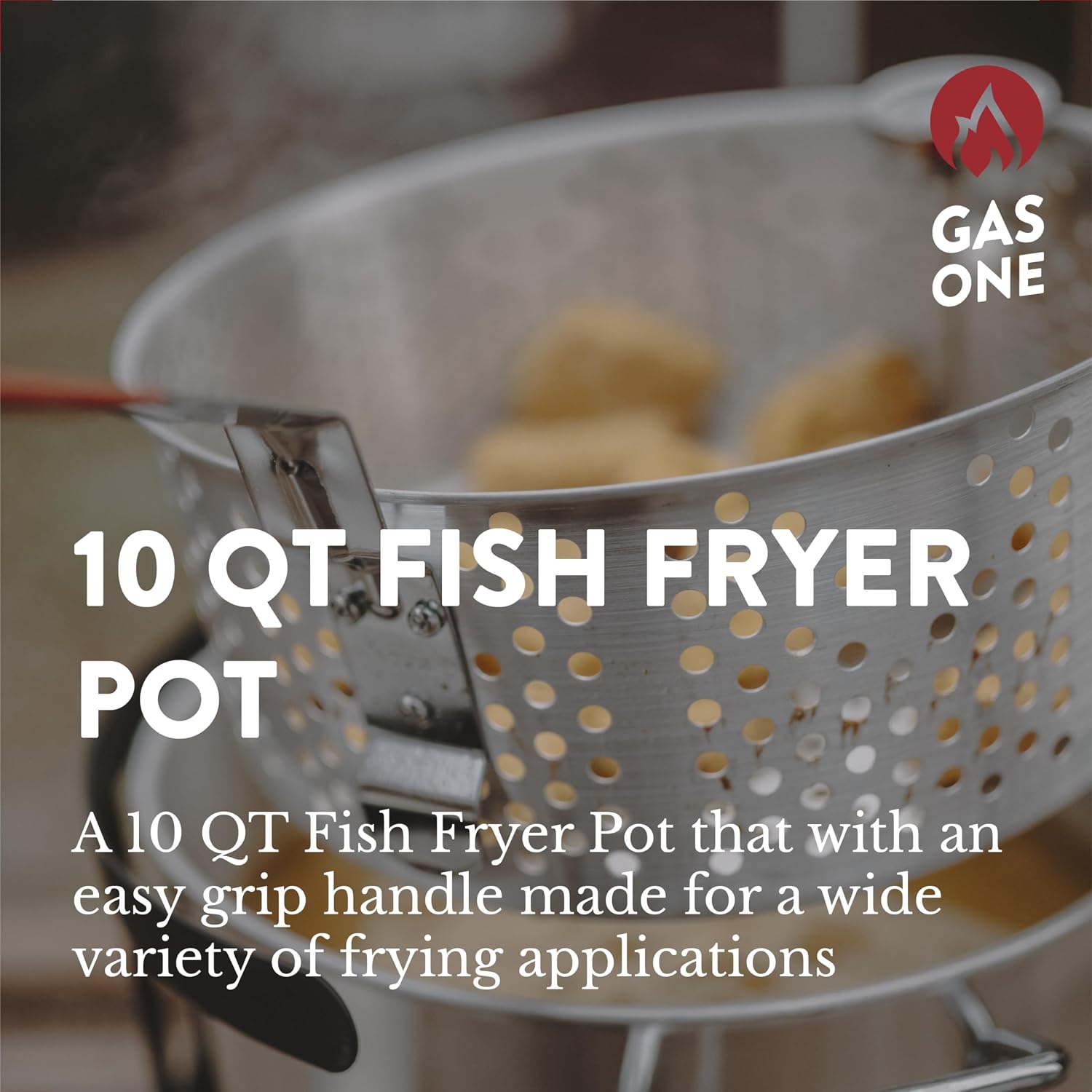
Across aggregated buyer reviews, the Gas One 10QT consistently earns praise for being well-built for its size, genuinely lightweight, and fast to heat on an outdoor propane burner. Reviewers keep coming back to how easy it is to move and clean — a meaningful advantage when outdoor post-fry cleanup with a hose is a real workflow, not a hypothetical.
What buyers actually cook in it: Chicken pieces (thighs, drumsticks, wings), fish fillets, battered shrimp, and small batches of fries. One reviewer’s detail worth flagging: tallow — rendered beef fat — used instead of vegetable oil. This raises a material question worth taking seriously.
Aluminum and animal fats — what the reactivity picture actually looks like: Aluminum reacts with acidic and highly alkaline substances; this is well-documented and is part of why NSF International’s NSF/ANSI 8 standard for food equipment materials distinguishes between acceptable and unacceptable contact scenarios. Animal fats like tallow are neither strongly acidic nor alkaline — they sit in a neutral-to-mildly-acidic range, and there is no established concern about tallow reacting with aluminum under normal frying temperatures (325–375°F). The reactivity concern with aluminum cookware is primarily about prolonged contact with tomato-based, citrus-heavy, or vinegar-based foods. Tallow is not in that category. That said, if you’re running an operation where fat choice cycles between tallow, duck fat, and acidic marinades being dunked in the same pot, aluminum is the wrong long-term material — stainless is the call.
Where the 10QT hits its ceiling: A whole chicken is marginal. A 3.5–4 lb bird might fit, but the basket geometry on most 10QT kits wasn’t designed to orient a whole bird safely — you’re likely to hit the basket walls before the bird is fully submerged. Chicken pieces are the correct use case. Do not attempt a small turkey in a 10QT; the oil fill required to submerge even a 6-lb bird will exceed safe headroom.
The FireRiot 18QT: The Multi-Use Outdoor Setup Most Buyers Don’t Anticipate
The FireRiot 18QT is the most instructive size to analyze because reviewers describe actual behavioral patterns — not just what they bought it for, but what they ended up doing with it. The pattern that emerges from aggregated reviews is genuinely useful: buyers purchase it for a Thanksgiving turkey, then discover the same day that it handles shrimp tempura and vegetables as a follow-on cook after the turkey is done.
That sequence — whole bird first, delicate battered items second — is the real multi-use case for an 18QT outdoor fryer, and most marketing copy never mentions it.
Why the 18QT hits the sweet spot for serious home outdoor cooks:
- An 18QT pot holds enough oil to fully submerge a turkey in the 10–12 lb range without requiring the extreme BTU output that a 30QT demands to bring that oil mass to temperature
- After the turkey fry, the oil is already hot and filtered; a batch of shrimp tempura or battered vegetables goes in within 20 minutes
- The basket on most 18QT kits (typically around 12–13 inches in diameter, 10–11 inches deep based on published product dimensions) is sized to handle a full turkey pouch-lowered on the hook, but also works as a conventional fry basket for smaller items when the hook is locked
The basket security question for whole-bird frying: Reviewers describe the FireRiot 18QT basket as secure enough for turkey lowering when the hook is properly seated — but this is a load-bearing operation and the language in those reviews is “felt secure,” not engineered-load-rated. For a 12-pound turkey submerged in 350°F oil, you are handling roughly 14–15 lbs of combined load on a hook-and-basket assembly. Serious Eats’ turkey fryer equipment overview recommends checking that the hook is fully locked and using two-person lowering for any bird over 10 lbs. That guidance applies here.
The tempura and vegetable use case: Battered foods and vegetables behave differently than whole birds in an 18QT. The basket works conventionally — food loads into the basket before or after it’s submerged, and the mesh (typically 3/8” to 1/2” wire grid on outdoor aluminum kits) retains battered shrimp without significant fallthrough. One reviewer’s description of using the 18QT for shrimp tempura and vegetables after a Thanksgiving turkey fry is worth taking seriously as a buying signal: this is a genuinely versatile pot for the serious outdoor cook who fries more than once a year.
The CHARD 30QT: When You’re Lifting, Not Frying
Here’s the honest read on the CHARD 30QT based on aggregated buyer reviews: the basket is being used as a strainer and lifter more than as a traditional fry basket. Reviews almost uniformly describe it as “great for turkey” and “perfect for the boil.” The boil context matters — crawfish boils, shrimp boils, and low-country boils all use the basket to dump large quantities of seafood, corn, and potatoes into boiling water and then lift the entire load out to drain and serve.
That is a fundamentally different mechanical role than a fry basket. In a boil application, the basket doesn’t need to seal against oil surface tension or prevent small battered pieces from falling through; it needs to hold volume and drain fast. The CHARD 30QT basket performs that function well, per reviewer consensus.
Where it works as a fryer: A 30QT pot is the correct size for a 16–20 lb turkey — the birds that simply don’t fit in an 18QT. The tradeoff is oil volume: a 30QT properly filled to safe depth for a large turkey requires 4–5 gallons of oil. At current retail pricing for frying oil (mid-2026), that’s a meaningful line item. Serious outdoor fryers who cook large birds annually typically reuse filtered oil 2–3 times, which amortizes the cost.
The basket-versus-turkey-rack distinction: A fry basket lowers food into oil and retrieves it via a handle or hook. A turkey rack (sometimes called a turkey stand or poultry rack) holds the bird upright on a vertical spike and is lowered by a separate hook attached to the rack’s top loop. In a 30QT pot, the turkey rack is the correct tool for a whole bird — the basket at this size is typically too wide to orient a turkey efficiently for full submersion. Restaurant Business Online’s coverage of portable outdoor fryer use in foodservice notes that basket-versus-rack confusion is one of the most common sources of both undercooking and oil-overflow incidents.
Frequently Asked Questions
Is the 10QT Gas One pot big enough to fry a whole chicken or just pieces? Chicken pieces are the safe, practical answer. A whole 3–4 lb bird is borderline — it may fit geometrically, but the basket geometry on most 10QT kits makes secure orientation difficult, and the oil fill required to fully submerge it leaves minimal headroom. Pieces are the intended use case and produce better results.
Can I use tallow instead of vegetable oil in an aluminum fry pot safely? Yes. Tallow is a neutral animal fat with no meaningful reactivity against aluminum at normal frying temperatures. The aluminum reactivity concern applies to acidic foods (citrus, tomatoes, vinegar) — not to animal fats. There are no established food-safety concerns with tallow in aluminum outdoor pots based on publicly available food equipment material standards, including NSF/ANSI 8.
Does the FireRiot 18QT basket fit securely enough to lower a full turkey safely? Reviewers describe it as secure when the hook is properly seated. For any bird over 10 lbs, use two-person lowering and confirm the hook is fully locked before the basket enters the oil — a practice Serious Eats’ turkey fryer guide consistently recommends regardless of brand.
What’s the difference between using a fry basket and a turkey rack in a 30QT pot? A fry basket holds food in a wire container and lifts it out horizontally. A turkey rack holds the bird vertically on a spike and lowers via a top hook. For whole turkeys in a 30QT, the rack provides better oil circulation around the bird and is the appropriate tool; the basket at that scale is better suited to boil applications or large seafood batches.
Do aluminum outdoor pots work on indoor gas ranges or only on propane burners? Most outdoor aluminum fry kits are designed for high-BTU propane burner stands and are physically too large for standard residential range grates. Cook’s Illustrated’s deep-frying equipment notes flag that residential indoor gas ranges are not rated for the BTU output or pot sizes required for whole-turkey frying, and the fire risk from indoor oil frying at that scale is significant. These kits belong outdoors.
How do I keep my outdoor fry pot stable on uneven ground while frying? Use a level surface whenever possible — a concrete patio or driveway pad is the standard recommendation. For uneven ground, propane burner stands with adjustable legs (available on several outdoor fryer kits) allow leveling before the oil is added. Never adjust a stand after oil is in the pot. Food and Wine’s turkey-frying safety guide recommends checking the pot’s level with a bubble level before lighting the burner, and keeping a 10-foot clearance from structures, decks, and overhead.
The Decision Rule
If you’re choosing between these three sizes, the logic is straightforward:
- 10QT → chicken pieces, fish, shrimp batches, small outdoor fry sessions. Fast to heat, easy to move, genuinely easy to clean. Not a whole-bird tool.
- 18QT → your highest-value size if you fry a turkey once or twice a year and want the same pot to handle smaller fry jobs on the same day. The FireRiot’s multi-use reviewer behavior is the honest buying signal here.
- 30QT → whole large turkeys (14 lbs and up) and boil applications where you’re lifting volume, not frying batches. Budget for oil volume and understand that the basket at this scale is a lifter, not a traditional fry basket.
The “turkey fryer” label on a lot of these kits is doing real damage to buyer expectations. A pot sold as a turkey fryer will fry a turkey — but whether the basket is the right tool for everything else you want to cook depends entirely on which size you buy and how you understand the geometry before the oil goes in.