If your commercial fryer basket just failed — bent hooks, rust blooming through the coating, mesh collapsing under load — the first question you probably asked was “what is this thing even made of?” That’s the right question, and the answer is less obvious than it should be. Most commercial fry baskets fall into two broad material categories: nickel-plated iron (a steel or iron wire form coated in a thin layer of nickel) and stainless steel (an alloy that resists corrosion throughout its entire thickness). Both can look identical in a product photo. Both get sold under the word “commercial.” The difference in real-world lifespan — and in what they cost you when they fail during a Friday-night rush — is significant. This guide breaks down how each material is made, where each one earns its place, and how to read a spec sheet well enough to know which basket you’re actually ordering.
| EDITOR'S PICKClivia's 4PCS Commercial Fryer… | Mid-tier2PCS Deep Fryer Basket With Non… | Budget pick2Pcs Deep Fry Basket - 13.2"x 6… | |
|---|---|---|---|
| Material | Stainless steel | Nickel plated iron | Stainless steel |
| Basket size | 13 x 6.5 x 6 in | 13 1/4 x 6.5 x 6 in | 13.2 x 6.5 x 5.9 in |
| Count included | 4 | 2 | 2 |
| Handle | Non-slip long handle | Non-slip | With handle |
| Price | $95.59 | $52.29 | $49.66 |
| See on Amazon → | See on Amazon → | See on Amazon → |
How These Two Materials Are Actually Constructed
Understanding the tradeoff starts with understanding the manufacturing process, because that process determines exactly where each material will fail.
Nickel-Plated Iron: A Coating, Not an Alloy
Nickel-plated iron baskets start as iron or low-carbon steel wire, formed into the basket shape — handle, frame, mesh — and then electroplated with a layer of nickel. The nickel layer is thin, typically measured in microns. The whole point is that nickel is harder and more corrosion-resistant than bare iron, so you get a basket that looks polished, resists light oxidation, and costs less to produce than a full stainless fabrication. The problem is structural: the nickel is a coating, not the base material. Once that coating is scratched, chipped at weld points, or worn through by repeated contact with fryer baskets, wire racks, and drain pans, the underlying iron is exposed — and iron in a high-moisture, high-acid frying environment corrodes fast.
The WebstaurantStore Blog, in its guide “How to Choose a Commercial Fryer Basket,” explicitly flags this failure mode, noting that chipping at welded joints is the most common point of coating failure on plated baskets. That observation lines up with what operators consistently report after running plated baskets in high-volume conditions.
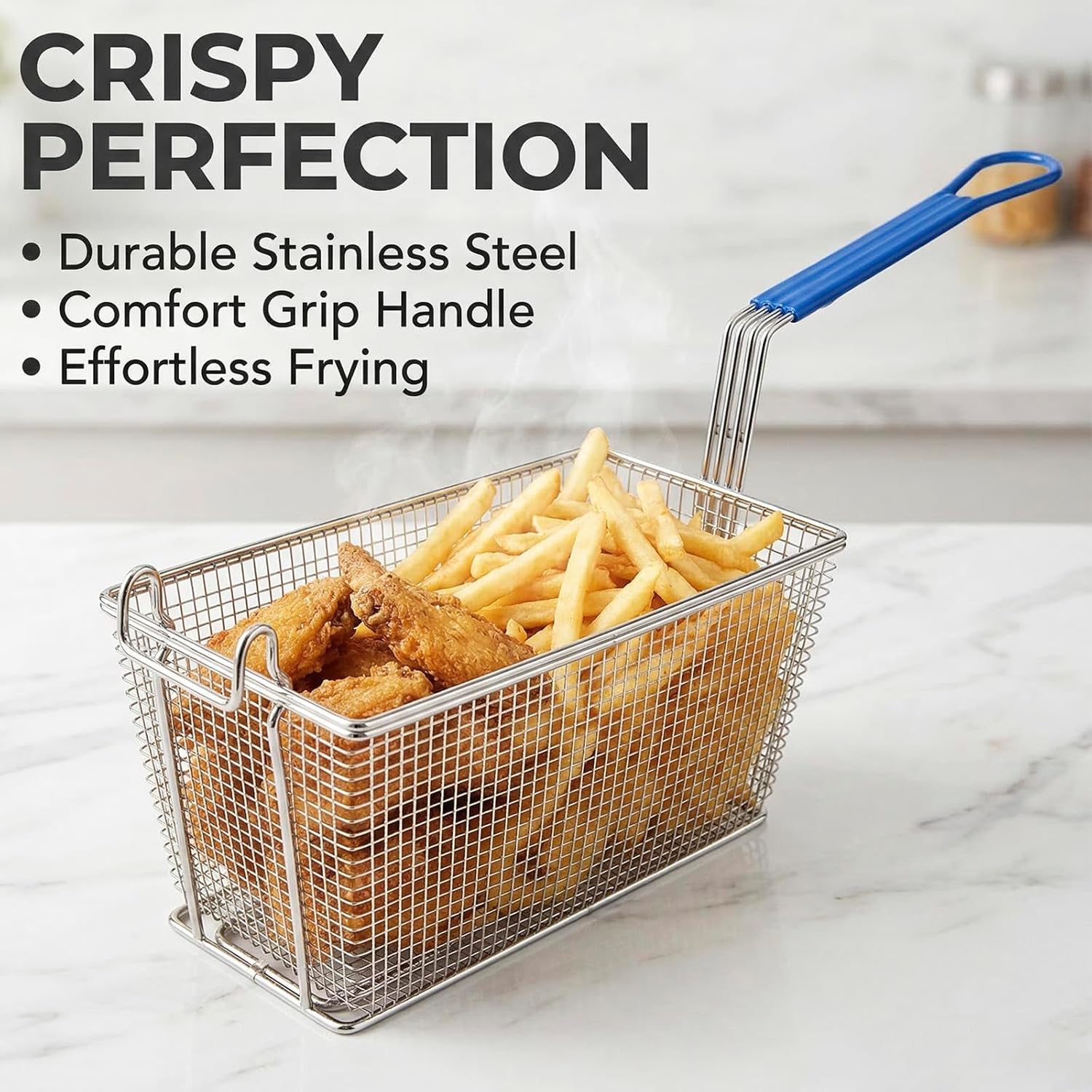
2Pcs
$49.66
In stock on Amazon
Check price on AmazonStainless Steel: Corrosion Resistance Through the Full Cross-Section
Stainless steel baskets — the real ones — are constructed from wire or sheet stock that is corrosion-resistant through its full cross-section. The corrosion resistance comes from chromium content (at least 10.5% by mass in any alloy that qualifies as stainless) that forms a passive oxide layer on the surface. Even if the surface is scratched, the chromium in the underlying metal re-forms that protective layer. The two grades you’ll encounter in commercial fry baskets are 304 stainless (also written 18/8, meaning roughly 18% chromium and 8% nickel in the alloy) and 201 stainless (a lower-cost variant with reduced nickel content and higher manganese). This distinction matters and we’ll get to it — because some suppliers sell 201 as though it were 304, and operators don’t discover the difference until corrosion appears.
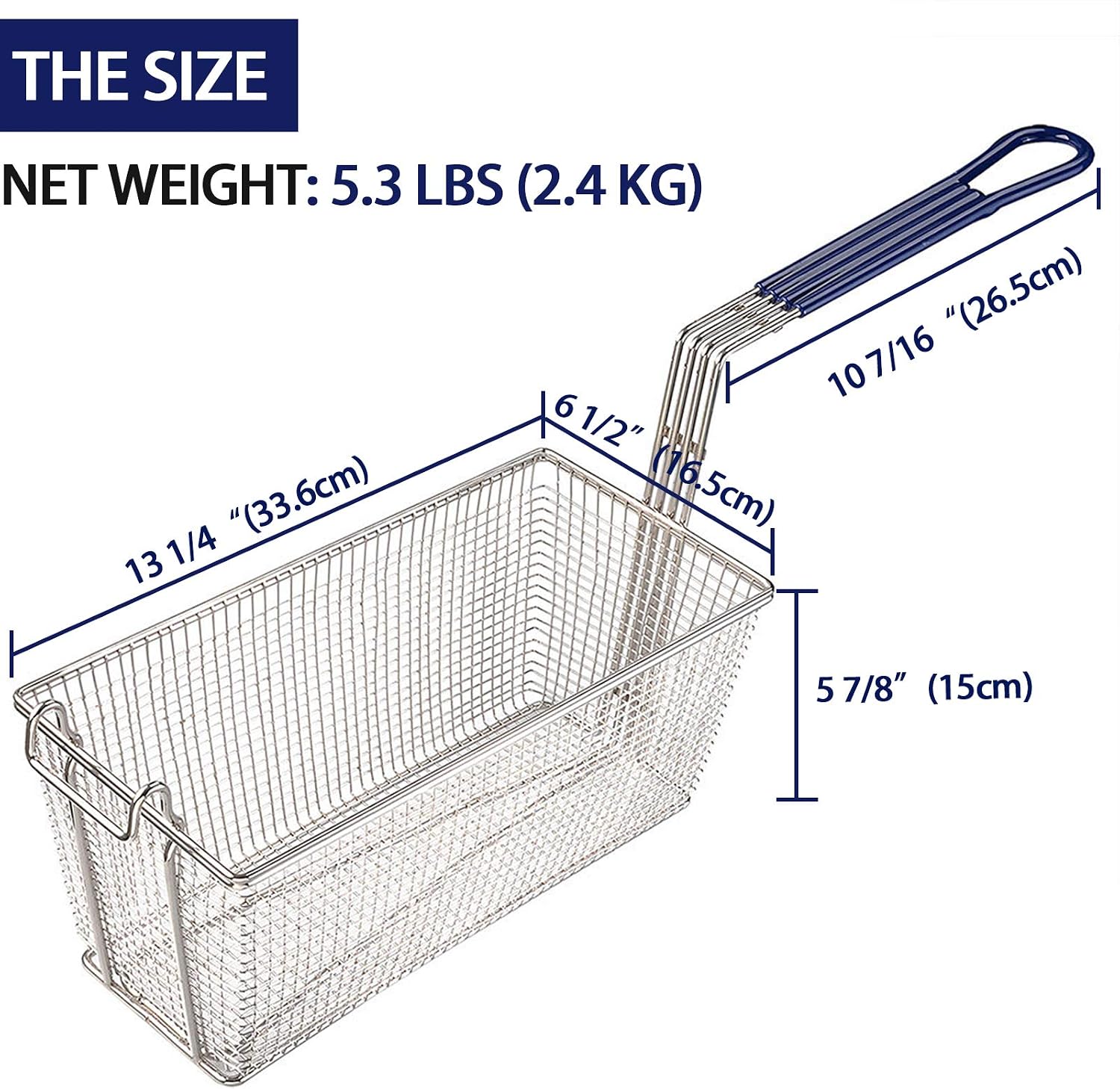
2PCS
$52.29
In stock on Amazon
Check price on AmazonChrome-Plated Steel: Rule It Out Immediately
There is a third category worth naming so you don’t confuse it with the above: chrome-plated steel, which appears on some very low-cost baskets and is even less durable than nickel plating. If you’re sourcing for a commercial operation, you can eliminate this category from consideration at the outset. No credible foodservice equipment supplier recommends it for continuous commercial use.
2Pcs
$49.66
In stock on Amazon
Check price on AmazonWhere Each Material Earns Its Place
This is where the decision frame gets practical. Nickel-plated baskets are not inherently wrong — they’re context-dependent.
The Case for Nickel-Plated in Lower-Volume Operations
In lower-volume operations with moderate fryer temperatures (325–350°F), gentle handling, and shorter basket lifecycles by design, nickel-plated baskets remain a legitimate budget option. They’re widely available, they fit many OEM fryer configurations, and their upfront cost is meaningfully lower. The KaTom Restaurant Supply Blog’s “Commercial Fryer Basket Buying Guide” notes that nickel-plated baskets typically run 30–50% less per unit than equivalent stainless configurations at the same mesh density. If your operation cycles baskets on a planned 6-month replacement schedule and you’re working with a tight equipment budget, the math can work.
2Pcs
$49.66
In stock on Amazon
Check price on AmazonWhere Nickel-Plated Fails the High-Volume Operator
High-volume operations — food trucks running continuous cycles, ghost kitchens with 10-plus hour fry days, restaurant lines doing 200-plus covers — generate conditions that accelerate coating failure: repeated thermal cycling, constant contact with other metal equipment, and cleaning with alkaline degreasers that can compromise plating at weld points. Restaurant Business Online’s reporting on foodservice equipment maintenance costs notes that operators frequently undercount the labor cost of mid-service basket failures — which is exactly the scenario nickel-plated baskets make most likely.
The NSF/ANSI 2 standard (published by NSF International as its food equipment certification) is worth understanding in this context. NSF certification on a basket certifies that the basket is constructed of food-safe materials and is cleanable to a specified standard — it does not certify material longevity or that a plated basket will maintain its coating integrity over a defined service life. A nickel-plated basket can be NSF-listed. So can a 304 stainless basket. NSF listing alone doesn’t tell you which material you have.
2PCS
$52.29
In stock on Amazon
Check price on AmazonOEM 304 Stainless for High-Volume and Compliance-Required Operations
For operations running more than 6 hours of fry time per day, or operating under any health code or franchise standard requiring documented equipment compliance, OEM 304 stainless is the defensible choice. The Pitco Frialator OEM Parts Catalog specifies 304 stainless for its OEM basket line and publishes gauge thickness for each model-specific basket. That specificity is part of what you’re paying for with OEM: when you match a Pitco basket to a Pitco fryer, you know exactly what gauge wire, what mesh opening, and what alloy you’re getting. When you source an aftermarket basket advertised as “fits Pitco SGH50,” you’re relying on the supplier’s claimed specs — and those claims are inconsistently verified.
Foodservice Equipment Reports, in its feature “Aftermarket Parts: When the Price Is Right and When It Isn’t,” noted that grade ambiguity is one of the most consistent complaints from operators who sourced off-brand replacement baskets — the basket looked right, fit the fryer, and then showed surface rust within a year.
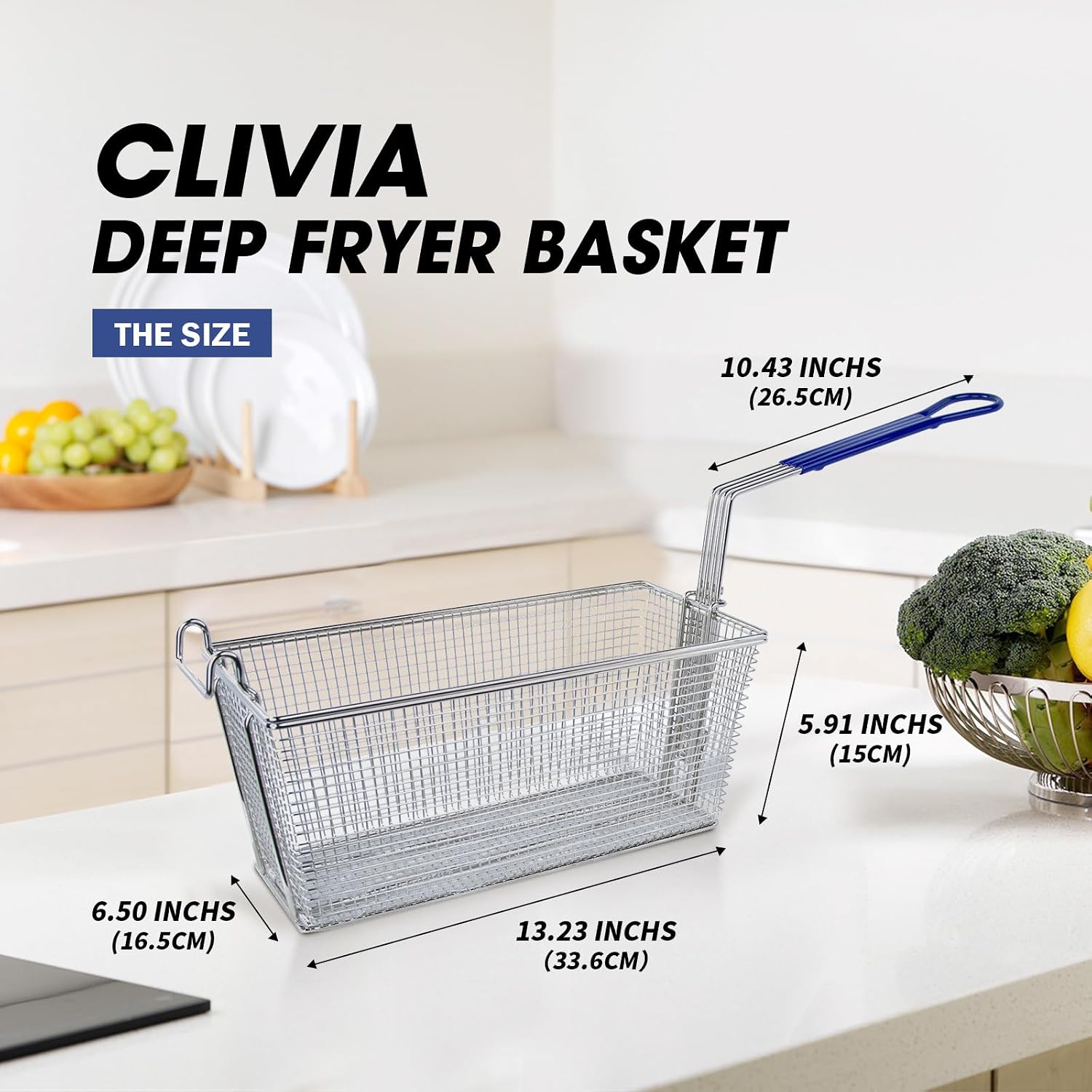
Clivia's
$95.59
In stock on Amazon
Check price on AmazonReading the Spec Sheet: 304 vs. 201 vs. Nickel-Plated, by the Numbers
The comparison table below aggregates basket pricing across major foodservice distributors as of mid-2026. OEM baskets from Pitco, Frymaster, Vulcan, and Manitowoc sit at the upper end or above these ranges for their certified-fit SKUs.
| Material | Chromium Content | Nickel Content | Typical Price Range (2026) | Expected Life (High-Volume) |
|---|---|---|---|---|
| Nickel-plated iron | N/A (coating) | Surface only | $18–$55 | 3–9 months |
| 201 Stainless | ~16–18% | ~3.5–5.5% | $35–$90 | 12–24 months |
| 304 Stainless | ~18–20% | ~8–10.5% | $55–$250+ | 3–7+ years |
The spec-sheet tell for 201 vs. 304 is the alloy designation itself — look for “304,” “18/8,” or “AISI 304” in the product listing. If the listing says “stainless steel” without specifying grade, assume 201 until proven otherwise. The KaTom Restaurant Supply Blog’s buying guide recommends treating any aftermarket basket that cannot supply a grade specification as a nickel-plated basket in terms of replacement budget — meaning plan to replace it sooner. That’s a reasonable working heuristic.
The OEM vs. Aftermarket Decision, Through the Material Lens
Most operators arrive at this decision when an OEM basket fails and sticker shock from the replacement price sends them searching for alternatives. Here’s the decision frame as cleanly as possible.
When to Pay OEM Price
- You’re running a high-volume commercial operation where basket failure costs you more in downtime than the price differential between OEM and aftermarket
- The fryer model has tight tolerance specs — older Frymaster and Vulcan units in particular have basket dimensions that don’t tolerate much variance without affecting drain and load behavior
- You need to maintain NSF compliance documentation for a health inspection or franchise audit — OEM baskets from major manufacturers come with traceable documentation that aftermarket baskets often don’t
Clivia's
$95.59
In stock on Amazon
Check price on AmazonWhen Aftermarket Is Defensible
- The supplier publishes explicit material specs: 304 stainless, gauge thickness in millimeters or wire diameter, and ideally a factory certification or mill certificate available on request
- You’re sourcing for a lower-volume or back-up operation where extended service life is less critical
- The aftermarket basket is demonstrably spec-matched to the OEM dimensions, not just described as “compatible” in marketing copy
2PCS
$52.29
In stock on Amazon
Check price on AmazonWhen to Walk Away From a Listing Entirely
If a listing says “commercial stainless steel fry basket” with no grade designation, no gauge specification, and a price that sits below the 201 stainless floor in the table above, that listing is almost certainly describing a nickel-plated basket or an unverified 201 alloy. The WebstaurantStore Blog’s fryer basket guide recommends confirming material grade with the supplier directly before ordering in commercial quantities — if the supplier cannot answer “304 or 201?” then you have your answer.
2Pcs
$49.66
In stock on Amazon
Check price on AmazonThe Material Mismatch That Actually Costs You
Here’s the real-world scenario operators consistently describe: an operator specs what they believe is a 304 stainless replacement basket based on a product listing, receives a basket that has a convincing stainless appearance, runs it for six to eight months, and then finds surface rust at the weld joints and along the handle attachment. The basket gets pulled. They’ve spent $60–$90 on a basket that lasted less than a year in a role where a genuine 304 basket would have run 3–5 years.
The cost isn’t just the basket. It’s the labor of mid-service troubleshooting when a corroded basket starts shedding particles into oil. It’s the oil change triggered by contamination concerns. It’s the health inspection risk if a corroded basket is flagged during a routine inspection — a risk that NSF International’s NSF/ANSI 2 food equipment standard addresses by requiring smooth, non-corrosive, non-porous surfaces for food-contact equipment, but which depends entirely on the integrity of the supplier’s certification rather than per-basket verification at point of sale.
Restaurant Business Online’s coverage of foodservice equipment maintenance costs frames this well: the hidden cost of low-specification equipment is rarely the purchase price itself — it’s the downstream labor, oil waste, and compliance exposure that accumulates before the operator connects those costs back to the original sourcing decision.
The Decision Rule
If your operation runs more than 6 hours of fry time per day, sources commercial quantities of oil, or operates under any health code or franchise standard requiring documented equipment compliance: specify 304 stainless with gauge confirmation, pay OEM or source from a supplier who can produce mill documentation, and budget accordingly.
If you’re running a lower-volume operation, replacing a basket for a home-adjacent commercial setup, or working within a tight capital budget where planned replacement is already accounted for: nickel-plated is serviceable if you source from a supplier who calls it what it is, price your replacement cycle honestly, and don’t run it past first signs of coating wear.
The worst outcome is not buying nickel-plated on purpose. It’s buying what you believe is 304 stainless because the listing didn’t specify otherwise — and finding out you were wrong when the rust appears. Ask for the grade. If the supplier can’t tell you, that’s the answer.