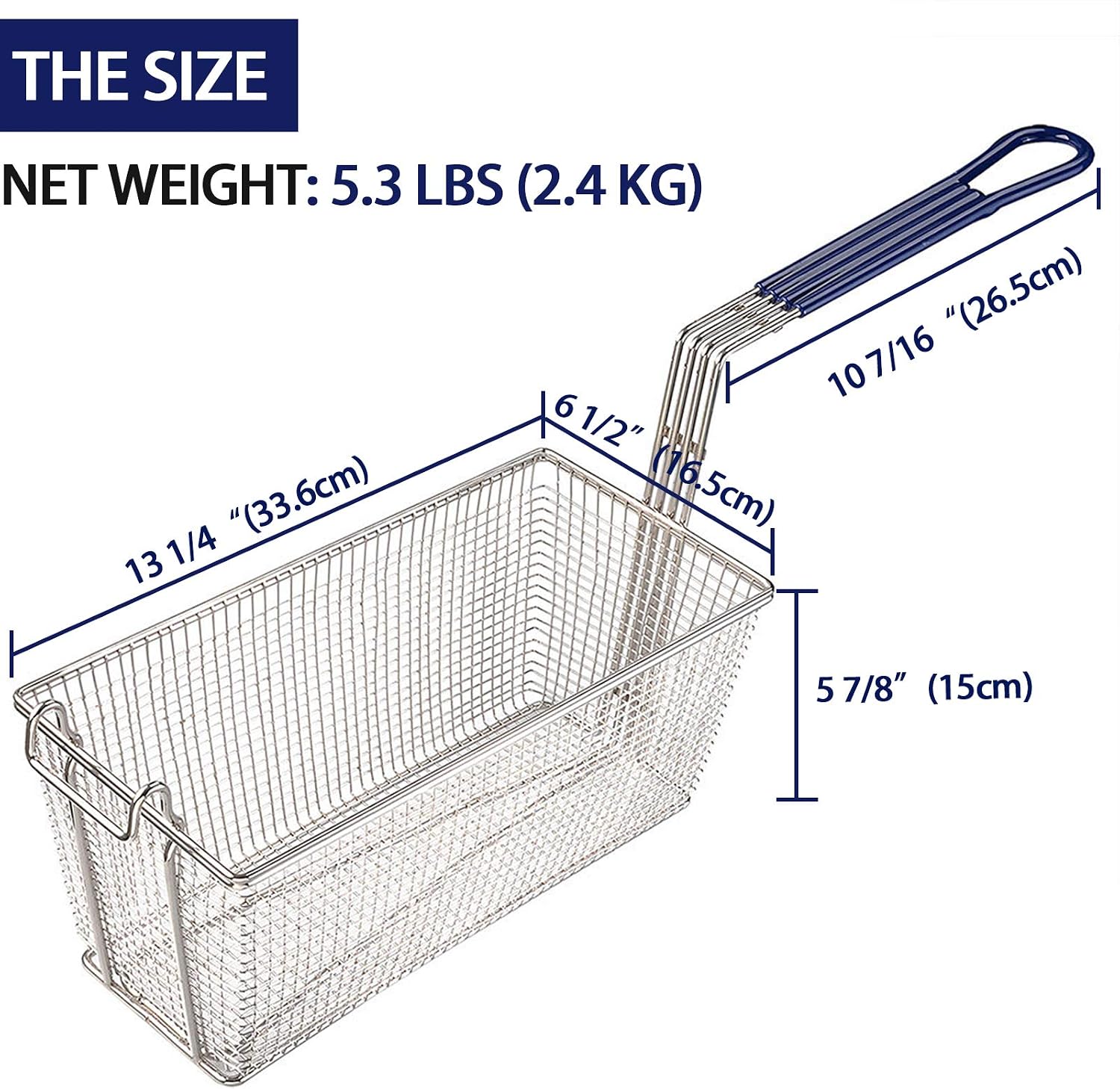
If the basket that came with your home fryer just snapped at the handle weld or is starting to shed rust-colored flakes into your oil, you are not alone — and the replacement market is full of options that look identical but behave very differently. A fry basket is the wire-mesh insert that holds food in hot oil and lifts it back out; the material it’s made from determines how long it survives repeated heat cycling, how safe it is in contact with food, and whether it will survive the commercial kitchen conditions that the marketing copy implies. This guide is for anyone standing at the fork between a $15 “commercial-style” basket and a $40–$80 alternative, trying to figure out whether the price gap reflects real material differences or just a different logo on the handle. We’ll walk through the stainless-versus-nickel-plated distinction, the weld-failure pattern that shows up repeatedly in long-term owner reviews, the fit question for Vulcan, Dean, and Pitco fryers, and the practical decision rules that let you buy once instead of twice.
| EDITOR'S PICKDeep Fryer Basket | Mid-tierWinco Green Fry Basket Handle | Budget pickKing Kooker Turkey Rack and Lif… | |
|---|---|---|---|
| Pack count | 2 | — | — |
| Basket size | 13.25" x 6.5" x 5.9" | — | — |
| Handle color | Blue | Green | — |
| Handle size | — | Medium | — |
| Finish | — | — | Chrome |
| Price | $54.99 | $27.58 | $19.99 |
| See on Amazon → | See on Amazon → | See on Amazon → |
Stainless Steel vs. Nickel-Plated Iron: Why the Label Isn’t Enough
The single most consequential thing to understand about this product category is that “stainless steel” and “nickel-plated iron” are not interchangeable, but they are frequently sold as if they were. Nickel plating is a thin electrochemical coating applied over a base metal — usually low-carbon steel or iron — to give the basket a bright, corrosion-resistant appearance. It looks, at a glance, nearly identical to brushed 304 stainless. The problem is that the coating is only as durable as the base metal underneath it, and once the plating chips, scratches, or wears through at stress points (which are almost always the welds), the underlying iron is exposed directly to hot oil, water, and acidic marinades.
Multiple aggregated reviewer threads on baskets marketed as stainless make this exact complaint explicit: buyers receive a basket that passes a casual visual inspection but fails a magnet test (a strong magnet will cling firmly to iron and most carbon steels; genuine 304 stainless is non-magnetic or only weakly magnetic). One reviewer of a widely sold nickel-plated iron set noted that “small welded pieces break off over time” — a textbook symptom of brittle nickel plating at a heat-stressed weld joint — though the reviewer added that, oddly, the basket retained its structural integrity after the fragments broke away. That may be reassuring for short-term function, but the fragments themselves represent a food-safety concern that is hard to dismiss.
The NSF International NSF/ANSI 8 standard for commercial food equipment requires materials in contact with food to be non-toxic, corrosion-resistant, and non-absorbent. Nickel-plated iron, once the plating breaches, does not reliably satisfy the corrosion-resistance requirement. NSF-certified baskets — a designation you can verify against NSF International’s online listings database — will specify the alloy in their certification documentation. If a seller cannot provide NSF certification or a material spec sheet, that absence is itself a data point.
Quick identification protocol before you buy:
- Run a strong rare-earth magnet across the mesh and the handle weld. Firm magnetic attraction = iron or carbon steel base, regardless of surface finish.
- Examine the weld points with a flashlight. Nickel plating tends to show micro-cracking or a slightly different sheen at welds because the plating process is less uniform at fillet joints.
- Check the product listing for alloy designation. “Stainless steel” without a grade number (304, 316, 201) is a marketing claim, not a material specification. 201 stainless, which is sold widely as an economy alternative, has significantly lower nickel content than 304 and corrodes more readily in acid and salt environments — Serious Eats’ fryer equipment notes flag this distinction when evaluating basket longevity.
The Weld-Failure Pattern: What’s Actually Breaking and Why
Weld failure is the dominant failure mode in this product category, and it is not random. It clusters at two locations: the junction between the handle and the basket frame, and the intersection points in the wire mesh itself. Understanding why helps you predict which baskets will fail and when.
Fry baskets cycle from ambient temperature to 325–375 °F (163–190 °C) and back, sometimes dozens of times per service. Every cycle creates differential thermal expansion between the wire intersections and their spot-welds. In a well-constructed basket made from a consistent alloy, the expansion coefficients are matched and the welds flex in a controlled way. In a basket where the frame is a different alloy or gauge than the mesh wires, or where the welds were made quickly at low heat to reduce production cost, that differential stress accumulates until the joint fails.
One long-term owner of a four-basket Clivia-branded set reported that all four baskets eventually broke at the weld points and required rewelding at approximately $20 per basket — a repair cost that, annualized over a year of use, nearly equals the original purchase price of the set. Restaurant Business Online’s equipment maintenance coverage identifies this pattern as common in import baskets that use mixed-gauge wire and spot-welded (rather than resistance-welded or brazed) construction. The difference is not always visible from a product photo.
By the numbers — weld failure risk factors:
| Risk factor | Lower-risk basket | Higher-risk basket |
|---|---|---|
| Frame-to-mesh material match | Same alloy and gauge | Mixed gauges, unknown alloys |
| Weld type | Resistance-welded or brazed | Spot-welded, visible flux residue |
| Gauge at handle junction | ≥ 4.0 mm rod | < 3.0 mm rod |
| NSF certification | Present, verifiable | Absent or unverifiable |
Food Service Equipment Reports’ procurement guide notes that OEM replacement baskets from Pitco, Vulcan, and Frymaster use resistance-welded construction and are spec’d to the fryer’s thermal cycling profile — which is a primary reason operators in high-volume environments tend to return to OEM sources despite the price premium, rather than cycling through aftermarket replacements every 12–18 months.
Fit Compatibility: Will a Standard 13.25” × 6.5” Basket Actually Work in Your Fryer?
The 13.25” × 6.5” external dimension is the closest thing the aftermarket has to a universal commercial basket standard. It fits a meaningful percentage of full-size commercial floor fryers, and one owner of a Vulcan fryer confirmed in a long-run review that an aftermarket basket at this dimension seated correctly in the top mounting rack. But “fits the rack” and “is drop-in compatible” are not the same thing.
Commercial fryers from Vulcan, Dean (now part of the Welbilt portfolio), Pitco, and Frymaster each have slightly different hang-tab geometries, rack-rail spacing, and basket-depth requirements that vary by model series, not just by brand. A Pitco SG14 takes a different basket profile than a Pitco SSH55 despite both being Pitco fryers. The practical approach for operators or serious home users is to cross-reference the fryer’s model number against the manufacturer’s published replacement parts list before ordering. Vulcan’s published equipment documentation and Pitco’s OEM parts catalog both list basket dimensions by model, and Food Service Equipment Reports’ compatibility guide recommends treating the model-specific spec sheet as the authoritative source rather than aftermarket listing claims.
For prosumer countertop fryers — Waring, Cuisinart Pro, and similar commercial-adjacent units — the dimensional variability is even higher, because these fryers are not built to a shared industry standard. Reviewers across multiple product categories consistently flag the experience of ordering a “universal” basket only to find the hang-tab hits the rail at the wrong angle or the basket sits 0.5” too high to close the fryer lid. The safest path is to measure the internal pot dimensions and the rail-to-rail distance of your fryer’s mounting rack before purchasing any aftermarket basket.
Handle Assembly: The Detail Nobody Mentions Until It’s Frustrating
A recurring surprise in buyer reviews of commercial-style baskets — including several at the nickel-plated and economy stainless price points — is that the handles are not pre-attached. The baskets ship flat or nested, with the handle packed separately. One reviewer noted genuine surprise at having to assemble the handle, and a second flagged that one handle, once attached, remained “a little wiggly” — suggesting either a tolerance issue in the handle socket or a missing retention clip.
This is worth flagging because a loose or improperly seated handle on a basket loaded with 350 °F oil is a burn hazard, not a minor inconvenience. Before first use, verify that: the handle rod seats fully into both frame loops, any included retention pins or clips are installed, and the handle does not rotate under a firm lateral load. If a basket ships with a handle that wiggles and no retention hardware, contact the seller before using it over hot oil.
Frequently Asked Questions
Will a standard 13.25” × 6.5” commercial basket fit my Vulcan, Dean, or Pitco fryer? Possibly, but model-specific confirmation is required. Cross-reference the fryer’s model number against the manufacturer’s published replacement parts spec. The standard dimension fits many full-size commercial floor fryers, but hang-tab geometry and rack-rail spacing vary by model series. A Vulcan owner confirmed aftermarket fit for one model in a long-run review, but that result does not generalize across all Vulcan series.
How can I tell if a basket is genuinely stainless steel or just nickel-plated iron before I buy? Use a strong magnet: firm attraction indicates iron or carbon steel, not stainless. Request the alloy grade number — 304 and 316 are the commercial food-service standards. “Stainless steel” without a grade number is a marketing claim. Verify NSF certification against NSF International’s listings database if the seller claims it.
How long should a commercial-grade fry basket last under regular home use? A properly spec’d 304 stainless basket with resistance-welded construction should last five or more years under home use, which typically involves far fewer thermal cycles per day than a commercial kitchen. Nickel-plated iron baskets, based on aggregated owner reports, show weld degradation within 12–24 months of regular use.
What causes fry basket weld failures and can they be prevented? Thermal cycling stress at mismatched-gauge or mixed-alloy welds is the primary cause. It cannot be fully prevented in a basket with poor weld construction, but you can reduce the rate by avoiding thermal shock — don’t plunge a very cold, wet basket into hot oil — and by allowing the basket to cool gradually rather than running it under cold water immediately after use.
Do these baskets require any assembly before first use? Many commercial-style baskets, particularly in the $15–$40 range, ship with handles unattached. Confirm that the handle seats fully and does not rotate under load before using the basket over hot oil. If the handle is loose and no retention hardware is included, treat that as a safety issue, not an aesthetic one.
Is there a meaningful performance difference between a $15 and a $40 commercial-style fry basket for home cooking? Yes, but not where you’d necessarily expect it. The cooking performance — how evenly food fries, how well oil drains — is similar between comparably sized mesh baskets. The difference is in material durability and weld integrity. The $15 basket is more likely to be nickel-plated iron with spot-welded construction; the $40 basket is more likely to be 304 stainless with resistance-welded joints. For light, infrequent use, the $15 basket may serve adequately. For regular use or commercial food-service environments, the cost-per-use math favors the higher-spec option once you account for the realistic replacement interval.
The Decision Rule
If you are a home cook frying once or twice a week and your fryer is a standard countertop model, spend at least $35–$40 on a verified 304 stainless basket with an NSF listing you can confirm. The magnet test costs nothing and takes ten seconds. The weld-failure pattern in nickel-plated baskets is consistent enough across aggregated reviews that the $15–$20 savings is almost certainly offset within a year.
If you are a food-truck operator or ghost-kitchen manager running continuous service, aftermarket baskets at the standard 13.25” × 6.5” dimension can be a legitimate cost lever — one food-truck operator rated them highly for commercial food-service use in a long-run review — but model-specific dimensional confirmation against the manufacturer’s published spec is non-negotiable. OEM baskets from Pitco, Vulcan, or Frymaster carry a price premium that is, in most high-volume cases, justified by construction quality and guaranteed fit. If the aftermarket alternative cannot produce a grade-spec’d material certification and an NSF listing, the risk calculus shifts back toward OEM.
The look of a commercial basket is easy to replicate. The construction behind it is not.