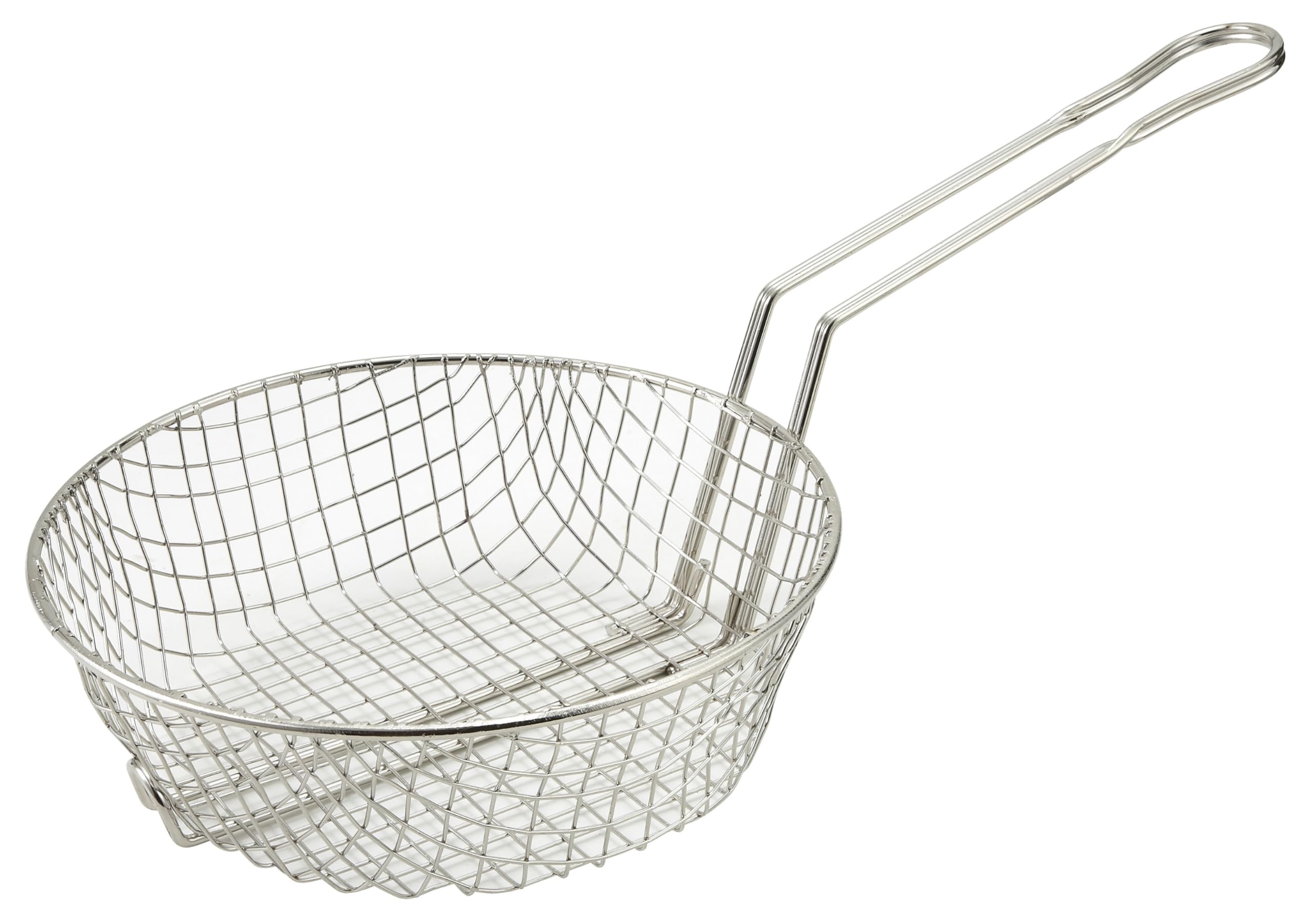
If your fry basket just broke — or you’re staring at a replacement listing and wondering why two baskets that look identical have completely different price tags — the answer is almost always hiding in two numbers: mesh size (how large the gaps between the wires are) and wire gauge (how thick each wire is). Mesh size determines what food can and can’t fall through; wire gauge determines whether the basket survives a commercial kitchen long enough to matter. Get either one wrong and you’re either losing shrimp to the oil or wrestling a warped basket out of the fryer six months from now. This guide works through both variables systematically, draws on what owners and operators have documented across real product reviews, and ends with a plain decision rule: given what you cook, here’s the basket specification you actually want.
| EDITOR'S PICK[Winco Culinary Basket](https://www.amazon.com/dp/B001VZ6ZCA?tag=greenflower20-20) | Mid-tierWinco Culinary Basket | Budget pick[HIC Kitchen Fry Basket](https://www.amazon.com/dp/B007UGLK7O?tag=greenflower20-20) | |
|---|---|---|---|
| Mesh type | Fine | Coarse | — |
| Diameter | 12" | 10" | 7" |
| Material | — | — | 18/8 SS |
| Brand | Winco | Winco | HIC |
| Price | $20.22 | $18.18 | $14.99 |
| See on Amazon → | See on Amazon → | See on Amazon → |
What “Mesh Size” Actually Means — and Why the Number Is Often Misleading
In wire mesh terminology, mesh count (or simply “mesh”) refers to the number of openings per linear inch. A 6-mesh basket has six square openings per inch — each opening roughly 3.5 mm across (the math: 25.4 mm ÷ 6, minus wire diameter). A fine mesh basket might have openings as small as 1–1.5 mm. The larger the mesh number, the smaller each hole — counterintuitive if you think of it like a sieve rating, but important to internalize.
Here’s where it gets practically useful: a verified purchaser of the Winco round 6-mesh basket (documented in aggregated reviews of that product) reports buying it specifically to cool and de-chaff freshly roasted beans — using the 6-mesh opening precisely because chaff falls through while the larger product stays in the basket. That’s a real-world calibration point. If chaff — which is thin, papery, and roughly 2–4 mm — drops through a 6-mesh opening reliably, then any food item smaller than roughly 4 mm is at risk of loss in a 6-mesh fry basket. Practical minimum for coarse-mesh frying: pieces no smaller than a large pea, and ideally larger.
By the numbers — approximate mesh opening sizes:
| Mesh designation | Approx. opening (mm) | Practical minimum food size |
|---|---|---|
| Coarse / 4–6 mesh | 3.5 – 5.5 mm | Whole wings, bone-in pieces, large fries, donuts |
| Medium / 8–10 mesh | 2.0 – 3.0 mm | Shrimp, onion rings, fish fillets, cut fries |
| Fine / 12–16 mesh | 1.0 – 1.8 mm | Small shrimp, calamari rings, breaded items with loose coating |
Manufacturers rarely publish mesh count on consumer-facing listings — which is exactly the problem. “Coarse” and “fine” are marketing categories, not engineering specifications. When a listing calls a basket “coarse mesh” without a number, your fallback is to look at the physical opening in product photos against a known reference (a coin, a ruler), or to rely on documented owner observations like the ones above.
Wire Gauge: The Specification That Determines Long-Term Value
Wire gauge governs structural integrity — how the basket holds up to repeated thermal cycling (going from room temperature into 375°F oil, then out to a drain rack), physical abuse from stacking, and the mechanical stress of handling heavy loads. In wire terminology, lower gauge numbers mean thicker wire: 10-gauge wire is approximately 3.4 mm in diameter and is considered heavy-duty; 16-gauge is roughly 1.6 mm and is the threshold below which baskets start warping under commercial use.
The testimony that lands hardest on this point comes from outside the kitchen entirely. Verified purchasers of the Winco coarse mesh basket have documented using it for garden soil sifting and — in at least one memorable review — archaeology fieldwork, citing its structural integrity and corrosion resistance as the reason it crossed over from kitchen tool to field equipment. That’s not a fringe use case; that’s a structural endorsement. A basket that holds up to gravel and field humidity is a basket that will hold up to repeated commercial fry cycles. Published specs on Winco’s commercial line cite stainless steel construction consistent with 304-grade alloy, which NSF International’s NSF/ANSI 2 Food Equipment Standard identifies as an appropriate material for food-contact surfaces in commercial environments.
The gauge tradeoff in practice: Heavier wire (lower gauge number) means the basket is harder to clean because battered coatings grip textured wire more aggressively. Fine wire, especially in welded intersections, offers less surface area for batter to grab — but it also flexes more and is more vulnerable to being bent out of shape during scraping. Operators in long-run commercial reviews consistently note this tension: heavy-gauge baskets earn their keep over a 2–3 year lifespan, while light-gauge baskets may need replacement within a season under daily commercial use.
For home cooks frying weekly, the gauge floor is 14-gauge stainless. For food-truck or ghost-kitchen operators running multiple fry cycles per service, 12-gauge or heavier is the defensible minimum, and OEM replacements from Pitco, Vulcan, or Frymaster — which publish material specs as part of their parts documentation — are worth the price premium specifically because gauge is verified, not estimated.
The Coarse vs. Fine Decision, Applied to Real Menus
The practical question is rarely “coarse or fine in principle” — it’s “coarse or fine for this specific item.” Here’s how to think through it.
Coarse mesh (4–8 mesh, openings 2.5 mm+): Works for any whole-piece item that won’t slip through the wire: chicken wings, bone-in thighs, whole shrimp (31/40 count and larger), thick-cut steak fries, donuts, and whole fish fillets. Coarse mesh drains faster — larger openings mean oil drops away quickly when you lift the basket — which matters for high-volume operations where every second of drain time is a throughput variable. It’s also easier to clean after breaded items because the openings are large enough to flush clear without a brush getting stuck in the mesh.
Fine mesh (10-mesh and finer, openings under 2.5 mm): Necessary for small-format items: calamari rings, small bay scallops, thinly sliced onion strings, breaded mushrooms, or any item where the coating itself is the structural integrity. Fine mesh also matters when you’re deep-frying battered items at volume and want to capture any coating fragments before they burn in the oil and create off-flavors. Serious Eats’ frying technique guides consistently flag carbonized batter bits as a primary cause of oil degradation — catching them at the basket level extends oil life meaningfully.
The two-basket kitchen strategy: Verified purchaser patterns around the Winco fine mesh 12-inch and Winco coarse 10-inch baskets suggest that buyers frequently acquire both units together — not as a backup-and-primary setup, but as a deliberate two-station strategy. Coarse basket handles the bone-in and large-cut items in one fryer position; fine mesh handles the delicate and small-format items in the other. For operators running a twin-well fryer or a dual-basket countertop unit, this is worth designing around at the procurement stage rather than retrofitting later.
A secondary use case worth noting: Verified buyers of the Lodge cast iron basket describe using it for flour-dusting pre-fry items — shaking pieces in the basket to coat them evenly before lowering into oil. This isn’t a frying application; it’s a prep application. The mesh size on that basket (mid-range, per the product geometry) turns out to be ideal for releasing excess flour while retaining the item. It’s a reminder that mesh specification has value across multiple kitchen stations, not just inside the fryer.
Design Flaws Worth Knowing Before You Buy
The HIC 7-inch basket draws a specific, well-documented complaint in verified purchaser reviews: the hanging bracket — the hook or lip that rests on the pot edge to hold the basket in a draining or blanching position — doesn’t align correctly with standard pot diameters when the basket is nominally sized to fit those pots. The issue is the tapered-sides design. Because the basket narrows toward the bottom, the point at which the bracket contacts the pot rim changes depending on the pot’s wall angle, and on straight-sided or slightly flared pots, the bracket seats at an angle rather than level. The result is a tilting basket that can drop items into the pot or require manual steadying. This is a geometry problem, not a materials problem — and it’s specific to tapered-wall designs in this size class. If you need a basket that self-hangs reliably on a pot for blanching or holding, straight-wall designs with a flat hanging lip are the more reliable configuration. Verified reviewers note it fits best on straight-sided stockpots with a rim diameter close to 7.5 inches; anything with a pronounced outward flare or an inward-angled rim creates the tilt problem.
Frequently Asked Questions
What is the minimum piece size you can fry in a coarse mesh basket without food falling through? Based on the documented 6-mesh calibration — where chaff at 2–4 mm falls through reliably — a safe practical minimum for coarse-mesh frying is roughly 15–20 mm (about three-quarters of an inch) in the smallest dimension. Smaller than that and you’re gambling on piece-to-piece variation. For anything under 20 mm, step down to fine mesh.
What is the difference between 6-mesh and fine mesh in practical terms? A 6-mesh opening is approximately 3.5 mm across. “Fine mesh” in the fry basket category typically means openings of 1–1.8 mm. In practical terms: 6-mesh holds chicken wings easily and lets chaff and very small crumbs fall through; fine mesh holds bay scallops and retains batter fragments. The gap between them is large enough that they serve different menus.
Why does the HIC 7-inch basket tilt when resting on the pot edge? The tapered-sides geometry means the bracket contacts different points on the pot rim depending on the pot’s wall angle. On any pot that isn’t straight-sided with a rim diameter close to the basket’s nominal top measurement, the bracket can’t find a flat, level seat. Reviewers report it fits most reliably on straight-sided stockpots.
Can you use a fry basket for boiling eggs or blanching vegetables without damage? Yes — stainless steel baskets are unaffected by boiling water, and operators frequently use them for blanching. Wire gauge matters here only in the sense that thin-wire baskets may deform under a heavy vegetable load; 14-gauge and heavier handles blanching duty without issue. There’s no material or thermal concern with moving a stainless basket between fry oil and boiling water applications.
Does wire gauge affect how easily a basket cleans after frying battered foods? It does. Heavier wire has more surface area per intersection, which gives batter more to grip. Fine wire tends to release batter more easily — but fine-wire baskets are also more vulnerable to damage from aggressive scraping. The pragmatic middle ground for battered-item cleanup is soaking the basket in hot water immediately after service, before the coating fully sets, regardless of gauge.
Is a fine mesh basket worth it for french fries or does coarse mesh work just as well? Coarse mesh works well for cut fries at standard sizes (at least 8 mm thick). For shoestring fries or any cut under 6 mm, fine mesh prevents the thinner pieces from threading through the gaps and dropping into the oil. If your menu runs both cut sizes, the two-basket strategy described above is the efficient answer.
If X, then Y — the decision rule: If you primarily fry whole pieces, large cuts, or anything you can hold between two fingers without it slipping through, a coarse-mesh heavy-gauge basket is the right specification. If your menu runs small-format, breaded, or delicate items — or if oil quality over a long service period matters to your operation — fine mesh is worth the procurement decision. If you run both, buy both deliberately and assign them to stations. That’s not redundancy; that’s a system.