If your deep fryer basket just gave up on you, you’ve probably also noticed something else: your oil is dark, foamy, and smells like last Tuesday’s fish. That’s where built-in oil filtration comes in — or at least where fryer brands say it does. Oil filtration, in plain terms, is any mechanism that strains used frying oil to remove burned food particles and moisture so the oil lasts longer between changes. Some countertop home fryers include a drain-and-filter system built right into the unit. Others leave that job entirely to you and a paper towel. This article is for buyers actively weighing whether to pay more for filtration or build a smarter workaround — and who want honest numbers, not marketing copy, to make that call.
What “Built-In Filtration” Actually Means (and Doesn’t)
The phrase “filters oil” earns a lot of real estate on box copy and product titles. Before you weight it heavily, it’s worth understanding what the mechanism actually does at a spec level.
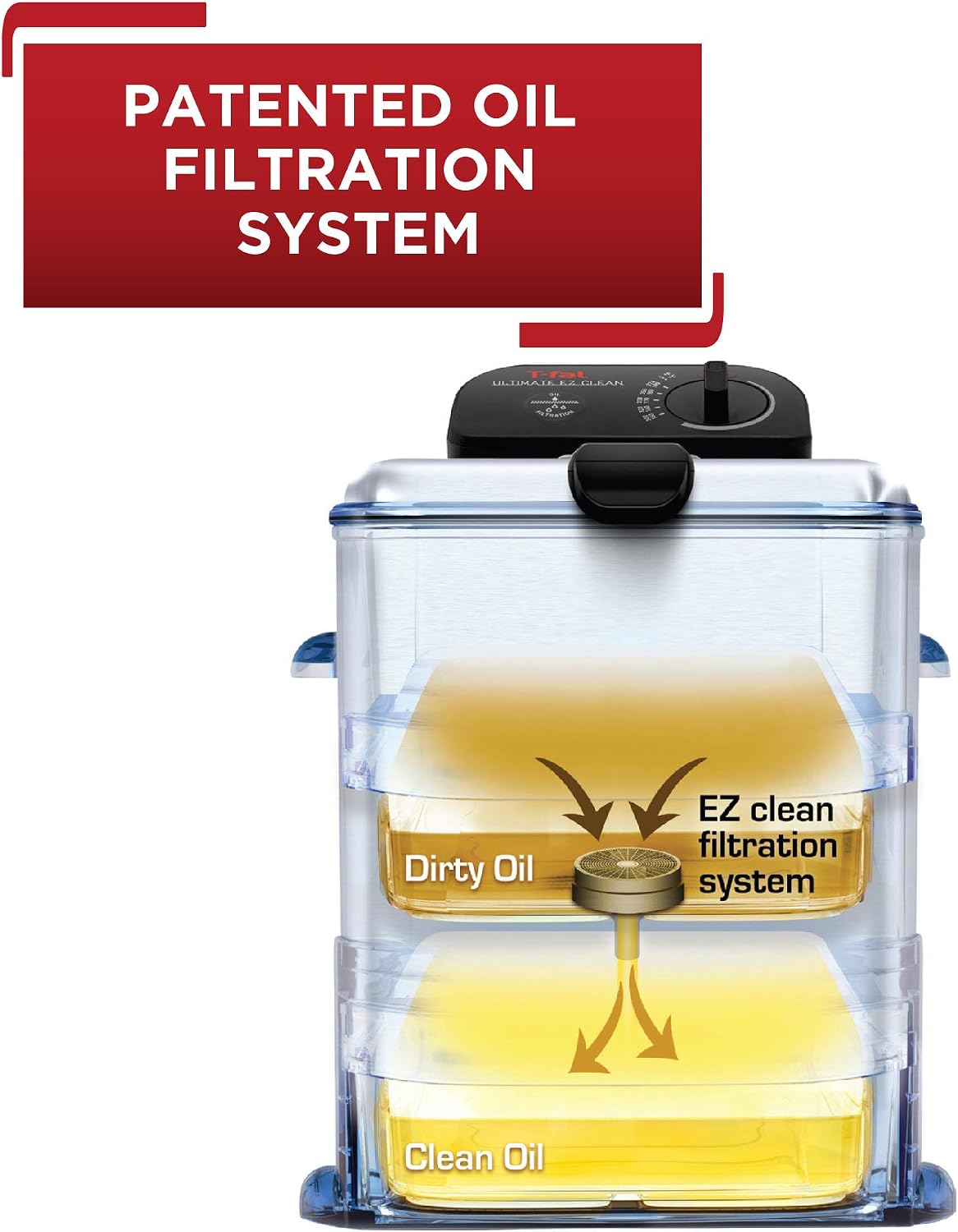
Most home fryers with built-in filtration — the T-fal FR8000 being the category’s most-cited example — operate on a drain-and-screen principle. When you’re done frying, you activate a drain valve that routes oil through a mesh filter or charcoal-assisted filter pad and into an integrated oil container below or behind the fry chamber. The filter catches suspended particles: breading crumbs, batter bits, the carbonized debris that accelerates oil breakdown. What it does not do is remove dissolved compounds — the polymerized fatty acids and polar molecules that accumulate from repeated high-heat cycling — which are the real markers of oil degradation over time.
That’s a meaningful distinction. Across aggregated owner reviews for the T-fal FR8000, the pattern is consistent: users praise the drain mechanism loudly and correctly. It’s genuinely easier than ladling hot oil into a separate container, and the filtration does extend usable oil life compared to unfiltered storage. What reviewers don’t claim — and you shouldn’t expect — is that the built-in filter restores oil to fresh-pressed condition. It removes particulates. Particulate removal is real value. Just know what you’re buying.
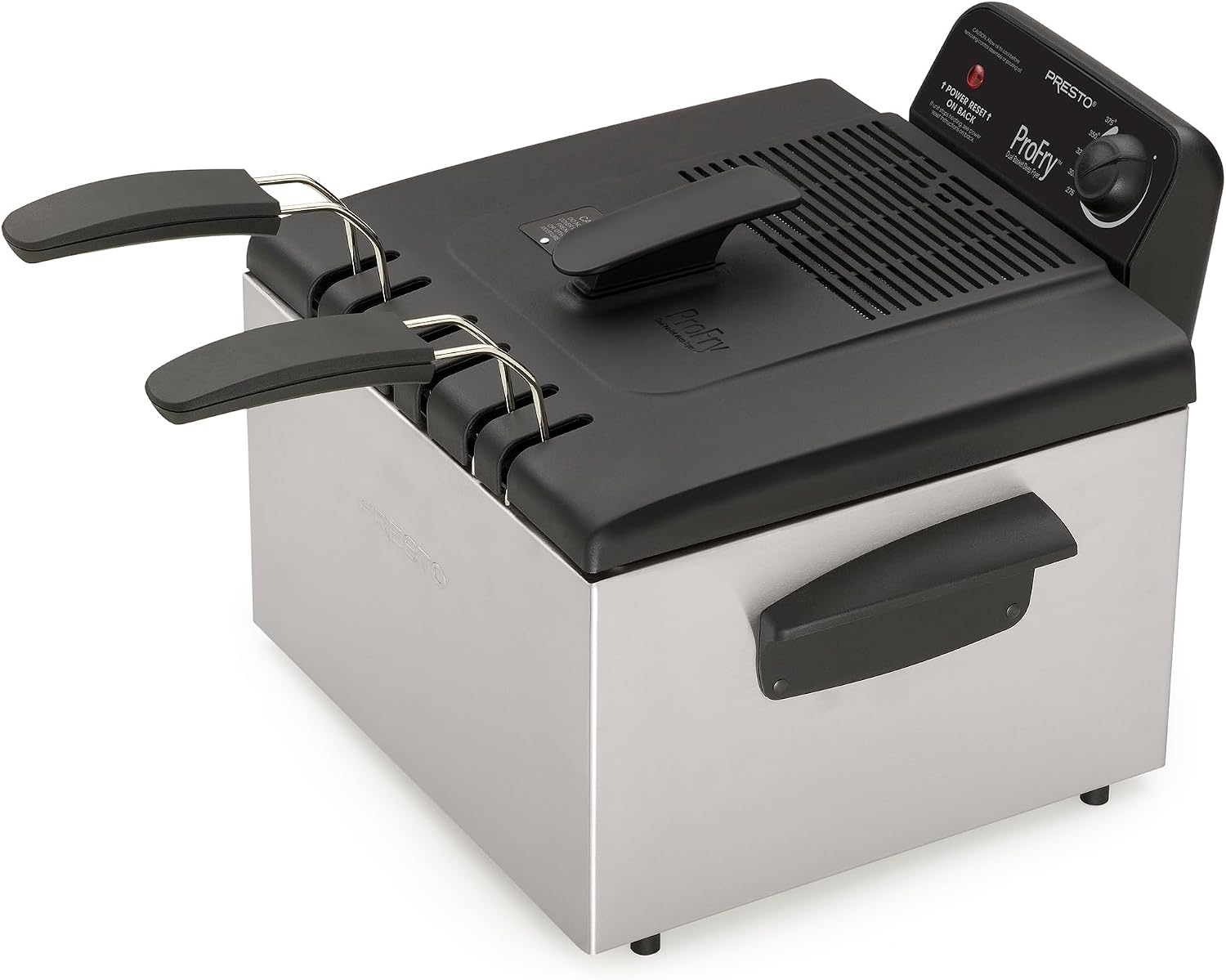
The Presto dual-basket Pro Fry Immersion Element fryer sits at the other end of this spectrum. Owners in long-run reviews consistently praise its rapid heat recovery and twin-basket convenience, but built-in filtration doesn’t enter the conversation at all. Manual oil management is the assumed workflow. If you’re serious about oil longevity with a Presto-style setup, that job falls entirely to you.
The Real Tradeoff Table: Built-In vs. Manual vs. Cone Filter Rigs
Here’s where the decision frame sharpens. You’re not choosing between “filtration” and “no filtration” — you’re choosing who does the work and how much particulate removal you actually get.
By the numbers:
| Approach | Particulate removal | Dissolved-compound removal | Setup cost | Labor per session |
|---|---|---|---|---|
| Built-in screen (T-fal FR8000) | Good | None | Included in fryer price | ~2 min drain cycle |
| Manual mesh strainer + storage container | Moderate | None | $8–15 | ~5–8 min |
| Paper cone filters + bucket rig | Excellent | None | $20–40 for full rig | ~10–15 min |
| Commercial filter machine (Frymaster, Pitco) | Excellent | Partial (with filter powder) | $400–2,000+ | ~5 min with training |
The cone-filter buyers are the most instructive segment here. Across product reviews for paper cone filter products, a distinct buyer profile emerges: people assembling complete systems — metal frames, 5-gallon food-grade buckets, commercial-grade filter bags — who are genuinely committed to maximizing oil life. These buyers have moved past the question of whether to filter; they’re optimizing filtration quality. Their setups can outperform any home fryer’s built-in screen on particulate removal, but they require discipline and a dedicated workflow.
For a solo cook or a small household doing one to three fry sessions per week, the T-fal’s integrated drain-and-filter is a legitimate convenience upgrade. Cook’s Illustrated, in their deep fryer equipment review published by America’s Test Kitchen on cooksillustrated.com, notes that ease of oil management is among the highest-weight factors in home fryer satisfaction — and the T-fal’s mechanism directly addresses that friction point. For anyone frying at higher volume or with more varied proteins (the fish-then-chicken-then-donuts cook), the cone rig gives you more control over what goes back into the oil.
The Stovetop Pot Question: A Legitimate Alternative?
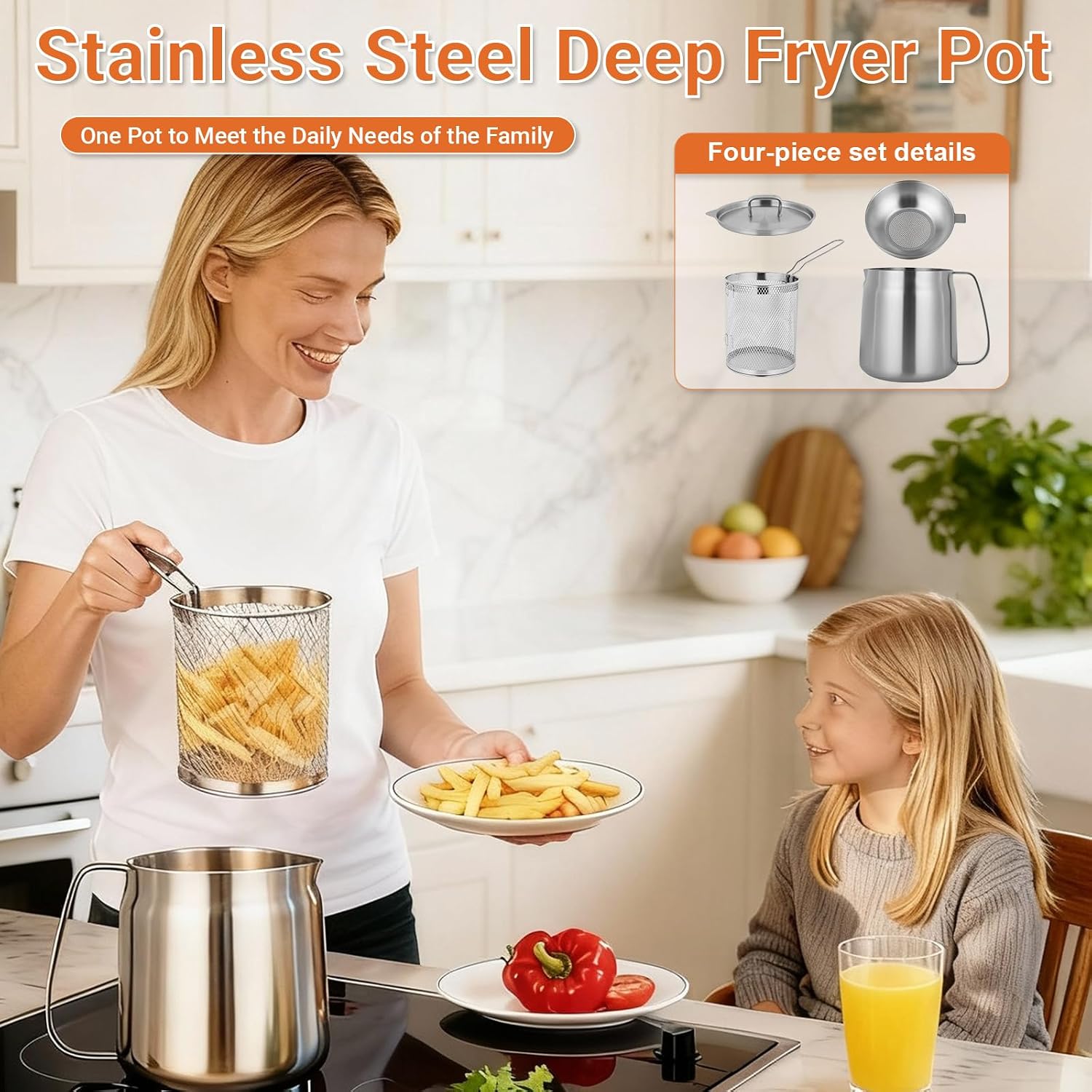
One segment worth addressing directly: the small stovetop stainless fry pot category is drawing real converts from full-sized electric fryers, specifically among solo cooks focused on oil economy.
Owner reviews for these pots consistently cite one behavioral shift: because the pot holds less oil — often one to two quarts versus a home fryer’s three to four — users become more intentional about oil management. Reviewers who switch from a full-sized fryer frequently describe the appeal as oil economy: using and storing a smaller batch of carefully filtered oil rather than a large reservoir that degrades between sessions.
The tradeoff is real: no thermostat, no timer, no basket-lift mechanism. Temperature management falls to a probe thermometer and your attention. Serious Eats’ deep fryer buyer’s guide, published on seriouseats.com by the Serious Eats editorial team, notes that maintaining consistent oil temperature — typically 325°F to 375°F depending on food type — is the single most important variable in fry quality, and stovetop pots demand more active management than any electric unit.
The honest decision rule: if you’re frying solo, doing it infrequently, and prioritize oil economy over convenience, the stovetop stainless pot is a legitimate substitute. If you’re cooking for four or running back-to-back batches, the electric fryer’s temperature recovery and volume capacity are worth the tradeoff.
119oz
$29.78
In stock on Amazon
Check price on AmazonSteam, Odor, and the T-fal Lid Claim
One of the T-fal FR8000’s most-discussed features is its lid design, which owners report traps steam and reduces frying odors during the cook cycle. Multiple reviewers specifically call this out as transformative for indoor frying in small spaces — apartments and RVs appear repeatedly in owner commentary.
Is it marketing? Partially, yes — any covered frying vessel reduces vapor dispersion, so T-fal isn’t doing anything physically novel. What appears to be genuine is the execution: the lid’s seal during frying is tight enough that reviewers in small, enclosed spaces report a meaningful difference versus open-vessel frying. Consumer Reports, in their deep fryer buying guide published on consumerreports.org, identifies oil vapor and odor as primary friction points for indoor home fryers, which gives the T-fal’s lid claim a legitimate problem to solve.
The caveat: the lid must be off during basket insertion and removal, so you’re not getting full containment for the entire session. The steam-trapping benefit applies during the actual cook, not during loading and unloading.
Presto
$89.99
In stock on Amazon
Check price on AmazonOil Degradation Science: What Filtration Can and Cannot Fix
Understanding the chemistry here helps calibrate expectations — and it’s less complicated than it sounds.
Frying oil degrades through two parallel processes. The first is particulate contamination: crumbs, batter, proteins, and starches that fall off food and burn at the bottom of the oil. These particles act as catalysts, accelerating breakdown of the surrounding oil molecules. This is the problem that filtration — whether built-in or cone-based — actually addresses.
The second process is molecular degradation: the oil itself transforms under repeated heat exposure. Triglycerides break down into free fatty acids and glycerol. Polar compounds accumulate. Polymers form. None of this is visible as particles, and none of it is addressable by any filter you can buy for home use. NSF International, in their NSF/ANSI 4 standard for commercial cooking equipment published on nsf.org, notes that particulate removal is the primary lever available in non-commercial frying contexts — a distinction that validates the ceiling on what any home filter can accomplish.
What this means practically: consistent particle filtration after every session genuinely extends oil life, but it doesn’t suspend degradation indefinitely. Across aggregated owner reports and manufacturer guidance, filtered oil used for moderate-volume home frying typically yields eight to twelve sessions before flavor degradation becomes noticeable. Unfiltered oil stored with particulates degrades faster — often noticeably by sessions four to six. Filtration buys you real sessions; it doesn’t stop the clock.
T-fal
$139.95
In stock on Amazon
Check price on AmazonFrequently Asked Questions
Does the T-fal built-in filter actually remove food particles or just drain the oil?
Based on published specs and owner-reported experience, the T-fal FR8000’s filtration mechanism does both — it drains the oil and passes it through a mesh and charcoal filter that catches suspended food particles. Reviewers consistently report cleaner oil in the storage container compared to unfiltered draining. It does not remove dissolved degradation compounds; for that, no home-scale built-in system exists. Think of it as meaningful particulate removal, not oil restoration.
Can I use cone paper filters with any home fryer or only with dedicated filtration pots?
Cone paper filters are fryer-agnostic — they filter oil, not fryers. Buyers building complete filtration rigs use them with any fryer that can drain into a container: drain the oil (hot or cooled, depending on your filter’s temperature rating), run it through the cone into a food-grade bucket or storage vessel, and return the filtered oil for the next session. The cone filter doesn’t care what brand of fryer you own.
How many fry sessions can I get from one batch of oil if I filter it properly?
This depends heavily on what you’re frying, at what temperature, and how diligently you filter. Filtered oil used for moderate-volume home frying — proteins and starches, not exclusively high-batter items — typically yields eight to twelve sessions before flavor degradation becomes noticeable. Unfiltered oil stored with particulates often degrades noticeably by sessions four to six. Consistent filtration reliably extends oil life; it does not suspend degradation entirely. NSF International’s commercial frying standards documentation on nsf.org identifies particulate removal as the primary accessible lever, which aligns with the longevity patterns owners report when filtering consistently.
Does the T-fal lid really trap steam and odors or is that marketing?
Both, with nuance. Owner accounts from apartment and RV users are consistent enough to suggest the lid provides genuine odor and vapor reduction during the cook cycle — this isn’t a fabricated claim. The physical mechanism is real. The marketing overstates it slightly: you’re still opening the lid to manage food, and frying odors aren’t eliminated. Managed is the better word than trapped. Consumer Reports’ deep fryer buying guide on consumerreports.org identifies odor as a primary friction point for indoor fryers, which confirms the T-fal is solving a real problem — even if imperfectly.
Is a stovetop stainless pot a legitimate substitute for an electric fryer for a single person?
Yes, with conditions. For a solo cook doing infrequent frying sessions, the stovetop pot’s lower oil volume and simpler cleanup are genuine advantages. The substitution breaks down if you’re cooking for multiple people, need consistent thermostat control without active monitoring, or fry frequently enough that setup and teardown time matters. Pair a stovetop pot with a quality probe thermometer and it’s a capable substitute; skip the thermometer and you’re guessing at temperature throughout. Serious Eats’ deep fryer guide on seriouseats.com makes clear that temperature consistency is the single biggest variable in fry quality — the stovetop pot puts that burden entirely on the cook.
Are the T-fal dishwasher-safe filter components durable long-term?
Owner accounts vary here more than on other T-fal features. The mesh components are rated dishwasher-safe per T-fal’s product documentation, and many owners report running them through the dishwasher regularly without issue. A subset of longer-term reviewers note that the charcoal filter pads — sold separately as replacements — have a finite lifespan regardless of washing. T-fal recommends replacement after a set number of uses, and owners who skip that step report diminishing filtration performance. The mesh basket components appear durable; the consumable filter pads are the variable that requires ongoing attention.
The Decision Rule
If you’re choosing a home fryer specifically for oil management:
- If you fry one to three times per week in a small space and hate manual oil handling → the T-fal FR8000’s built-in drain-and-filter system is worth the price premium. Owners report genuine convenience and real oil-life extension from the particulate removal alone.
- If you fry at higher volume or with varied proteins and want maximum oil longevity → build the cone filter rig. It costs $20–40, outperforms any built-in home screen on particulate removal, and works with any fryer you already own.
- If you’re a solo cook prioritizing oil economy above all else → a quality stovetop stainless fry pot paired with a probe thermometer and cone filters is the most cost-efficient path, per the owner experience pattern across that category.
- If filtration isn’t mentioned in a fryer’s feature list → assume it doesn’t exist in any meaningful form. “Heavy-duty mesh basket” is not filtration. Plan your oil management workflow before you buy.
The Presto dual-basket Pro Fry is a capable, well-reviewed fryer for performance and capacity. It just doesn’t solve the oil problem for you — and for serious home fryers, that’s the honest reason to look elsewhere or budget for the cone rig alongside it.