If you’ve ever pulled a soggy basket hinge out of the trash and decided it was finally time to buy a real home electric fryer — a countertop appliance with a heating element, a dedicated oil reservoir, and a basket that actually clips in — you’re in the right place. Home electric fryers range from small 1-liter units meant for a handful of fries all the way up to twin-basket commercial-adjacent machines. The three models compared here — the T-fal FR8000 (3.5-liter oil capacity), the Hamilton Beach 35021 (4.5 liters), and the Presto 05466 Dual Basket Profry — sit in the practical sweet spot for households that fry regularly. This article breaks down what each one actually does well, where each falls short, and which tradeoffs matter depending on how and where you fry.
By the time you finish reading, you’ll have a clear decision frame: the right fryer for your situation isn’t the one with the flashiest specs — it’s the one whose weaknesses don’t intersect with your use case.
| EDITOR'S PICKT-fal 3.5L Stainless Steel Deep… | Mid-tierPresto 05466 Stainless Steel Du… | Budget pickPresto Jumbo ProFry™ Basket for… | |
|---|---|---|---|
| Capacity | 3.5L | — | — |
| Wattage | 1700W | — | — |
| Material | Stainless Steel | Stainless Steel | — |
| Dual Basket | ✗ | ✓ | — |
| Oil Filtration | ✓ | — | — |
| Price | $139.95 | $89.99 | $37.00 |
| See on Amazon → | See on Amazon → | See on Amazon → |
The Decision Frame: What Actually Separates These Three
Before diving into unit-by-unit detail, here’s the honest short version. Published specs and aggregated owner feedback paint a consistent picture across all three models.
Specs at a glance
| Model | Oil Capacity | Max Temp | Basket Config | Oil Filtration |
|---|---|---|---|---|
| T-fal FR8000 | 3.5 L | 375°F | Single, hinged lid | Drain-to-reservoir with mesh |
| Hamilton Beach 35021 | 4.5 L | 375°F | Single, large open | None |
| Presto 05466 Dual Basket | ~6 cups total | 375°F | Dual independent | None |
Two things jump out immediately: every fryer on this list tops out at 375°F, and none performs oil filtration in a true mechanical sense — more on that in the FAQ section below. That shared temperature ceiling shapes what they can and can’t cook, and it’s the first tradeoff to name explicitly.
Unit-by-Unit Analysis
T-fal FR8000 3.5L: The Sealed-System Case
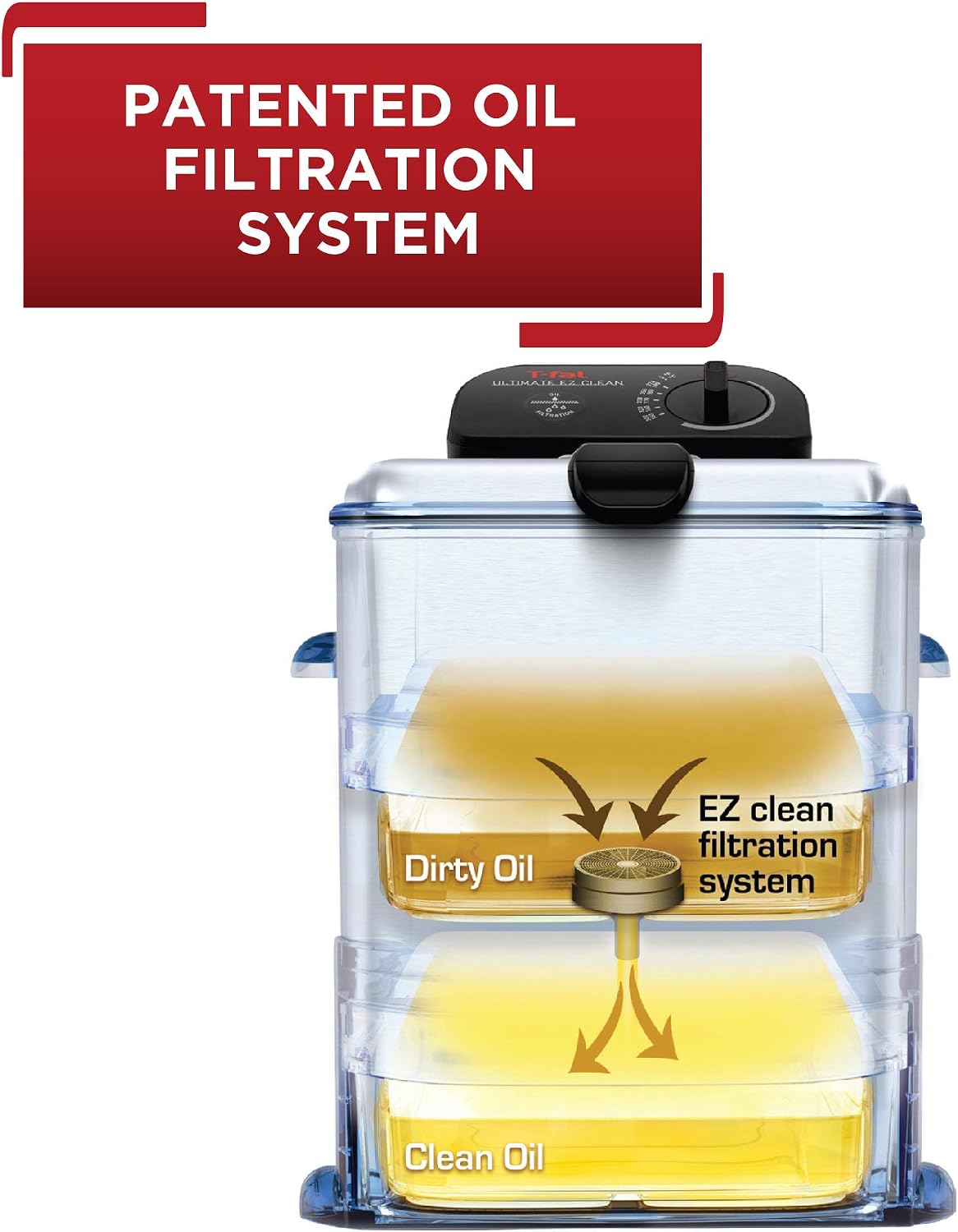
The T-fal FR8000’s defining design choice is enclosure. The lid locks down, a filtration housing channels steam through a charcoal filter, and the entire oil reservoir drains into a sealed storage container when you’re done. For buyers who fry indoors in tight spaces — apartments, small kitchens, RVs — this matters in a way that’s hard to overstate.
Owner reviews aggregated on the T-fal USA product page are unusually specific on this point. Several reviewers cite odor and steam containment as the primary reason they chose this unit over open-top alternatives, with at least one noting use aboard an RV as a primary context. That’s not marketing copy — that’s owners telling you where the design philosophy lands in practice.
Enclosed fryers inevitably trap some moisture, which can affect crisping on certain foods. Wet batters that need steam to escape quickly — tempura and light beer batters in particular — can suffer in a sealed environment. But for fragrant foods like fish or heavily spiced wings cooked indoors, the odor containment trades favorably. The editorial team at Serious Eats, in their guide “The Best Deep Fryers for Home Cooks” published on seriouseats.com, notes that sealed-lid designs are worth considering specifically when indoor air quality is a priority, even if they impose minor trade-offs on certain batter textures.
One reviewer on the T-fal USA product page — citing thirty years of home frying experience — calls this the best fryer they’ve owned. The 3.5L capacity is the smallest of the three models here. For a household of two frying wings or fries one batch at a time, it’s workable. For a family of four trying to finish a full load of chicken tenders before anyone gets impatient, expect two or three batches.
If X, then T-fal: You fry in a space where odor or steam control matters — apartment, RV, shared kitchen. You fry in smaller batches for one or two people. You want integrated oil storage built into the machine.
Presto
$37.00
In stock on Amazon
Check price on AmazonHamilton Beach 35021 4.5L: Capacity and Simplicity, With One Real Ceiling
The Hamilton Beach 35021 makes a straightforward case: more oil, bigger basket, no-frills operation. The 4.5-liter capacity is the largest of the three, and for families or anyone cooking for a group, that’s a genuine advantage — more food per batch, less total cook time, less standing over the counter waiting.
Owner reviews aggregated on the Hamilton Beach Brands product page are consistently positive about reliability and ease of use. The machine heats up, runs simply, and does the job without demanding much attention. The Serious Eats editorial staff, in their published guide “The Best Deep Fryers for Home Cooks” on seriouseats.com, has noted that large-capacity single-basket units excel for batch cooking whole pieces — bone-in chicken, large fish portions — where you need volume without subdividing the basket.
The 375°F temperature ceiling is a real operational boundary, and at least one reviewer on the Hamilton Beach Brands product page flags it directly as a frustration. This matters because some foods genuinely benefit from 380–400°F to finish properly. Doughnuts traditionally fry at 375°F and are unaffected. But for thin-cut fries that need a high-heat second fry to achieve a truly crispy rather than greasy result, or for churros and beignets that want a hotter initial plunge, you’re working at the absolute edge of the machine’s capability. The fryer excels at what it does, but it won’t stretch into the hotter zone that separates very good results from excellent results on specific applications.
There’s no oil filtration system, no sealed lid, and no steam management. In a ventilated kitchen that’s fine — run your hood fan, open a window. In a small apartment, it’s a different calculation.
If X, then Hamilton Beach: You have a proper kitchen ventilation setup. You cook for larger groups where batch efficiency matters. Your primary frying targets — wings, fries, bone-in chicken — live comfortably within the 375°F window. You want simplicity and don’t want to manage an oil storage system.
Presto
$89.99
In stock on Amazon
Check price on AmazonPresto 05466 Dual Basket Profry: The Bar-Kitchen Credibility Machine
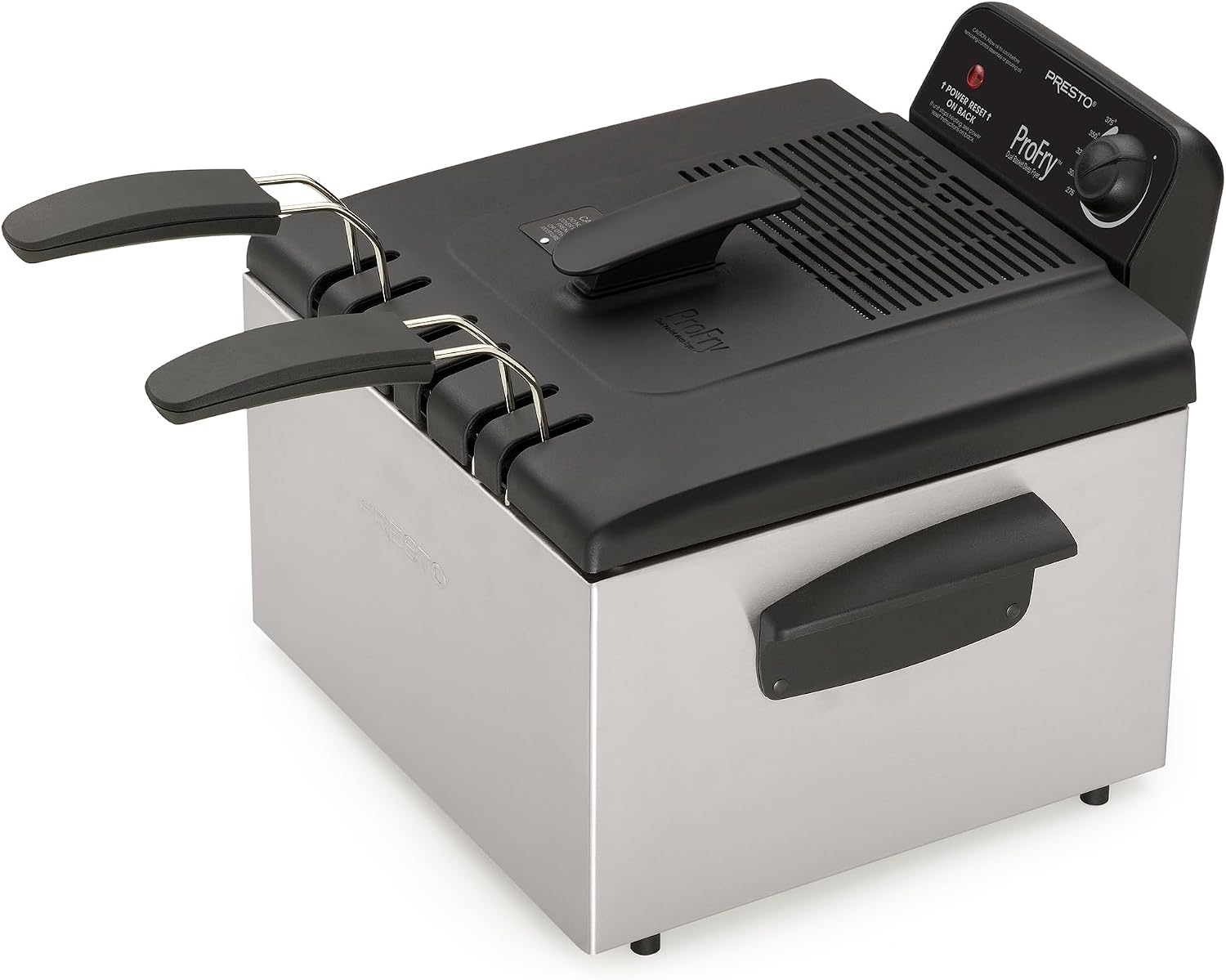
The Presto 05466’s reputation in owner reviews rests on two things: the immersion heating element and the dual-basket configuration. The immersion element — meaning the heating coil sits directly in the oil rather than heating through the vessel wall — is the same design philosophy used in commercial fryers for a concrete reason: it recovers temperature faster after cold food is added. One reviewer on the National Presto Industries product page specifically identifies this unit as “the same fryer they use at our local bar,” which is an unusually concrete real-world endorsement. Bars fry high volumes of wings, mozzarella sticks, and appetizers repeatedly throughout a service shift. If a commercial bar kitchen is running this unit in production, the heat recovery story checks out.
The dual-basket design is the other headline feature. Two independent baskets let you run fries and onion rings simultaneously, or reserve one basket for allergen-sensitive food without cross-contact. For a household that regularly fries multiple items at once, this eliminates the scheduling friction of single-basket cooking entirely.
The capacity math works differently here than it does for the other two fryers. The Presto 05466 uses approximately 6 cups of oil total — roughly 3 cups per basket side. That’s less total oil than the Hamilton Beach, but distributed across two simultaneous cook zones. Per-basket capacity is meaningfully smaller than either competitor; you’re trading raw volume for flexibility and simultaneous cooking.
The Jumbo Basket Accessory — A Real Gap Revealed
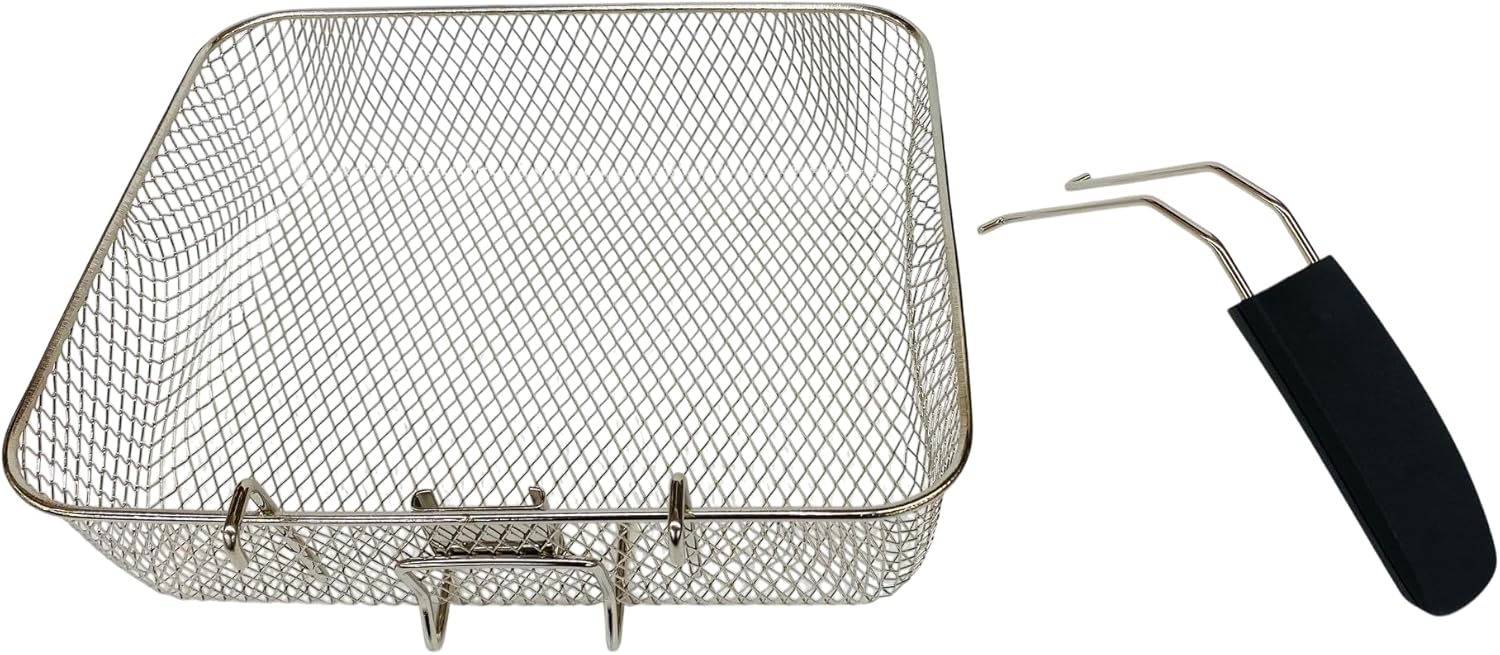
Presto sells a separate Jumbo Basket accessory designed for use with select dual-basket fryer models — intended for owners who occasionally want a single oversized basket for larger items like a whole fish or a larger batch of wings in one pass, without the divider in the way. The reviews on the National Presto Industries product listing for this accessory are among the most practically useful in the entire product category: at least one buyer posted actual interior tank measurements and basket dimensions directly in the review thread to confirm fitment. That kind of owner-generated dimensional verification is rare. If you own a Presto dual-basket unit and want the Jumbo Basket, locate those dimension-specific reviews and cross-reference them against your exact model number before ordering — the fit is model-specific and not universal across the Presto fryer line. Do not assume compatibility based on brand name alone.
If X, then Presto: You fry multiple food types simultaneously and hate waiting for sequential batches. You value fast heat recovery — especially for bone-in chicken or larger pieces that drag oil temperature down hard on entry. You want the machine that most closely mirrors the heat management philosophy of a commercial bar kitchen setup.
T-fal
$139.95
In stock on Amazon
Check price on AmazonFrequently Asked Questions
Does the T-fal oil drain system actually filter the oil or just store it?
It stores with particle collection. The T-fal FR8000’s system passes oil through a mesh strainer as it flows into the sealed storage container, removing large food particles. It does not pass oil through chemical filter media or otherwise purify it. The charcoal filter in the lid manages steam and odor — it doesn’t treat the oil itself. Think of it as clean storage with debris removal, not filtration in the sense that a commercial oil-polishing system would mean. NSF International, whose Foodservice Equipment Certification Program sets standards for commercial food equipment (published and maintained at nsf.org), defines oil filtration as a distinct mechanical process. The T-fal drain-and-mesh system does not meet that commercial definition, though it meaningfully extends oil life compared to no particle removal at all.
Why does the Hamilton Beach fryer only go to 375°F, and does that limit what I can cook?
The 375°F ceiling is a design and safety choice common to consumer-grade countertop fryers. For most home frying applications — wings, fries, fish, doughnuts, tempura — this range is fully adequate. It becomes a limitation for recipes that specifically call for an initial 385–400°F plunge, or for a high-heat second-fry finish on certain double-fried items. If your primary targets live comfortably within the 375°F window, this ceiling won’t frustrate you in practice.
How much oil does the Presto Dual Basket require?
National Presto Industries’ published guidance for the 05466 specifies approximately 6 cups of oil total for proper operation. Under-filling reduces heat recovery performance and leads to uneven cooking; over-filling creates displacement overflow risk when food is lowered into the basket. Use the fill line marked inside the reservoir as your guide.
Will the Presto Jumbo Basket fit my specific Presto model?
Not universally. The Jumbo Basket accessory is designed for specific Presto fryer models, and owners of the dual-basket unit have reported both successful and unsuccessful fits depending on model variant. The most reliable verification method is the dimension-specific owner reviews on the National Presto Industries product listing for this accessory — at least one buyer posted interior tank and basket measurements directly in the review thread. Cross-reference those dimensions against your specific model’s published tank dimensions before purchasing. Never assume cross-model compatibility within the Presto line without confirming measurements.
Can I use my electric fryer indoors without the kitchen smelling like a fast food restaurant?
It depends on the fryer design and your ventilation. The T-fal FR8000’s enclosed lid and charcoal steam filter represent the strongest odor-control design in this comparison — owners who’ve used it in RVs and small apartments report meaningful containment. Open-top designs like the Hamilton Beach and Presto release more steam and aroma into the room; a range hood or a window fan pointed outward makes a significant difference. The food type matters as much as the fryer: fish and heavily spiced foods generate more persistent odor than plain fries regardless of which machine you use.
How often should I change the oil in a home electric fryer?
The Serious Eats editorial staff, in their guide “The Best Deep Fryers for Home Cooks” published on seriouseats.com, recommends that home fryer oil used two to three times per week should be changed every eight to ten uses, or sooner if it darkens significantly, smells off, or begins foaming persistently. Removing food particles after each use — which the T-fal’s drain system assists with mechanically — extends oil life meaningfully. Frying at the correct temperature matters too: oil degraded by repeated overheating or sustained low-temperature cooking turns faster than oil managed carefully within its optimal range.
The Bottom Line: Which Fryer Fits Which Buyer
The T-fal FR8000 is the right call for anyone whose kitchen situation makes odor and steam control non-negotiable — small spaces, apartments, or anyone who fries fish regularly and wants to stay on good terms with their neighbors. The Hamilton Beach 35021 earns its place when raw capacity is the primary variable and you have the ventilation to let it breathe freely. The Presto 05466 is the most commercially-adjacent of the three in philosophy: the immersion element, the dual-basket flexibility, and the bar-kitchen endorsement in owner reviews all point to a machine that handles high-frequency mixed frying better than its price suggests it should.
None of these fryers will exceed 375°F. None will replace a commercial floor fryer for volume work. But in the countertop tier, each one has a clear lane — and choosing correctly means knowing which lane is yours before you buy.