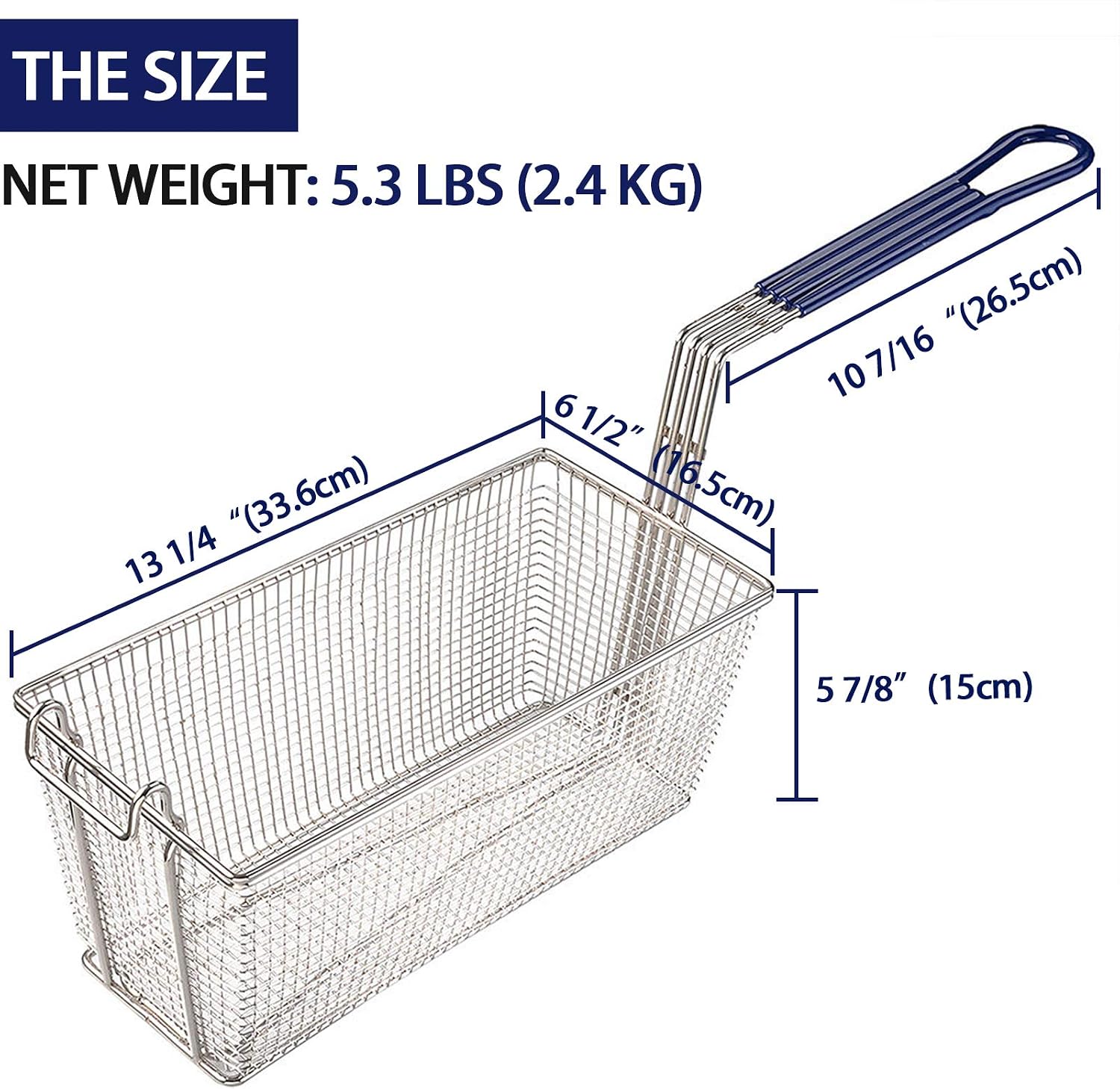
If you’ve ever pulled a fry basket out of hot oil and felt the handle twist in your hand — or noticed a tiny weld joint sitting loose at the bottom of the fryer — you already know the problem this article is about. A fry basket is a simple object: wire mesh, a frame, a handle. But those three pieces have to stay joined under repeated thermal stress (heating and cooling cycles stretch and contract metal), chemical exposure (oil, cleaning agents), and mechanical load (shaking, lifting, hooking and unhooking). When the joints fail — and with certain budget baskets, they do, quickly — you’re not just dealing with an annoyance. You may be dealing with a safety issue, a surprise repair bill, or a procurement decision you need to revisit. This guide breaks down where and why baskets fail, what the nickel-plated versus stainless distinction actually means in practice, and how to make a defensible buy decision at every volume tier.
| EDITOR'S PICKOCS Parts Pro Series 2-Pack Dee… | Mid-tier2PCS Deep Fryer Basket With Non… | Budget pickDeep Fryer Basket | |
|---|---|---|---|
| Dimensions | 13.25" x 6.5" x 5.875" | 13.25" x 6.5" x 6" | 13" x 6.5" x 6" |
| Material | Nickel plated steel | Nickel plated iron | Nickel plated iron |
| Front Hook | ✓ | — | — |
| Non-Slip Handle | — | ✓ | — |
| Price | $63.17 | $52.29 | |
| See on Amazon → | See on Amazon → | See on Amazon → |
Where Baskets Actually Break: A Failure Map
Most fry basket failures cluster at three points: the weld joining the handle to the frame, the welds connecting the mesh to the frame’s perimeter, and (less commonly) the hook or hang point at the top of the handle. Understanding which failure mode you’re looking at changes whether you have a cosmetic problem, an operational inconvenience, or a genuine safety event.
Handle-to-frame weld failure is the most consequential. This joint bears the full load of the basket plus its contents — which can run 3–5 lbs of food plus the basket’s own weight in a standard commercial single basket, more in deep-capacity designs. When this weld cracks or separates, the handle doesn’t gradually loosen and announce itself; it can release suddenly over a hot fryer. Multiple reviewers of the Clivia 4-pack documented exactly this failure mode, with all four baskets reportedly breaking at weld points within a year of regular use — and then paying approximately $20 per basket in rewelding costs. That’s a post-purchase expense that erases any savings from the original price point and then some.
Mesh-to-frame weld failure is more common in nickel-plated baskets and tends to be gradual. A small welded tab or wire end breaks free; the basket still holds food and still functions. One detailed reviewer of a nickel-plated multi-pack made this distinction explicitly and usefully: the pieces that broke off were small, non-structural, and the basket remained usable. That’s a genuinely important nuance — cosmetic weld failures are not the same as structural ones. But the same reviewer went on to warn that nickel-plated baskets are unsuitable for medium-to-high-volume use. That’s the practical ceiling, stated plainly by someone who’d watched it happen.
The Pronto turnover basket drew a sharper complaint: weld failure after just two months of daily use. “Daily use” at food-truck or ghost-kitchen volume is a different stress profile than daily home cooking — but it’s also the exact use case the product was marketed toward. When a basket marketed for frequent use fails structurally in under sixty days, that’s not a manufacturing defect edge case; it’s a design-load mismatch.
Nickel-Plated vs. Stainless: The Real Durability Gap
Here’s the framing most product listings don’t give you: nickel-plated and stainless steel baskets are not the same material category with different price points. They are different materials with different failure modes, different safe lifespans, and different appropriate use cases.
Nickel-plated baskets start as a base metal — typically carbon steel or low-grade steel — and receive a nickel coating. That coating provides corrosion resistance and a clean appearance, but it’s the coating doing the work, not the substrate. Under repeated thermal cycling, oil exposure, and mechanical stress, two things happen: the plating can chip or flake (a food-safety concern if it ends up in oil), and the base metal beneath becomes vulnerable to rust once the plating is compromised. Food Service Equipment Reports’ analysis of stainless grades in commercial kitchens notes that once protective coatings on non-stainless substrates fail, corrosion accelerates rapidly in the moisture and heat environment of a commercial fryer station.
304 stainless (the grade you want to see specified) is a chromium-nickel alloy that resists corrosion as its inherent property, not as a surface treatment. It handles thermal cycling better, welds more cleanly, and doesn’t have a coating to lose. NSF International’s NSF/ANSI 4 standard — which governs commercial cooking equipment — requires materials to be non-toxic, corrosion-resistant, and capable of withstanding repeated cleaning and sanitizing cycles. Nickel-plated baskets rarely carry NSF certification for exactly this reason; 304 stainless baskets from established commercial manufacturers commonly do.
201 stainless is the grade to watch out for. It’s sold as “stainless steel” — technically accurate — but it substitutes manganese for some of the nickel content, making it less corrosion-resistant than 304. As we’ve noted in other coverage on this site, calling out 201 stainless marketed as “heavy-duty commercial grade” is a core editorial obligation. If a listing doesn’t specify the alloy grade, assume 201 until proven otherwise.
By the Numbers
| Material | Typical Lifespan (Home Use) | Typical Lifespan (High-Volume Daily) | NSF Certifiable? |
|---|---|---|---|
| Nickel-plated carbon steel | 1–3 years | 3–6 months | Rarely |
| 201 stainless steel | 3–5 years | 1–2 years | Sometimes |
| 304 stainless steel | 7–15+ years | 3–7+ years | Commonly |
Lifespan estimates synthesized from aggregated long-run owner reviews and manufacturer-published guidance; actual results vary by cleaning practices and oil type.
Handle Wobble: Structural Risk or Assembly Issue?
The Hakka 4-pack drew a specific complaint: handles ship disassembled, require assembly by the buyer, and at least one unit arrived with a handle that felt loose after assembly. This flags two separate problems that are easy to conflate.
Assembly-required handles are a legitimate design choice for shipping efficiency and are not inherently inferior — but they shift quality control responsibility to the buyer. A handle that’s correctly assembled to spec should be as secure as a factory-welded one. The question is whether the joining mechanism (usually a bolt, rivet, or press-fit sleeve) is engineered to the same load tolerance as a welded joint. In most budget multi-packs, it isn’t; the hardware is lighter gauge than the basket wire, and torque specifications (if they exist) aren’t communicated in any documentation.
A handle that feels loose after correct assembly is a different issue entirely. If the attachment point has play in it after the hardware is fully tightened, the joint is undersized for the application. A loose handle on a basket over hot oil is not a cosmetic defect — it’s a drop-hazard and a burn-hazard. Serious Eats’ equipment notes consistently flag handle security as a primary evaluation criterion for fryer baskets, and for good reason.
Can you tighten a wobbly handle at home? Sometimes, and we’ll address that directly in the FAQ below. The short answer: if it’s a bolt-and-nut assembly, yes, with the right tool. If it’s a press-fit or factory-riveted joint that’s worked loose, meaningful repair requires equipment most home cooks and many food-truck operators don’t have on hand.
The True-Cost Framework for Budget vs. Commercial-Grade Baskets
A food-truck operator who reviewed the 7.2x8.3 electric fryer basket described ordering backup sets preemptively — treating basket failure not as a defect but as an operating assumption. That’s a rational adaptation to a known supply chain reality, but it’s also a sign that the baseline product isn’t matching the use case. Let’s run the math explicitly.
Budget nickel-plated 4-pack at ~$25: If two of four baskets fail structurally within six months at a food truck, and each reweld costs ~$20, the effective cost is $25 + $40 = $65 for two functional baskets — roughly $32.50 each. A single OEM or well-spec’d aftermarket 304 stainless basket from a commercial supplier runs $80–$150 but typically lasts years under the same load. The breakeven on the commercial basket starts looking achievable within the first operating year once you account for labor downtime, rewelding costs, and replacement procurement time.
For home cooking at one to three frying sessions per week, the calculus shifts. Thermal cycling is lower, cleaning frequency is lower, and even a nickel-plated basket at the lower end of the durability range may last two to three years before cosmetic failure becomes functional failure. At that volume, a $25 replacement every two years may legitimately beat a $100 investment that lasts a decade — depending entirely on how much operational friction the failures create.
Restaurant Business Online’s analysis of foodservice equipment cost-of-ownership consistently surfaces the same principle: the sticker price of durable equipment looks expensive until you account for replacement frequency, labor, and downtime. That math is less pronounced at home; it’s decisive at commercial volume.
Frequently Asked Questions
How long should a nickel-plated fry basket realistically last under home use vs. food truck volume? Under typical home use — one to three sessions per week, hand-washed and dried — a nickel-plated basket can reasonably last one to three years before coating degradation or weld fatigue becomes noticeable. At food-truck volume (multiple service periods daily, commercial fryer temperatures, frequent cleaning), the same basket may fail structurally within three to six months. Reviewers across multiple nickel-plated basket listings confirm this trajectory, and at least one reviewer explicitly stated these baskets are unsuitable for medium-to-high-volume use.
Are weld failures on commercial-style baskets a safety hazard or just a cosmetic issue? It depends on which weld fails. Small cosmetic welds — wire ends, decorative tabs — can break off without affecting structural integrity; one long-run reviewer made exactly this distinction and noted the basket remained functional. Handle-to-frame weld failures are a different category: they represent a load-bearing joint over hot oil, and separation is a burn and spill hazard. If your handle has any movement at its base or any visible cracking at the weld point, treat it as a safety issue and replace the basket.
What does “commercial grade” actually mean on Amazon fry basket listings? In most cases, very little. “Commercial grade” is unregulated marketing language with no defined standard. The meaningful certifications are NSF listing (per NSF/ANSI 4, which requires documented material, construction, and cleanability standards) and explicit material specification — 304 stainless, gauge thickness in millimeters or wire diameter. If a listing says “commercial grade” but doesn’t name the alloy, specify the wire gauge, or carry NSF documentation, the label is decorative.
Is it worth buying stainless steel baskets at 2–3x the price for home cooking? For most home cooks frying occasionally, a well-constructed nickel-plated or 201 stainless basket at the lower price tier is adequate — provided you inspect welds before use and replace at the first sign of handle instability. The 2–3x investment in 304 stainless makes clear sense if you fry frequently (more than four times per week), run a countertop commercial-adjacent fryer at higher temperatures, or simply want to buy once. Consumer Reports’ guidance on kitchen tool cost-of-ownership supports the “buy once, buy well” logic when usage frequency is high.
Can a wobbly handle attachment be tightened at home? If the handle is attached via a bolt-and-nut assembly, yes — tighten with the appropriate wrench or pliers, check that the fastener isn’t stripped, and apply a small amount of food-safe thread-locking compound if it continues to loosen. If the handle is attached via a press-fit collar or factory rivet that has worked loose, home repair is unlikely to restore original holding strength without welding equipment. In that case, retire the basket rather than risk a drop.
Why do some baskets ship disassembled, and how hard is it to put together correctly? Disassembled handles reduce shipping volume and cost. Assembly is usually simple — two to four minutes with basic tools — but the critical step most instructions underemphasize is torque: the fastener needs to be tight enough to eliminate all rotational play, but not so overtightened that you strip the threads or crack a collar. After assembly, test by gripping the handle firmly and trying to rotate and flex it against the basket frame. If there’s any movement, do not use over a hot fryer until it’s re-tightened or the hardware is replaced.
The Decision Rule
If you’re a home cook frying fewer than three times per week: a quality nickel-plated or lower-grade stainless basket at the $15–$30 range is defensible, but inspect every weld joint before first use and replace at any sign of handle instability. The money you save is real at this usage level.
If you’re a food-truck operator, ghost-kitchen owner, or anyone running daily service volume: the Clivia and Pronto failure patterns are not anomalies — they’re predictable outcomes at that stress level. Budget at $80–$150 per basket, specify 304 stainless, verify NSF listing or manufacturer-documented alloy grade, and source OEM or well-documented aftermarket from suppliers who publish model compatibility data. The math on durability closes within the first operating year.
If you’re in between — a serious home cook or prosumer fryer owner who fries four-plus times per week — treat yourself as the light-commercial buyer. The $60–$100 range in heavy-gauge stainless twin-basket setups represents your floor, not your ceiling.