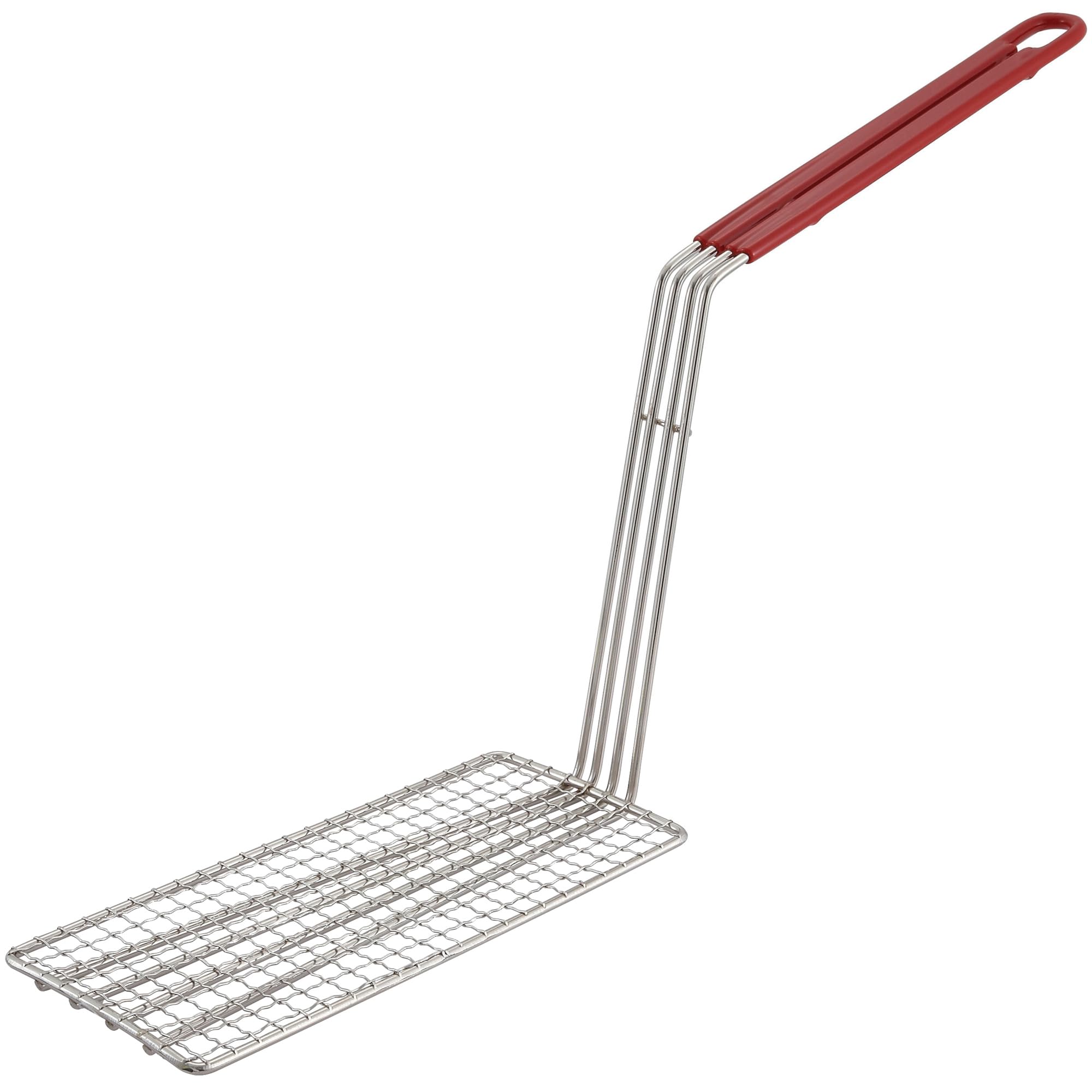
If you’ve ever watched a basket full of hush puppies bob stubbornly at the surface of a fryer — half-cooked on the bottom, pale on top — you already understand the core problem this article solves. Frying works by surrounding food with hot oil on all sides at once. When food floats, that equation breaks. The accessories covered here — press bars (weighted or hinged bars that hold food below the oil surface), detachable-handle baskets (baskets that separate from their handles so you can use them in vessels like dutch ovens, not just electric fryers), replacement handles, and spider skimmers (long-handled wire-mesh tools for pulling small pieces from hot oil) — are the gap-fillers between your main basket setup and a fryer that actually runs the way you need it to. Most buyers only discover these parts after something goes wrong or after watching a more experienced operator work. This guide compresses that learning curve.
| EDITOR'S PICKWinco Green Fry Basket Handle | Mid-tierWinco FBR-9 Steel Round Wire Fr… | Budget pick94066 Deep Fryer Basket Handle… | |
|---|---|---|---|
| Type | Handle | Basket | Handle |
| Diameter | — | 9 in | — |
| Shape | — | Round | — |
| Compatible | — | — | Presto models |
| Color | Green | — | — |
| Size | Medium | — | — |
| Price | $27.58 | $18.42 | $13.99 |
| See on Amazon → | See on Amazon → | See on Amazon → |
Press Bars: The Fix for Floating Food at Volume
The floating-food problem sounds minor until you’re running four baskets simultaneously during a lunch rush and you realize someone has been holding one basket on top of another with their bare hand — an improvised technique that reviewers of the Winco press bar describe explicitly as the thing they were doing before they bought the accessory. That detail matters: it tells you the press bar isn’t a luxury item for a finicky cook. It’s the formalized version of something operators already do out of necessity.
What foods actually need a press bar? The short list, backed by the food science covered in Serious Eats’ overview of frying physics: anything with significant air content or low density relative to oil. Donuts and beignets are the canonical example — the yeast-leavened dough traps gas bubbles that make the item buoyant. Breaded items with thick batters, pierogies, stuffed peppers, and certain fish fillets with a skin-side air layer also float consistently. Chicken wings, by contrast, are dense enough that floating is rarely an issue. If your menu skews toward the first category, a press bar goes from optional to operational.
The Winco BFPB-10 press bar is the most-cited example in commercial and semi-commercial contexts. Published specs from Winco Foodservice describe it as designed to fit the FB-10 and FB-20 baskets specifically, using a hinged attachment at the basket rim. Reviewers in high-volume catering contexts report it eliminates the need for the improvised two-basket stack entirely, which matters for both safety (no one is reaching over a fryer with two wire baskets) and consistency (even submersion means even cook time). The tradeoff reviewers flag: it does not function as a universal press bar across all basket brands. If you’re running a mix of Winco and non-Winco baskets, you’re not guaranteed a fit without verification against the rim dimensions of your specific basket.
Decision rule: If you’re running Winco FB-10 or FB-20 baskets and frying anything that floats, the press bar is a near-automatic add. If you’re running a different basket brand, measure your rim first and contact the manufacturer before ordering — the Winco spec is not a catch-all.
Detachable-Handle Baskets: A Different Audience Than You’d Expect
Here’s a counterintuitive finding from aggregated buyer reviews: the detachable-handle basket format earns its strongest praise not from electric fryer owners, but from cast iron dutch oven users. The reason makes sense once you think through it. A traditional electric fryer basket rides on a built-in hook system inside the fryer tank. A dutch oven or stock pot on a stovetop has no such hook — which means a standard basket either has to be held (hot, awkward, dangerous) or propped (unstable). A basket with a handle that detaches cleanly solves both problems: you clip the handle on to lower, unclip to let the basket rest inside the vessel, then clip back on to lift.
Buyers in this segment are typically one of two things: serious home cooks who fry in a 5-7 quart enameled dutch oven for temperature control and capacity reasons, or small-batch operators using a stock pot setup in a commissary or catering prep kitchen where a dedicated electric fryer isn’t available or permitted.
Can you use a detachable-handle basket to serve food at the table? Practically, yes — the basket becomes a serving vessel once the handle is removed, which some operators use for presentation (the “basket of fries at the table” style popular in casual dining). The caveat is that basket mesh retains heat and residual oil, so bare-hand contact without a cloth or glove is a burn risk. From a food safety standpoint, NSF International’s NSF/ANSI 2 standard covers food-contact surface requirements; if you’re using a basket for table service in a licensed establishment, confirm the basket’s NSF certification covers that use case, not just cooking use.
Replacement Handles: When to Buy One vs. Replace the Whole Basket
This is a more contested decision than it looks. Buyer reviews of the Presto replacement handle reveal two things that should inform your thinking:
- People lose or damage handles independently of baskets far more often than the market acknowledges. A handle gets knocked off a shelf, melts on a burner edge, or simply becomes so grease-soaked that the grip is compromised — while the basket itself is structurally fine.
- The price of an OEM plastic replacement handle, even at the Presto price point, feels disproportionate to buyers. Reviewers consistently flag the value mismatch: you’re paying a meaningful fraction of the whole basket’s cost for what is, materially, a plastic injection-molded part.
The math, approximately:
| Scenario | Typical cost range | Recommendation |
|---|---|---|
| OEM replacement handle, home fryer | $8–$18 | Buy if basket mesh is still solid |
| Full basket replacement, home fryer | $15–$35 | Buy if mesh is bent, rusted, or warped |
| Commercial OEM handle (Pitco, Frymaster) | $25–$60 | Verify model compatibility first |
| Aftermarket handle, commercial | $12–$30 | Check gauge and hook geometry |
The key variable is basket condition. If the mesh is good — no broken welds, no rust pitting, flat bottom, clean rim — buying a replacement handle is almost always the better financial call. If the mesh is compromised, the handle cost is sunk money toward a basket you’ll replace anyway.
The Winco green handle (the model reviewers reference for commercial use) carries an important real-world note: buyers fitting these handles to Dean fryers have reported needing to bend the front hook slightly with pliers to achieve a proper seat. This isn’t a defect — Dean fryer rim geometry differs from Winco’s native basket design — but it means “commercial handle replacement” is not always a straight swap. Per aggregated reviews, the adjustment is minor and the handle performs well afterward, but if you’re procuring for a line kitchen where you need zero-modification installation, verify the hook geometry against your specific fryer model before ordering in volume.
Decision rule: Replace the handle if the basket mesh is sound and your fryer model is confirmed compatible. Replace the whole basket if the mesh has structural damage or if handle compatibility is uncertain enough to require field modification you’re not comfortable doing.
Spider Skimmers: The Oil Cost Argument
Spider skimmers — the long-handled, wide wire-mesh scoops used to remove small food particles from oil between batches — generate a specific justification in commercial kitchen reviews that home fryer buyers almost never mention: oil cost savings.
The logic, cited consistently by restaurant operators in reviews and supported by Restaurant Business Online’s coverage of fry oil management, is direct: small food particles suspended in hot oil accelerate oil degradation. Proteins and starches shed from food during frying carbonize quickly at frying temperatures (325–375°F / 163–190°C), and those carbon particles act as accelerants for the chemical breakdown of the oil itself. Frequent skimming between batches removes the particles before they reach that stage.
At commercial scale, where a single fryer can consume 35–50 pounds of oil per week and quality frying oil runs $40–$70 per 35-pound container (2026 pricing per commercial foodservice supply catalogs), the math on oil lifespan becomes meaningful fast. Operators who report skimming every 2–3 batches consistently describe oil that “looks cleaner longer” and passes the color-and-smell check more batches in. This isn’t a marginal benefit — it’s the difference between oil that lasts a full service shift versus oil that needs a top-off or a full change mid-service.
How often should you skim? Serious Eats’ frying science overview, and the practical guidance from Restaurant Business Online’s oil quality pieces, both point to the same answer: skim after every batch if you’re frying breaded items or anything with heavy particle shed (battered fish, dredged chicken). For lower-shed items like plain cut fries, every 2–3 batches is workable. The skimmer itself is a low-cost tool — this is a habits decision more than a purchasing decision.
Frequently Asked Questions
Does the Winco fry basket press bar only work with Winco FB-10 and FB-20 baskets, or is it universal? Per Winco’s published product specs, the BFPB-10 press bar is designed specifically for the FB-10 and FB-20 basket dimensions. It is not marketed as a universal press bar. Whether it fits a non-Winco basket depends entirely on whether your basket’s rim width and geometry match Winco’s spec. Measure before you order.
Can a detachable-handle basket be used for serving food at the table after frying? Practically, yes. The handle-free basket is a common casual dining presentation format. Safety caveat: baskets retain heat and oil, so handling requires a cloth or glove. If you’re using it in a licensed commercial setting, verify the basket carries NSF certification for food-contact use — not all baskets rated for frying are certified for table service.
Is a replacement basket handle worth buying, or should you just replace the whole basket? Buy the handle if the basket mesh is structurally sound — no broken welds, no rust, flat bottom. Buy a whole new basket if the mesh is damaged. The handle is the cheaper path when the basket is still good; spending handle money on a basket you’ll soon replace anyway is wasted spend.
How often should you skim a fryer between batches to protect oil quality? After every batch for breaded or heavily battered items. Every 2–3 batches for lower-shed items like plain fries. The frequency directly affects oil lifespan — more frequent skimming removes carbonizing particles before they accelerate oil breakdown.
What foods float during frying and actually need a press bar to cook evenly? Donuts, beignets, pierogies, stuffed items, and thick-battered fish are the primary culprits. The common factor is either trapped gas (leavened doughs) or air pockets (thick batter layers). Dense proteins like chicken wings rarely need press-bar assistance.
Will Winco replacement handles fit Dean or Frymaster fryers without modification? Based on aggregated owner reviews, Winco handles often require minor hook adjustment — specifically, bending the front hook with pliers — to fit Dean fryer rim geometry. Frymaster compatibility varies by model. If you need zero-modification installation for a line kitchen procurement, confirm hook geometry against your specific fryer model’s published rim spec before ordering in quantity.
The through-line across every accessory here is the same: each one solves a specific operational problem that the main basket doesn’t address. Press bars exist because food floats. Detachable handles exist because not every frying vessel is an electric fryer. Replacement handles exist because parts fail independently and replacing a whole basket for a broken handle is waste. Skimmers exist because oil has a cost and particles have a consequence. If X is any of those problems on your line, Y is the accessory that directly addresses it — no guesswork required.