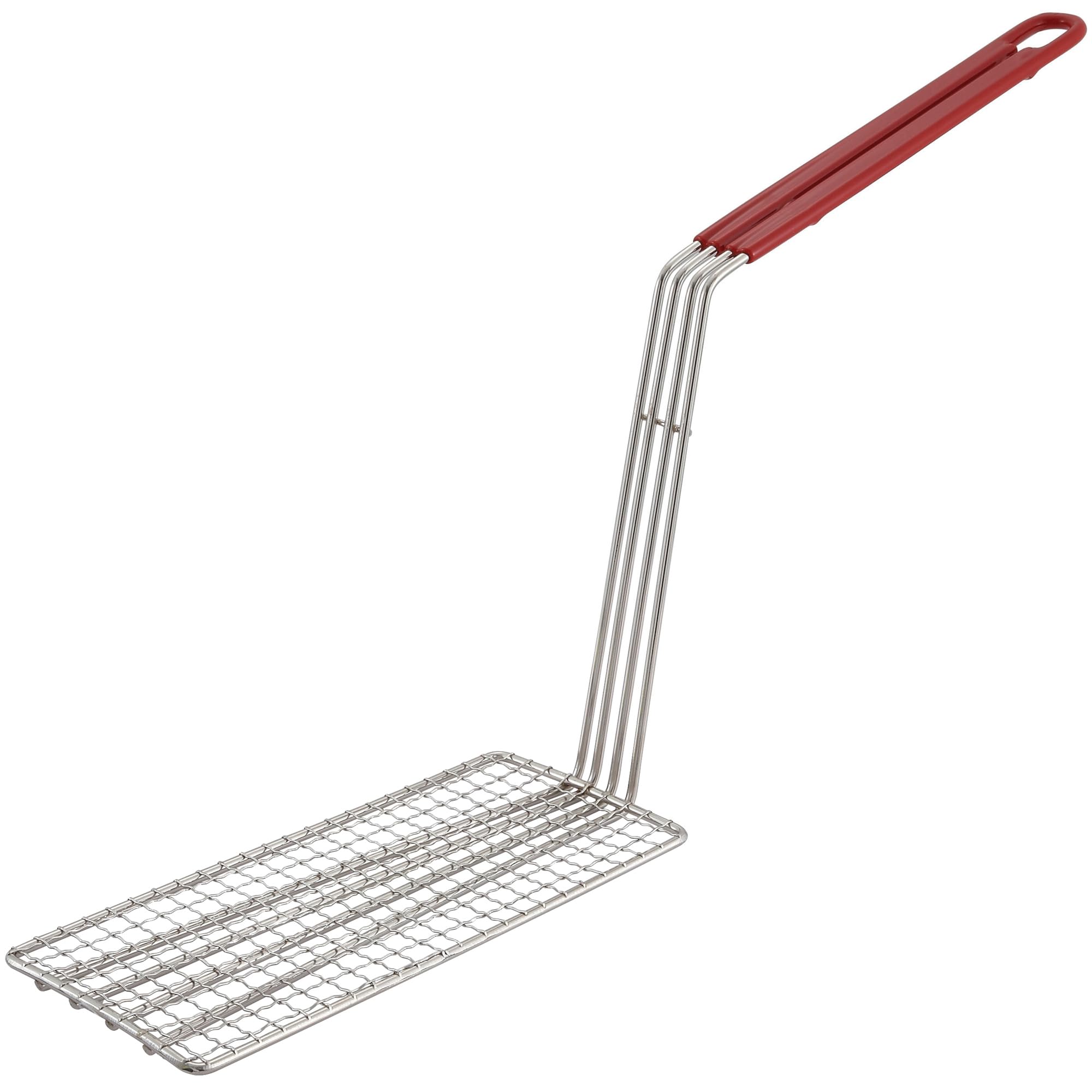
If your fry basket just started wobbling, or the handle cracked mid-service, or you keep burning your wrist because floating food won’t stay submerged — welcome to the part of frying nobody puts in the brochure. A fry basket is the metal mesh container that holds food in hot oil during frying; the handle is how you lift it safely; the hook (or “hang tab”) is the bent piece at the top that lets you rest the basket on the fryer’s lip so oil drains back into the pot; and a press bar is a cross-piece that clips across the top of a loaded basket to physically hold floating food below the oil surface. Each of these is replaceable or upgradeable on its own — and each one solves a different problem. This guide breaks down when each accessory is worth buying, how owners and operators have adapted them to real kitchens, and what tradeoffs you’ll face at every price point.
The Press Bar: A $10 Fix for a Problem That’s Costing You Labor
Here’s the honest version of why press bars exist: certain foods float. Breaded items, frozen foods with trapped air, and anything with a large surface-area-to-weight ratio will ride up above the oil line as soon as you lower the basket. When that happens, the top surface of the food steams instead of fries — you get uneven color, soggy patches on one side, and inconsistent cook times. The standard workaround on a busy line is for a staff member to hold a second basket on top of the first to weigh the food down. That works, but it ties up a hand, raises the risk of a splash burn, and compounds fatigue across a long shift.
The Winco FB-PB press bar is a purpose-built answer to exactly this. A restaurant operator documented their purchase of four press bars — one per fryer basket — explaining that during large orders, the press bar eliminates the need to physically hold a second basket over the food. The operator’s framing matters here: this isn’t a “nice to have” convenience item, it’s a labor-reduction tool on a busy line. Per Restaurant Business Online’s coverage of small-equipment labor efficiency (2024), even modest reductions in two-handed tasks at the fryer station translate into measurable throughput gains when aggregated across a service.
The tradeoff to name explicitly: A press bar works best when your basket already fits the fryer snugly. If there’s lateral play in the basket — meaning the basket slides around inside the fryer pot — the press bar can shift and release the food. Check basket-to-fryer fit first. Press bars are also model-specific by basket width, so confirm the bar’s listed span against your basket’s interior opening dimension before ordering.
By the numbers — floating food physics: Serious Eats’ science-of-frying overview notes that food floating above the oil surface can experience a 30–40°F effective temperature drop at the exposed surface relative to the submerged portion — enough to produce meaningfully different texture between the top and bottom of the same piece.
Replacement Handles: Repair Logic vs. Replace Logic
A broken or missing handle is the most common reason people think they need a new basket when they don’t. The repair math is straightforward: if your basket’s wire frame, mesh, and hook are all intact, you’re looking at replacing a $6–$15 part rather than a $25–$80 basket. That arithmetic was the explicit reasoning of one Presto handle replacement buyer who called the handle price “steep for just a handle” — but then bought it anyway, because replacing only the handle was still clearly cheaper than replacing the whole basket. That’s the right frame. The objection isn’t really about the handle price; it’s about relative value, and the relative value is real.
Winco Replacement Handles — and the “Smidge Long” Problem
The Winco green handle replacement generates one of the more instructive installation reviews in the product set. An operator fitting it to a Dean commercial fryer noted the handle ran a “smidge long” — meaning it extended slightly past the ideal hang position on the fryer’s front hook. Their fix: use pliers to compress or shorten the front hook on the handle just enough to achieve proper seating.
This is a practical modification technique worth documenting. Commercial fryer hook geometry varies by manufacturer — Dean, Pitco, Vulcan, and Frymaster all use slightly different lip depths and hook angles. Aftermarket handles are designed to cover a broad range of these geometries, which means some degree of fit adjustment is expected, not exceptional. If you’re sourcing a Winco replacement for a named commercial fryer brand, budget a few minutes with needle-nose pliers to fine-tune the hook position. It’s not a defect; it’s the cost of broad-fit aftermarket design.
The Garneck Grip — and the Bending-Sides-Apart Installation Tip
The Garneck replacement grip (a sleeve-style handle that clamps over an existing or replacement handle rod) ships with a fit that multiple owners have described as initially loose on standard-diameter rods. The documented fix: manually squeeze or bend the grip’s side walls slightly outward before installation, which spreads the internal channel just enough to create a friction-fit around the rod. After that adjustment, owners report solid seating.
The takeaway for any practitioner: grip accessories designed to fit a range of handle diameters will almost always need minor field adjustment. If a grip feels loose out of the package, the answer is mechanical adjustment, not a return. This is especially true in commercial settings where handle rods may vary by a millimeter or two across different basket generations from the same manufacturer.
Detachable-Handle Baskets: The Case for Cast Iron and Dutch Oven Frying
A detachable-handle basket is exactly what it sounds like — a mesh basket where the handle unscrews or unclips, leaving a low-profile basket you can submerge in a deep vessel without the handle getting in the way. Fixed-handle baskets have a leverage problem in deep vessels: the handle angles up and out of the pot, which limits how deep you can submerge the basket and can cause it to list to one side.
Cook’s Illustrated’s equipment notes on Dutch oven frying flag handle clearance as the primary reason purpose-built fry baskets outperform improvised wire alternatives in cast iron — and a detachable handle solves the clearance issue entirely by removing the protrusion.
One reviewer of a detachable-handle round basket confirmed specific fit compatibility with a Le Creuset 5.5 qt Dutch oven — one of the few instances in the product set where cast-iron brand-specific fit is verified by an actual owner rather than inferred from diameter specs. That confirmation matters because Le Creuset’s interior diameter is slightly more generous than some competing 5.5 qt cast iron pots, meaning a basket that fits Le Creuset may not fit a tighter competitor at the same nominal quart size.
The tradeoff: Detachable handles add a connection point that can loosen over time, particularly under the torque stress of heavy loads. In commercial settings, a fixed-handle basket is more durable by design. For home Dutch oven or cast iron frying, the detachable handle is a genuine ergonomic upgrade. For a food truck or restaurant fryer taking 300+ dips a day, stick with fixed.
Hook Geometry: Why the Hang Matters More Than It Looks
The hook — the bent or curved extension at the top of a basket handle — does two jobs: it holds the basket on the fryer lip during draining, and it determines how level the basket sits. A hook that’s too shallow lets the basket tip forward; one that’s too deep holds the basket at an angle that pools oil in one corner. Neither is acceptable in volume service.
NSF/ANSI 8, the standard NSF International applies to commercial foodservice equipment materials and construction, doesn’t mandate a specific hook angle, but it does require that equipment design prevent the pooling or retention of food soils in ways that compromise sanitation — which a poorly angled basket hook can contribute to if it causes oil or food debris to pool consistently.
When evaluating aftermarket replacement hooks or handles, check the hang angle against your fryer’s lip depth. Manufacturer spec sheets (Pitco, Frymaster, Vulcan all publish these) list fryer pot dimensions including the lip or ledge depth — cross-referencing that dimension against a replacement handle’s hook depth is the most reliable way to predict fit before purchase.
Frequently Asked Questions
What is a fry basket press bar and do I actually need one?
A press bar is a metal cross-piece that clips or rests across the top of a loaded fry basket, physically holding food below the oil surface. You need one if food floats above your oil line during frying — a common issue with breaded, frozen, or air-trapped items. If food is already staying submerged on its own, you don’t need one. For high-volume settings where a staff member is routinely holding a second basket on top of a loaded one, a press bar is a direct labor-reduction tool.
Can I replace just the handle on my fry basket instead of buying a whole new basket?
Yes, in most cases. If the mesh, frame, and hook of your basket are structurally sound, a replacement handle is the right call. Replacement handles for common basket sizes (typically 1/4, 1/3, 1/2, and full-size commercial formats) are widely available aftermarket. The repair-vs-replace logic is simple: if your basket costs $40–$80 and a replacement handle costs $8–$15, the handle replacement pays for itself immediately.
Will the Winco replacement handle fit my commercial fryer brand?
Winco replacement handles are designed for broad compatibility, but fit to specific commercial brands (Dean, Pitco, Vulcan, Frymaster) may require minor hook adjustment. Owners report that the handle can run slightly long for some Dean fryer lip geometries, correctable with needle-nose pliers on the front hook. Cross-reference the handle’s listed hook-to-grip measurement against your fryer’s published lip depth before assuming drop-in fit.
Why does food float above the oil in my basket and cook unevenly?
Floating is caused by trapped air inside the food (common with frozen or heavily breaded items) or by the food’s density being lower than the oil’s. When food floats, the top surface is exposed to steam and ambient air rather than oil — producing a temperature differential that causes uneven cooking. Solutions include: using a press bar to hold food submerged, increasing the fill depth of your oil (if your fryer allows), or breaking up frozen clumps before frying so air can escape more readily.
Does a detachable-handle basket work better in a cast iron Dutch oven than a fixed-handle basket?
For most home cast iron frying setups, yes. A fixed handle protrudes above the pot and can limit submersion depth or cause the basket to sit unevenly. A detachable handle removes that obstruction entirely. One owner has confirmed specific fit compatibility between a detachable-handle round basket and a Le Creuset 5.5 qt Dutch oven. For commercial fryer use, fixed-handle baskets remain the more durable choice given the higher cycle count stress on the handle connection point.
The Decision Frame: If X, Then Y
- If your staff is manually holding a second basket to submerge floating food → buy a press bar sized to your basket’s interior width. The Winco FB-PB is the most documented option in this category.
- If your basket frame and mesh are intact but the handle is cracked or missing → replace the handle, not the basket. Verify hook geometry against your fryer’s published lip depth and budget for minor pliers adjustment on commercial brands.
- If a grip sleeve feels loose on installation → bend the sides outward slightly to widen the internal channel before seating. This is a normal field adjustment, not a defect.
- If you fry in a cast iron Dutch oven at home → a detachable-handle round basket solves the clearance problem a fixed-handle basket creates. Confirm interior diameter against your specific pot model, not just quart size.
- If you’re speccing accessories for a commercial fryer running 300+ cycles per day → prioritize fixed-handle baskets and OEM-compatible press bars; detachable connections are a weak point at that volume.