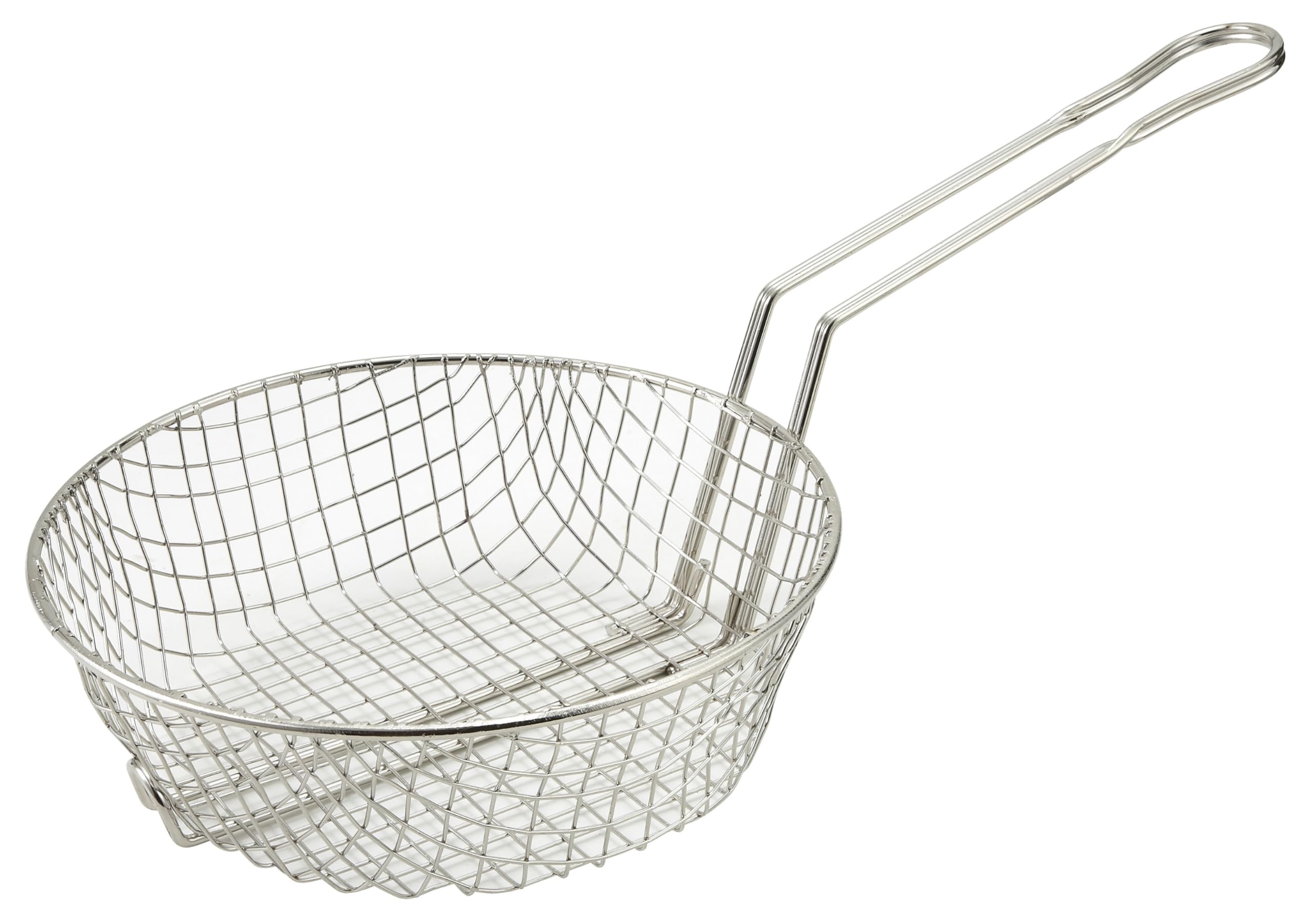
Your fry basket just arrived, you lower it into the oil, and half your breaded calamari rings are sitting on the bottom of the pot — fallen straight through the mesh. It’s a maddening experience, and it happens constantly, because product pages almost universally describe basket dimensions and material without saying a word about the one measurement that actually determines what food you can cook: the size of the holes. That measurement is called mesh coarseness — essentially, how many wire crossings fit into a single inch of basket wall. More crossings per inch means smaller holes; fewer crossings mean larger openings. This guide explains how to read those numbers, why they matter more than marketers let on, and how to make the right call before you buy — not after your shrimp disappear into the oil.
| EDITOR'S PICKWinco Culinary Basket | Mid-tierWinco Culinary Basket | Budget pickHIC Kitchen Fry Basket | |
|---|---|---|---|
| Diameter | 12" | 10" | 7" |
| Mesh Type | Fine | Coarse | — |
| Material | — | Nickel | 18/8 SS |
| Price | $20.22 | $18.18 | $14.99 |
| See on Amazon → | See on Amazon → | See on Amazon → |
What “6-Mesh” Actually Means — and Why It’s on Nobody’s Product Page
When engineers and manufacturers specify wire mesh, they use a mesh count: the number of openings (or wires) per linear inch. A 6-mesh basket has six openings per inch in each direction, which works out to approximately 3.35 mm per opening — roughly the diameter of a pencil eraser. That’s a large hole by kitchen standards, appropriate for thick-cut fries, chicken tenders, onion rings with structural breading, and other foods where nothing smaller than a grape is hitting the oil.
A standard commercial fry basket — the kind you’d find on a Pitco SG14 or a Frymaster MJ45 — typically runs somewhere in the 4- to 6-mesh range. That’s intentional: coarse mesh drains oil fast, resists clogging from starch buildup, and holds up to repeated high-heat cycling in a commercial environment. It is genuinely excellent for its intended purpose. The problem begins when buyers carry that basket into a menu that includes small or fine-breaded foods, because at 6-mesh, a calamari ring — or any piece of food smaller than about 3 mm — simply passes through.
A fine-mesh basket, by contrast, typically runs 10-mesh to 20-mesh or higher (openings as small as 0.8–1.5 mm). These catch small shrimp, finely breaded items, and even seeds. The tradeoff is oil drainage: finer mesh traps more oil between wires, so food needs a longer hang-drain time, and the mesh is more prone to starch and breading fouling in high-volume service.
The Mesh Spectrum at a Glance
| Mesh Count | Approx. Opening Size | Appropriate For |
|---|---|---|
| 4–6 mesh (coarse) | 3.2–4.7 mm | Fries, tenders, rings, whole wings |
| 8–10 mesh (medium) | 2.0–2.4 mm | Breaded shrimp, calamari rings, hush puppies |
| 12–20 mesh (fine) | 0.8–1.5 mm | Whole clams, spice straining, small seeds |
These are general benchmarks, not industry-universal standards — individual manufacturers specify their own wire gauges and tolerances, so always cross-reference the manufacturer’s published opening dimension when it matters.
Where Real Buyers Run Into Trouble — and What the Reviews Reveal
Aggregated owner reviews across multiple SKUs tell a consistent story that product descriptions almost never flag.
The Winco DFBL-10 coarse-mesh basket — a 10-inch round, widely used in both home and light-commercial kitchens — has a strong overall owner reputation. But a notable cluster of four-star reviews includes an explicit caveat: the basket is “not for calamari or clams” because the mesh openings are too large for breading-retention duty. Owners who bought it for fries or wings are satisfied; owners who tried it with fine-breaded seafood learned an expensive lesson. Winco’s own commercial catalog does not specify the mesh count numerically, which is part of why buyers keep getting surprised.
The Lodge cast iron fry basket generates an interesting secondary-use pattern in owner reviews. Because its mesh is relatively tight for a fry basket, several owners report using it not for submerged frying at all, but as a flour-dusting station — loading the basket with pre-floured food, shaking it over a bowl to knock off excess flour, and achieving a more even, light coat than a bag-shake method provides. This is a legitimate and clever use, but it also surfaces a Lodge-specific design complaint worth understanding before you buy.
Multiple Lodge owners flag a drain-tilt problem: when you hang the basket on the pot’s rim to drain after frying, the basket tilts downward (toward the oil) rather than upward (away from it). This matters because a properly draining basket should angle up so gravity pulls oil back into the pot. When the basket tilts the wrong direction, oil pools in the basket and re-saturates the food. The cause is a handle-to-basket angle that wasn’t optimized for pot-edge resting — it’s a geometry issue, not a material defect, but it has real consequences for food quality in any application where oil drainage matters (which is most of them).
The HIC Harold Import Co. 7-inch basket surfaces a different geometric problem. Its tapered (slanted) sidewalls are designed to aid food release, but in straight-walled pots — the most common home frying vessel — the taper means the basket’s hanging hooks make contact with the pot rim at an angle. Reviewers consistently report the hanging bracket slips, fails to seat, or rotates. In a commercial context, this kind of instability would be a liability concern. In a home kitchen, it’s an ergonomic frustration that also affects drainage. The fix is using HIC’s basket only in the tapered vessel it was designed for — but that information doesn’t appear on most product listings.
Cook’s Illustrated’s equipment notes on fry baskets and mesh strainers reinforce the broader pattern: basket geometry and mesh coarseness are interdependent with the cooking vessel, and buying either in isolation from the other produces avoidable mismatches.
Matching Mesh to Menu: The Decision Framework
This is where the practitioner calculus lives. If you’re sourcing baskets for a ghost kitchen, a food truck, or a multi-basket countertop setup, the question isn’t “what’s the best basket?” — it’s “what’s the right coarseness for each station on my menu?”
Wings, fries, and thick-cut product: 4–6 mesh is correct. Coarse mesh drains fast, tolerates high-starch loads, and is easy to clean between drops. The full commercial lineup from Pitco, Frymaster, Vulcan, and Manitowoc ships with coarse-mesh baskets because that’s what the majority of QSR and casual-dining menus require. For these applications, the OEM basket is often worth its price premium — gauge thickness and hook geometry are engineered to the fryer’s specific basket-guide rails, and aftermarket alternatives occasionally fail to seat flush, which affects heat distribution in twin-basket configurations.
Breaded seafood, calamari, and small shrimp: You need at minimum 8-mesh, and 10-mesh is safer for anything in a light tempura or rice-flour batter. Serious Eats’ guide to spider strainers and fry baskets notes that fine-mesh spider strainers are often a better tool than traditional fry baskets for delicate, small-format fried foods — the mesh is finer, the lifting geometry is gentler, and the circular form factor handles irregular shapes better than a rectangular basket.
Spice-infused oils and seed straining (achiote, chili, annatto): Standard fry baskets — even medium-mesh options — will not hold small seeds. Owners of stovetop fry pots that include a secondary fine-mesh screen report that the included screen is what makes the seed-straining application work; the primary basket is irrelevant for this task. If you’re infusing oils as a kitchen prep step, a dedicated fine-mesh strainer or a chinois is the appropriate tool. A fry basket is not a substitute, and no amount of mesh-count shopping will make a standard basket fine enough to retain annatto seeds without a secondary screen.
Flour-dusting and pre-fry coating: As Lodge basket owners document, a medium-coarse fry basket can double as a shaking vessel for knocking excess flour off breaded proteins. This works because you’re not retaining the flour — you want it to fall through. Coarser mesh is actually preferable here; fine-mesh baskets clog with flour and become harder to shake cleanly. This is a secondary use, not a primary one, and it doesn’t affect your mesh-coarseness decision for the frying application itself.
The Drainage Problem Nobody Talks About Enough
Mesh coarseness affects drainage speed, but basket geometry — specifically the handle angle and hook design — determines whether drainage works at all. The Lodge tilt issue is a clear example: a basket with the right mesh count but wrong resting geometry will re-oil your food every time you hang it to drain.
NSF/ANSI 2 (Food Equipment standard, published by NSF International) requires that commercial food equipment be designed to facilitate cleaning and drainage — which is one reason NSF-certified commercial baskets from Pitco and Vulcan specify handle angles that seat above the oil line when resting on the fryer’s built-in basket guides. Consumer and prosumer baskets that lack this standard may seat incorrectly on home pot rims, producing exactly the downward-tilt problem Lodge owners describe.
If drainage quality matters to your operation — and for any volume-frying application, it does — the handle geometry deserves as much scrutiny as the mesh count. Look for published hook-angle specifications or, in the absence of those, owner reviews that specifically address how the basket rests between drops.
Frequently Asked Questions
What mesh size do I need for frying calamari or small shrimp without losing food through the holes? Target 8-mesh to 10-mesh minimum. A 6-mesh coarse basket — standard on most commercial fryers — has openings of roughly 3.35 mm, which is large enough for light breading and small rings to fall through. Aggregated reviews of coarse-mesh baskets consistently flag this for calamari and clam applications. If your fryer only accommodates its OEM coarse basket, a fine-mesh spider strainer used for retrieval is a practical workaround.
Can a fry basket be used as a breading or flour-dusting basket? Yes — and owners of the Lodge cast iron fry basket document this use explicitly. Load your breaded protein, shake over a bowl or sheet pan, and excess flour falls through the mesh. Coarser mesh works better for this application than fine-mesh (fine mesh clogs with flour). Note that this is a secondary use; it doesn’t replace a proper dredging station for high-volume service.
Why does my basket tilt downward when I hang it on the pot edge to drain? This is a handle-angle geometry issue, most commonly reported with the Lodge fry basket. The angle at which the handle connects to the basket body determines whether the basket rests above or below the pot rim’s center of gravity. When the geometry is off, the basket dips toward the oil rather than angling up — and oil pools in the basket instead of draining back into the pot. The fix is either a fryer with built-in basket guides (which hold the basket at the correct angle mechanically) or choosing a basket whose handle geometry is documented to seat above rim level on your specific vessel.
What is the difference between a 6-mesh and a standard coarse fry basket? “6-mesh” is a specific measurement: six openings per linear inch, yielding approximately 3.35 mm openings. “Standard coarse” is a marketing descriptor with no fixed specification — it could mean 4-mesh, 5-mesh, or 6-mesh depending on the manufacturer. When mesh count matters (i.e., when you’re frying small or fine-breaded food), ask for the numerical mesh count or the opening dimension in millimeters. If a product page only says “coarse mesh,” treat it as unverified and assume maximum opening size until proven otherwise.
Is there a basket fine enough to strain achiote seeds or spice-infused oil? Not among standard fry baskets. Achiote (annatto) seeds are small enough to pass through even medium-mesh fry baskets. Owners of stovetop fry pots that include a secondary fine-mesh insert report that the included screen — not the basket — handles seed straining. For oil infusion as a prep step, a fine-mesh strainer, a chinois, or a purpose-built oil filter is the correct tool. If you’re sourcing equipment for a commercial kitchen where spice-oil infusion is a regular prep step, spec it as a separate station from your fry basket setup.
The Decision Rule
If X, then Y:
- Frying wings, fries, tenders, or onion rings at any volume → 4–6 mesh coarse basket, OEM or NSF-certified aftermarket, matched to your fryer’s basket guides.
- Frying calamari, small shrimp, or finely breaded seafood → 8–10 mesh minimum; if your fryer doesn’t support a finer basket, supplement with a fine-mesh spider for retrieval.
- Flour-dusting or pre-fry coating as a prep step → any medium-coarse basket works; coarser is better; no separate purchase needed if you already own a fry basket.
- Straining achiote, spice seeds, or infused oil → do not buy a fry basket for this task; source a fine-mesh strainer or chinois separately.
- Unsure about drainage geometry on a consumer basket → read owner reviews specifically for pot-edge resting behavior before purchasing; the Lodge tilt complaint and HIC bracket-slip complaint are both patterns that show up clearly in aggregated reviews and are worth checking on any basket you’re considering for a straight-walled vessel.
Mesh coarseness is the spec that product pages skip and buyers discover the hard way. Now you know what to ask for — before the basket arrives.