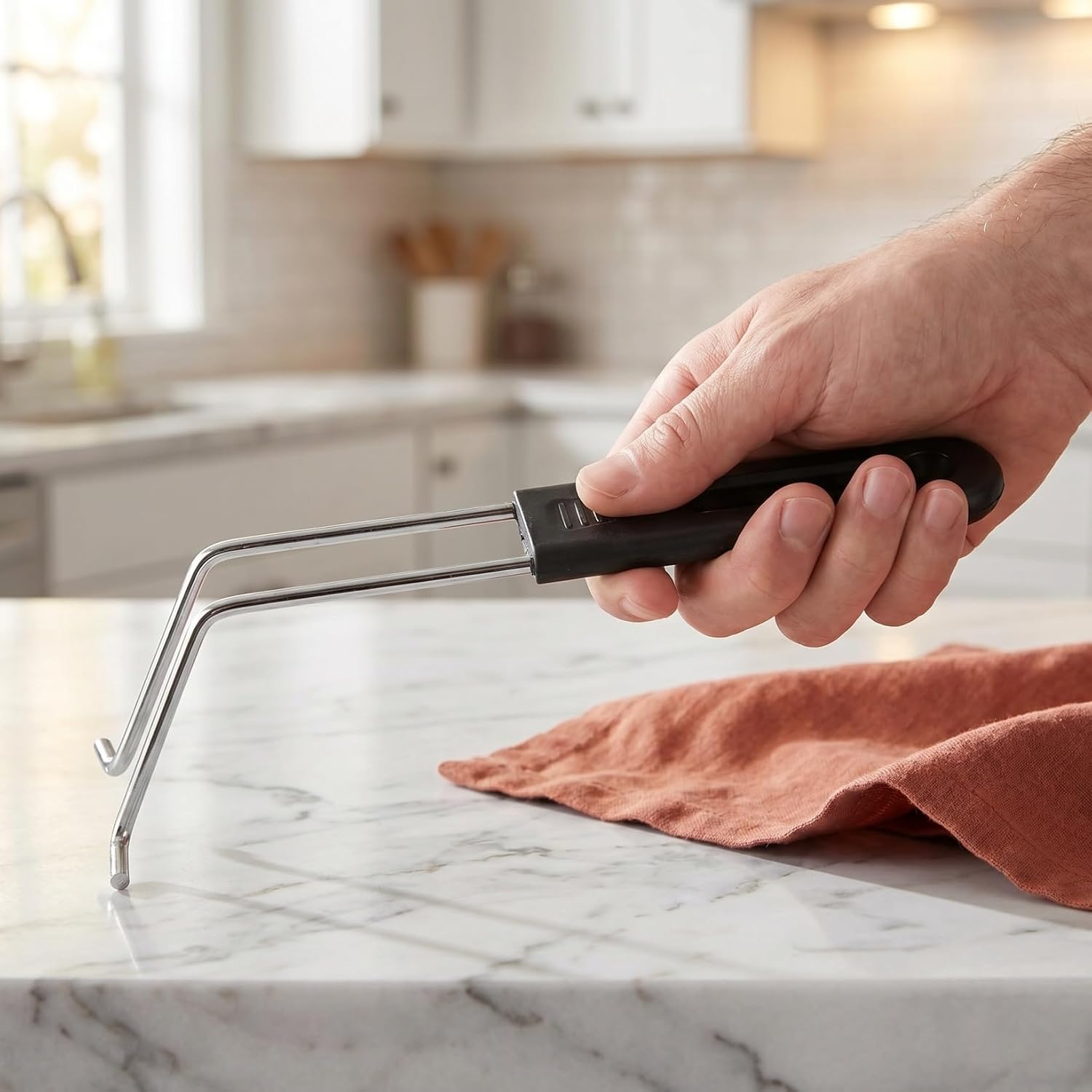
If your deep fryer basket (the metal mesh container that holds food in hot oil) is otherwise in good shape but the handle — the grip you use to lower and lift it — is cracked, loose, or snapped off, you have a real decision to make before you spend money. The basket body itself is the expensive, wear-intensive part. Handles are often replaceable on their own, sometimes for a few dollars in parts. But not always — and buying the wrong handle or forcing a repair on a basket that’s actually worn out can cost you more in the long run, especially in a commercial kitchen where a dropped basket means a burn risk and a potential health-code conversation. This guide walks through exactly how to make that call: assess what you actually have, price out both paths, and leave with a clear decision rule whether you’re running a home countertop fryer or a six-basket Pitco floor unit.
| EDITOR'S PICKWinco Green Fry Basket Handle | Mid-tierWinco FB-PB Fry Basket Press fo… | Budget pickGarneck Heatproof Replacement F… | |
|---|---|---|---|
| Fits basket model | — | FB-10, FB-20 | — |
| Heat resistant | — | — | ✓ |
| Non-slip grip | — | — | ✓ |
| Material | — | Stainless steel | — |
| Color | Green | Silver | — |
| Price | $27.58 | $16.21 | $9.99 |
| See on Amazon → | See on Amazon → | See on Amazon → |
What a Fry Basket Handle Is (and What Makes It Fail)
A fry basket handle is the rigid or semi-rigid extension welded, riveted, or hooked onto the basket body — your connection point when the basket is submerged in 350°F oil. Handles on commercial baskets are typically 304 stainless steel, sometimes with a phenolic (heat-resistant plastic) or silicone grip molded or welded onto the shaft. Consumer-grade and budget aftermarket handles are more frequently mild steel with nickel plating or 201 stainless — grades that hold up less well under repeated high-temperature cycling and commercial dishwasher alkalinity.
Failure modes break down into three categories:
- Weld failure — the handle separates at the point where it joins the basket frame. Common in high-volume commercial use after 12–24 months. The basket body is usually undamaged.
- Grip degradation — the plastic or silicone overmold cracks, melts, or delaminate. More a safety and comfort issue than a structural one.
- Corrosion at the joint — pitting and rust at the handle-to-frame weld, often a sign of 201 stainless or nickel-plated steel sold as heavier-duty material. Per KaTom Restaurant Supply Blog’s Fryer Basket Buying Guide, this is one of the most common quality complaints on budget aftermarket baskets: corrosion concentrates right at the handle attachment point because that’s where dissimilar metals, flux residue, and moisture pool.
The critical diagnostic question is whether the failure is isolated to the handle or whether it’s a symptom of overall basket degradation. If the mesh has thinning welds, the frame is bent, or there’s visible corrosion spreading across the basket body, no handle fix changes the picture — you’re buying a new basket.
The Repair-vs-Replace Math
Here’s the framework. Four numbers matter:
By the Numbers — Handle Repair Decision
| Scenario | Handle cost (OEM or aftermarket) | New basket cost | Repair makes sense if… |
|---|---|---|---|
| Commercial OEM (Pitco SG/SSH, Frymaster HD50) | $18–$45 per handle | $90–$250 per basket | Basket body is sound; >12 months life remaining |
| Prosumer countertop (Waring, Cuisinart Pro) | $8–$22 per handle | $40–$95 per basket | Handle is the sole failure; mesh and frame intact |
| Budget home fryer (sub-$60 fryer) | $5–$15 aftermarket | $12–$28 replacement basket | Often not worth the repair labor; basket is cheaper |
| Multi-basket commercial config (Vulcan VC/VEG) | $22–$55 per handle | $120–$220 per basket | Yes, if OEM handle + labor < 30% of new basket cost |
The 30% rule is a practical ceiling: if a handle replacement (parts + any labor) costs more than 30% of a new basket, the marginal life extension rarely justifies it unless the basket body is genuinely in exceptional condition or the model is on extended lead time.
Frymaster’s Dean Series Fryer Replacement Parts Manual confirms that handle assemblies for HD50 and MJ45 models are sold as discrete line items — meaning the manufacturer explicitly designed these as field-replaceable components. The same is true for Pitco’s SG and SSH series per Pitco’s OEM parts catalog. When a manufacturer lists a handle assembly with its own part number, they’re telling you this repair path is valid. When they don’t — when the basket is sold only as a whole unit — that’s a signal the basket construction doesn’t support easy handle swap.
OEM Handle vs. Aftermarket Handle: The Tradeoff Table
For commercial operators, the handle material and certification status genuinely matter. NSF International’s NSF/ANSI 4 standard covers commercial cooking equipment and requires that food-contact components be made from corrosion-resistant, smooth, non-toxic materials that can withstand repeated cleaning. Per NSF International’s published standard documentation, that includes replacement parts installed in the field — a non-OEM handle that hasn’t been certified doesn’t carry that compliance coverage automatically, which can matter during a health-department inspection.
If you’re in a commercial kitchen under inspection:
- OEM handles (Pitco, Frymaster, Vulcan-Hart) arrive with documentation and are made to the same spec as the original. Per Vulcan-Hart’s OEM Parts Guide, their replacement handle kits for VC and VEG series fryers are manufactured to the original tolerances and materials — 304 stainless, same gauge, same weld geometry.
- Aftermarket handles sourced through restaurant supply distributors like WebstaurantStore or KaTom can be cost-effective, but per WebstaurantStore Blog’s Commercial Fryer Baskets guide, operators should verify the supplier’s spec sheet explicitly states 304 stainless construction and provides compatible model numbers rather than relying on “universal fit” claims.
If you’re a home or prosumer user: Aftermarket is almost always the right call on cost. The stakes on NSF compliance don’t apply to a home kitchen, and a well-sourced 304 stainless aftermarket handle from a named restaurant-supply seller is functionally equivalent for residential use.
One practical note on “universal” handles: the term is marketing language. Handles attach via specific mechanisms — hook-over-frame, rivet-through-frame, or welded collar — and the basket frame tube diameter and hook gap vary by manufacturer and era. A handle rated “fits most 1/2-size commercial baskets” may still need a 3mm shim or may not seat flush with a Pitco SSH frame versus a Dean Series frame. Measure your existing handle’s mounting geometry before ordering.
How to Assess Your Basket Before You Decide
Walk through this five-point check before you order anything:
1. Frame straightness. Set the basket on a flat surface. The frame should sit flat on all four corners. Any rock means the frame is bent — that won’t be corrected by a new handle, and a bent basket doesn’t seal evenly against the fryer well, which affects fry evenness.
2. Mesh weld integrity. Run your thumb firmly along the interior mesh seams. Any loose wire ends, open welds, or soft spots are a food-safety risk (loose wire = contamination vector) and a sign of material fatigue throughout the basket.
3. Handle attachment point. Inspect the weld or rivet where the handle meets the frame. Surface rust is one thing; pitting or a crack propagating into the frame body means the metal is failing at the structural joint, not just at the handle itself.
4. Corrosion pattern. Spot rust on the handle shaft is manageable. Rust that’s spreading from the handle joint into the basket frame is a systemic materials issue — this is the 201 stainless or nickel-plating failure pattern. Once it’s in the frame, you’re buying a new basket.
5. Manufacturer part number availability. Look up your fryer model and basket model number (usually stamped on the frame or in the fryer’s owner manual). If the manufacturer lists a handle assembly as a discrete part, the repair path is fully supported. If they don’t, you’re either doing a DIY fabrication repair (not recommended for commercial use) or buying new.
The Decision Rule
If your situation fits one of these descriptions, here’s the call:
If the basket body passes the five-point check AND the manufacturer lists a handle part number → repair. Buy OEM if you’re in a commercial kitchen under inspection; buy 304 stainless aftermarket (verified by spec sheet, not just marketing copy) if you’re in a home or prosumer kitchen. The economics are clear: you’re spending $18–$55 to extend the life of a $90–$250 basket.
If the basket shows corrosion spreading from the handle joint, bent frame, or loose mesh welds → replace the whole basket. A handle repair here is throwing good money at a basket already in structural decline. Operators in this position should also audit how that basket failed — if it’s under 12 months old, the material grade was likely undersold and the replacement selection should prioritize documented 304 stainless construction.
If you’re on a consumer-grade fryer under $60 and the replacement basket costs $12–$28 → skip the repair. The labor time of sourcing and swapping a handle on a sub-$60 fryer basket usually exceeds the cost of just buying a new basket, especially when full replacement baskets at this price point are readily available through restaurant supply retailers.
If you’re in a multi-basket commercial configuration and even one handle failure grounds a basket → keep OEM handles on hand as consumable stock. KaTom Restaurant Supply Blog’s Fryer Basket Buying Guide notes that high-volume operators typically treat fry basket handles the same way they treat fryer screens and skimmers: as a supply-room line item with a par level, not a one-off emergency purchase. Carrying two replacement handles per active fryer cuts the downtime decision to near zero.
The basket body is where your money and your frying performance live. The handle is the consumable. Treat it that way and the math almost always works in your favor.