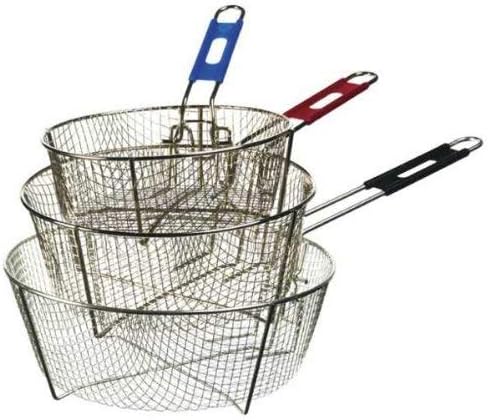
If you’ve ever lifted a basket of fried chicken out of hot oil, hooked it on the pot’s rim to drain, and watched the whole thing tilt nose-down — dumping half your food toward the front — you’ve run into what we’re calling the tilt problem. A fry basket’s draining hook (the curved metal piece that hangs the basket on the pot wall while oil drips back in) sounds simple, but it only works as intended when the hook geometry matches the pot diameter precisely. Get that relationship wrong by even half an inch and the basket seesaws forward instead of sitting level. Most product listings don’t mention this. Most reviewers don’t flag it until they’re writing their two-star note. This guide explains why it happens, which basket designs are most prone to it, what the math looks like for common pot sizes, and how to make a confident buying decision before you’re stuck improvising with tongs.
| EDITOR'S PICKLodge Silver Deep Fry Basket -… | Mid-tierLodge Deep Frying Basket | Budget pickWinco FBR-9 Steel Round Wire Fr… | |
|---|---|---|---|
| Diameter | 11.5 in | 9 in | 9 in |
| Material | Nickel-plated steel | — | Steel |
| Shape | — | — | Round |
| Build | — | — | Wire |
| Price | $29.99 | $24.90 | $18.42 |
| See on Amazon → | See on Amazon → | See on Amazon → |
Why the Hook Geometry Goes Wrong
A draining hook works on a simple lever principle. The hook catches the pot rim, the basket hangs on the outside of that fulcrum point, and the basket’s own weight — plus the food in it — should keep the whole assembly level or gently tilted back toward the pot. That’s the intended resting angle: flat to very slightly back-tilted, so oil runs toward the pot rather than toward your stovetop.
The problem starts when the hook’s contact point is too close to the basket’s center of gravity. On a correctly sized pairing, the hook grabs high on the pot wall, the basket hangs well outside the rim, and the moment arm (the physics term for the distance that determines how something rotates around a pivot) keeps everything balanced. Shrink the pot diameter — or widen it — and the hook contacts the rim at a different height relative to the basket. On a pot that’s too narrow for the hook, the contact point drops lower on the wall, shortening the stabilizing moment arm on the back side and letting the basket’s front-heavy load win. The result: tilt-down.
Aggregated customer reviews of the Lodge round basket consistently flag this exact failure mode, with multiple reviewers describing it as their only complaint on an otherwise well-built product. The complaint isn’t about the basket’s construction — Lodge’s seasoned carbon steel is well-regarded — it’s about the hook-to-pot pairing. When Lodge reviewers are frying in a Lodge cast iron Dutch oven or skillet with a matching diameter, the ratings climb. When they’re improvising with a pot they already own, the tilt complaints follow.
The Tapered-Side Variable Most Buyers Miss
Straight-walled round baskets and tapered-side round baskets look similar at a glance, but they create very different hook contact geometry. A straight-walled basket’s hook is designed to contact the rim of the pot at a consistent angle regardless of how much of the basket is submerged. A tapered-side basket — where the basket walls angle outward from bottom to top — has a hook position optimized for a specific rim diameter. On a wider pot, that hook sits correctly. On a narrower pot, the geometry shifts.
The HIC 7-inch basket is a documented example. Across multiple aggregated reviews, a recurring 3-star criticism points specifically to the tapered-side design: when the basket is used in a narrower pot, the hanging bracket contacts the rim at the wrong point on the taper, producing the same nose-down tilt. The HIC basket earns strong marks for wire gauge and overall build, but the design flaw is consistent enough that reviewers specifically call it out as a fit problem rather than a quality problem — which is exactly the distinction a practitioner needs to make before purchasing for a specific setup.
By the numbers:
| Basket diameter | Recommended minimum pot diameter | Margin for hook clearance |
|---|---|---|
| 7 in (HIC style) | 7.5–8 in inner diameter | ≥ 0.5 in per side |
| 9 in (Le Creuset style) | 9.5–10 in inner diameter | ≥ 0.5 in per side |
| 11.5 in (Lodge large) | 11–11.5 in inner diameter | Rim-fit dependent |
Le Creuset’s own product listing and customer Q&A for their 9-inch detachable-handle basket explicitly notes compatibility with the 5.5-quart Dutch oven — a pairing that reviewers consistently confirm works without tilting. That 5.5-quart round Le Creuset has an inner diameter of approximately 9.5 inches at the rim, giving the 9-inch basket just enough clearance that the hook contacts the rim at the correct height. One Le Creuset buyer in the aggregated review pool describes this pairing in exactly those terms, calling it a perfect fit and contrasting it with a previous experience using the same basket in a narrower pot.
The Winco Exception: A Different Draining Convention
If you’ve researched commercial-tier round baskets, you’ve probably come across Winco stainless options and noticed something unusual: the reviews are consistently positive on build quality, but almost nobody mentions a hook. That’s not an oversight. Winco’s round fry basket designs — per their published product specification sheets — often use a handle-and-rest convention rather than a hook-over-the-rim draining system. The basket rests across the pot on a handle or cross-bar that spans the opening, keeping the basket elevated above the oil line without requiring rim contact.
This is a meaningful operational difference. The hook-over-rim system creates the tilt problem because it relies on rim geometry for stability. The handle-rest-across-top system doesn’t — it’s pot-diameter-agnostic as long as the handle span exceeds the pot’s opening. For practitioners running multiple pot sizes in a ghost kitchen or food-truck setup, Winco’s convention eliminates the sizing math entirely. The tradeoff is that handle-spanning designs require a pot opening wide enough for the handle to seat without wobbling, and they’re not interchangeable with basket hooks designed for commercial fryer rail systems.
Serious Eats’ equipment coverage of fry baskets and spider strainers notes that draining method matters as much as mesh fineness when evaluating round basket performance — a point that’s easy to overlook when listings lead with wire gauge and capacity.
Fixed Hook vs. Detachable Handle: The Decision Frame
This is where the tilt problem intersects with a broader design question. Fixed-hook baskets are one piece: the hook is welded or bent as part of the basket frame, so the hook geometry is fixed relative to the basket. Detachable-handle baskets (like the Le Creuset 9-inch) separate the handle from the basket body, which means the draining position is determined by how you rest the detached handle across the pot — giving you more flexibility to find a stable position.
For a home cook using one or two pots of known dimensions, a well-matched fixed-hook basket is simpler and typically more affordable. The hook does the work; you don’t have to think about it. But if the basket is even slightly mismatched to the pot — wrong diameter, tapered sides, shallow rim — the fixed hook gives you no adjustment. You’re locked into the tilt.
A detachable-handle basket trades that simplicity for adaptability. The Le Creuset format, for instance, lets you seat the handle across the pot rim at whatever angle provides the most stable hang. Reviewers using this system in correctly sized Dutch ovens report zero tilting. The handle attachment point becomes the draining fulcrum, and since you’re placing it manually, you can correct for minor diameter mismatches.
Decision rule: If you’re buying for a single, known pot and you’ve confirmed the diameter match against the basket’s published hook geometry specs, a fixed-hook basket is the cleaner choice. If you’re buying for multiple pots, an unfamiliar pot, or any setup where the rim diameter is uncertain, a detachable-handle design eliminates the variable.
Frequently Asked Questions
Why does my fry basket tilt down instead of sitting level when I hook it on the pot?
The hook is contacting the pot rim at a lower point than the design assumes, shortening the stabilizing moment arm on the back side of the basket. This almost always means the pot’s inner diameter is narrower than the basket’s hook was calibrated for. Check the basket’s published specs against your pot’s actual inner rim diameter — not just the nominal quart size, which doesn’t tell you rim dimensions.
What pot diameter do I need for a 9-inch round basket to sit correctly?
Based on Le Creuset’s confirmed pairing and aggregated reviewer reports, a 9-inch round basket needs a pot with an inner rim diameter of at least 9.5 inches to give the hook enough clearance to contact the rim at the correct height. Tighter than that and the tilt problem appears. The Le Creuset 5.5-quart Dutch oven at approximately 9.5 inches inner diameter is the most frequently confirmed working match in owner reviews.
Does the Lodge 11.5-inch basket fit the Lodge cast iron chicken fryer?
Lodge’s product Q&A and cross-reference materials address this pairing, and the answer depends on the specific chicken fryer model. Lodge’s 5-quart cast iron chicken fryer has a top opening of approximately 11 inches, which is slightly narrower than the 11.5-inch basket’s outer diameter. Reviewers report mixed results — some find the hook seats correctly on the rim; others find the basket rests on the rim walls rather than hooking cleanly. Confirming inner-rim measurements against Lodge’s published basket dimensions before purchasing is the safer path than relying on the nominal size match.
Can I bend the hook to fix a tilting basket, or will that weaken it?
For carbon steel baskets like Lodge’s, modest hook adjustment is physically possible but carries real risk. Bending work-hardens the metal at the bend point, and if the basket is seasoned or coated, bending can crack the finish. More importantly, a field-bent hook is an unknown geometry — you’re as likely to overshoot as to land on the correct angle. The safer fix is matching the basket to the correct pot rather than modifying the hardware. If you’re committed to making a mismatched pair work, a detachable-handle basket eliminates the problem without requiring any metalwork.
Is a detachable-handle basket better for draining than a fixed-hook basket?
Better is context-dependent. Detachable-handle baskets offer more positional flexibility during draining because you’re manually seating the handle rather than relying on a fixed hook geometry. For multi-pot kitchens or any setup where pot diameter varies, detachable handles win. For a single, correctly matched pot, a fixed-hook basket is simpler and has fewer moving parts to lose. The Le Creuset detachable-handle format earns consistently strong reviews specifically from users who fry in multiple vessel types.
Do tapered-side baskets always cause draining problems on smaller pots?
Not always — but the risk is higher than with straight-walled baskets. The HIC 7-inch tapered basket is the clearest documented case, with reviewers specifically identifying the taper as the cause of hook misalignment on narrower pots. Tapered-side baskets have a hook designed for a specific rim diameter that matches the basket’s widest point. Use the basket in a pot narrower than that target diameter and the hook’s contact point migrates down the wall, creating tilt. The fix is using the basket in a pot at or above the target diameter — or choosing a straight-walled design where the hook geometry is less sensitive to pot size variation.