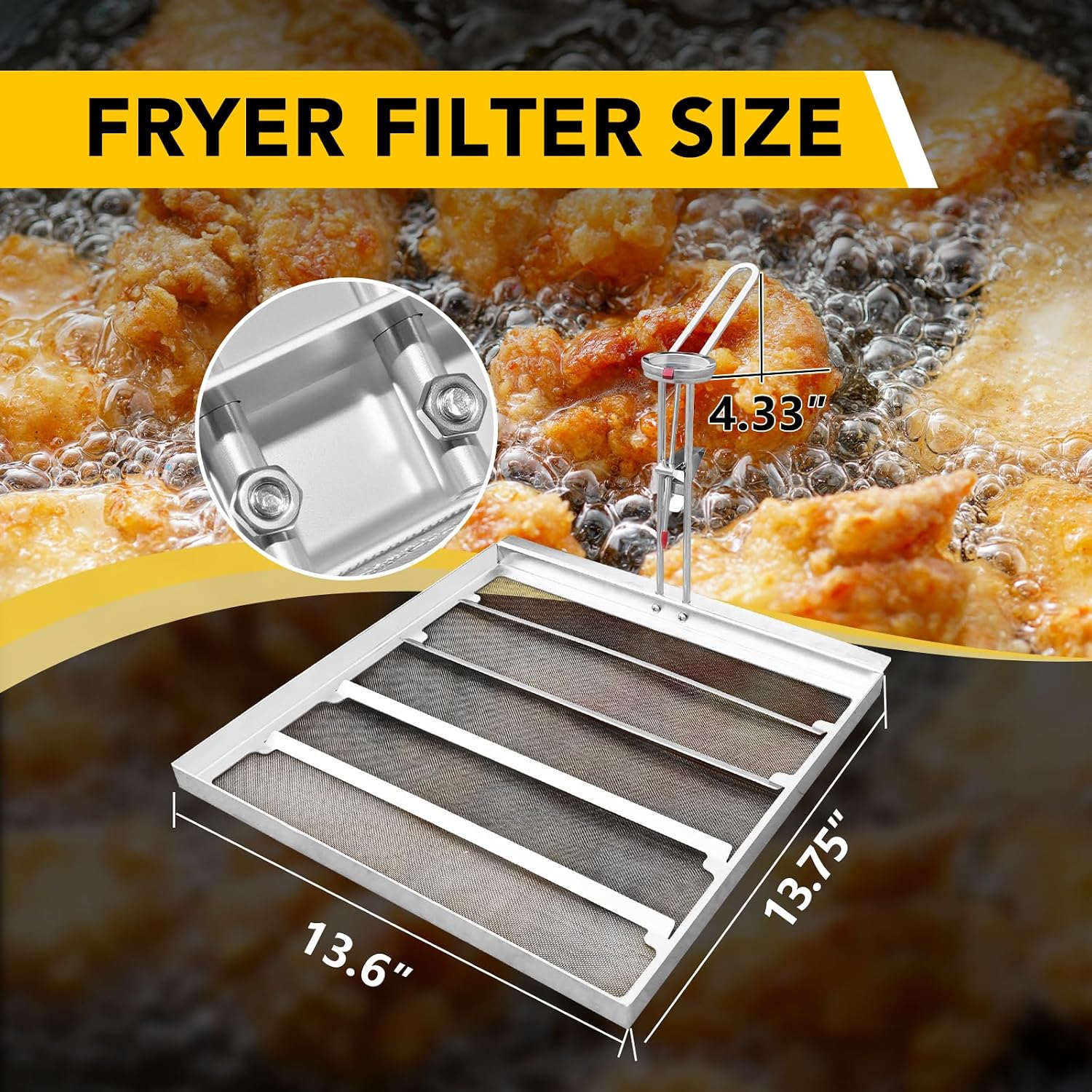
If your deep fryer basket just started looking gunky and your oil is going dark faster than it should, here’s what’s happening: every time food hits hot oil, it sheds tiny particles — crumbs, batter fragments, breading flakes — that sink to the bottom of the fryer vat and keep cooking. Those burned particles (the industry calls them “fines” or “carbon particles”) accelerate what’s called oil degradation — a process where heat, oxygen, and contamination break oil down chemically, making it darker, more acidic, and worse-tasting. A $400–$800 commercial oil filtration machine solves this with a pump, filter paper, and a holding tank. But before you get there, a $10–$60 filter screen or strainer basket can do a surprising amount of the same work by physically removing those fines before they burn. This guide explains what these low-tech tools actually do, what separates a useful one from a useless one, and the honest decision rule for when the filter machine becomes worth the investment.
| EDITOR'S PICKCommercial Deep Fryer Filter Sk… | Mid-tier(100 Pack) Commercial 10" Deep… | Budget pickWinco Universal Fryer Screen | |
|---|---|---|---|
| Type | Mesh skimmer | Filter cones | Fryer screen |
| Material | Stainless steel | — | Chrome plated |
| Size | 13.75" x 13.6" | 10" | 13" x 13" |
| Quantity | 1 | 100 pack | 1 |
| Fits brand | Dean SR142GN | — | Universal |
| Manual | ✓ | — | — |
| Price | $96.69 | $36.99 | $11.05 |
| See on Amazon → | See on Amazon → | See on Amazon → |
What Filter Screens and Strainer Baskets Actually Do (and Don’t Do)
Let’s be precise about the mechanism, because a lot of products in this category are sold with vague claims.
What they do: A fryer oil strainer basket — essentially a fine-mesh basket you ladle or pour oil through — physically catches suspended solids above a certain particle size. A filter screen placed over a holding pot or drain port does the same thing passively as oil flows through it. Both interrupt the cycle where fines stay in the vat, carbonize, and accelerate oil breakdown.
What they don’t do: They don’t remove dissolved contaminants — free fatty acids, polar compounds, and oxidation byproducts that accumulate in oil over time regardless of solid particle load. They also don’t remove water introduced by wet or frozen food, which causes its own degradation pathway. The WebstaurantStore blog’s oil-life guide notes explicitly that mechanical filtration removes particulates, but chemical degradation requires either filter powder (like magnesium silicate) or oil replacement.
This distinction matters for your purchasing decision. If your oil is degrading from heavy particulate load — high-volume fry operations, breaded product, fish — a strainer basket returns real value. If you’re frying clean items (plain fries, tortilla chips) at moderate volume and your oil is still going dark in two days, you likely have a temperature or turnover problem that no screen solves.
The practical takeaway: Filter screens and strainer baskets extend oil life by addressing one of several degradation pathways. They’re a lever worth pulling, but not the only lever.
The Hardware: What You’re Actually Buying
Strainer Baskets
A fryer oil strainer basket is a fine-mesh basket — typically 8 to 14 inches in diameter — with a handle or bail, used to ladle hot oil from the vat into a holding pot or filter unit. The mesh catches fines as oil passes through.
Mesh size matters enormously here. Mesh is measured by the number of openings per linear inch — a 20-mesh screen has 20 openings per inch, a 40-mesh has 40. For catching the breadcrumb and batter fines that damage oil fastest, you want at minimum 20-mesh; 30–40 mesh catches finer particles but flows slower and clogs faster.
Material determines whether this is a one-month tool or a five-year tool:
- 201 stainless: Cheaper, lower corrosion resistance. The Katom blog’s fryer oil management guide flags that 201-grade stainless is commonly used in budget strainer baskets marketed as “commercial grade” — it will rust at welds and where mesh meets frame when exposed repeatedly to hot oil and cleaning chemicals. Fine for home use, a liability in commercial volume.
- 304 stainless: The minimum spec worth buying for any foodservice application. Better corrosion resistance, holds up to repeated hot-oil contact and alkaline fryer cleaners. NSF/ANSI 8 (the commercial food equipment standard from NSF International) requires materials to be non-toxic, corrosion-resistant, and cleanable — 304 stainless reliably meets this; 201 is borderline.
- Nickel-plated steel: Avoid for oil straining. The plating degrades with heat and repeated chemical cleaning, exposing base steel. Operators in long-run reviews on WebstaurantStore consistently note plating failure within 3–6 months of daily commercial use.
Sediment Trays and Crumb Screens
Separate from strainer baskets, sediment trays are flat or slightly dished screens that sit in the bottom of the fryer vat or directly above the heating elements. Their job is passive: they catch fines before those particles contact the elements and carbonize.
These are more nuanced than they appear. The fryer vat geometry matters — a sediment screen that doesn’t fit flush creates a gap where fines accumulate underneath it, defeating the purpose. For OEM-fit applications, Pitco, Frymaster, and Vulcan all publish replacement part numbers for their vat screens. Per Foodservice Equipment Reports’ overview of oil filtration basics, properly fitted sediment trays can meaningfully reduce the rate at which fines carbonize at the element level — the key word being “properly fitted.”
Drain Port Filter Assemblies
Some commercial fryers — particularly Frymaster’s MJ and MJCF series and Pitco’s Solstice line — have built-in filter-ready drain ports that accept aftermarket filter cone assemblies. These are disposable paper or reusable mesh cones that catch fines during the drain cycle. If your fryer model supports this, a reusable 304-stainless cone filter in the $20–$45 range is one of the most cost-effective oil management tools available. Check your fryer’s installation manual for drain port specifications before buying — cone diameter and thread pattern vary by brand and generation.
The Economics: When the Math Favors Low-Tech
Here’s the decision frame that makes this concrete.
By the numbers — fryer oil cost benchmarks (May 2026):
| Operation type | Oil capacity (lbs) | Avg. oil cost | Change frequency without filtration | Cost/week |
|---|---|---|---|---|
| Food truck (single 15-lb fryer) | 15 lbs | ~$0.80–$1.10/lb | 3–4× per week | $36–$66 |
| Ghost kitchen (twin 40-lb fryers) | 80 lbs total | ~$0.75–$0.95/lb | 2–3× per week | $120–$228 |
| QSR / casual (80-lb vat) | 80 lbs | ~$0.75–$0.95/lb | 2× per week | $120–$152 |
Per Restaurant Business Online’s operating cost benchmarks for quick-service frying operations, effective filtration — including mechanical particulate removal — can extend oil life by 50–100% in high-volume breaded-product operations. Even at the conservative end (50% extension), a ghost kitchen spending $150/week on oil saves $75/week, or roughly $3,900 annually. A $400 filtration machine pays back in about five weeks. A $40 strainer basket doesn’t replicate that — but for a food-truck operator changing a 15-lb vat, the math is different: even a 25–30% extension from disciplined straining yields $9–$20/week saved, and the $40 basket is paid off in two or three days.
The honest tradeoff: Low-tech straining requires labor discipline. You need someone to strain the oil every 1–2 hours during service, which adds approximately 5–10 minutes per session. In a staffed commercial kitchen, that labor cost may exceed the savings. On a food truck where the operator is already managing every station, it pencils out clearly.
Matching Tool to Operation: The If/Then Decision Framework
This is where practitioners tend to under-specify. Here’s the decision tree based on published operational data and aggregated operator experience:
If you’re a food-truck or pop-up operator with a single fryer under 20 lbs: A 304-stainless strainer basket (30-mesh minimum, with a heat-safe handle rated for oil temps) plus a dedicated filter pot is your most cost-effective move. Total investment: $30–$65. Strain every 90 minutes during service. The Katom blog’s fryer oil management guide recommends this as baseline practice before any powered filtration investment.
If you’re a ghost-kitchen or small QSR with twin fryers and breaded protein volume: You’re already in the range where a filter machine ROI is real — but use strainer baskets as an interim measure or as a complement, not a substitute. The machine handles the drain-and-filter cycle efficiently; the basket handles the in-service skimming between full cycles. Budget $40–$80 for a quality strainer setup and use it.
If you’re a restaurant kitchen manager with a 40–80 lb vat running a full-service menu: At this volume, the $400–$800 filter machine is almost certainly already justified. The framing question here is whether your current filter machine’s consumables (filter paper, powder) are being used correctly — Foodservice Equipment Reports notes that improperly loaded filter envelopes and skipped powder applications account for a significant share of “filtration isn’t working” complaints in commercial settings. Before buying anything new, audit the process.
If you’re a home cook or prosumer with a countertop fryer under 8 lbs: A fine-mesh sieve (30–40 mesh, stainless) and a clean glass or stainless holding vessel between uses will do most of what a dedicated strainer basket does, for less money. NSF certification isn’t relevant at this level — food safety is still managed by temperature and oil freshness. Strain after every session, store covered, and discard when the oil reaches a dark amber color or develops a sharp, acrid smell.
What to Actually Look For on the Spec Sheet
When evaluating any filter screen or strainer basket — OEM or aftermarket — these are the specs worth checking:
Mesh size: Stated as X-mesh or X wires per inch. Minimum 20-mesh for commercial use; 30–40 mesh for fine-particle capture. Anything coarser than 16-mesh won’t catch the fines that matter.
Wire diameter (gauge): Heavier wire means longer-lasting mesh but slower flow. For a strainer basket used in active service, 0.016–0.020-inch wire diameter in 304 stainless is a reasonable target. Budget screens often use 0.010-inch wire that deforms after a few weeks of heavy use.
Frame and handle construction: Welded 304-stainless frame with a handle that won’t conduct heat to the grip. Some operators in WebstaurantStore reviews flag that folded (non-welded) frames trap oil and food debris in the seam — a cleaning and food-safety problem in commercial settings.
NSF listing: For any commercial application, look for NSF/ANSI 8 listing or confirm the material spec independently. NSF International maintains a publicly searchable certified-products database — if a manufacturer claims NSF compliance, the listing should be findable there. “NSF-grade materials” without a listing number is a marketing claim, not a certification.
The Bottom Line
The $400 filtration machine isn’t overkill — at commercial volume, it’s the right tool. But the path to justifying it runs through understanding what you’re actually solving: particulate contamination is the lever these screens pull, and it’s a real lever worth the $30–$65 investment even if powered filtration is coming eventually. Buy 304-stainless, specify mesh size before you order, match the tool to your drain port or vat geometry, and strain on a disciplined schedule. For most food-truck and ghost-kitchen operators, that discipline alone is worth one or two extra oil changes per month — and at current oil prices, that math closes fast.