Commercial Fry Baskets for Home Kitchens: What ‘Heavy Duty’ Actually Delivers — and Where Welds Fail
If your home fryer basket just snapped a weld — the wire-to-wire joint that holds the mesh together — you’re not alone, and you’re probably already shopping for something labeled “commercial grade” or “heavy duty.” Those phrases sound reassuring, but in the fry basket market they are marketing words, not engineering standards. A commercial fry basket is simply a wire-mesh basket designed to hold food in hot oil; the wire is welded at every intersection and the handle is welded or crimped to the frame. The difference between a $14 basket and a $90 one comes down to what metal those wires are made of, how thick they are, and how well those hundreds of tiny welds hold up over time. This article walks through what spec sheets, published equipment guides, and aggregated buyer reviews actually reveal — so you can make a smarter call before your next purchase arrives already wobbling.
The Materials Problem Nobody Puts on the Front of the Listing
The first thing to sort out: what metal are you actually buying?
The phrase “stainless steel” covers a wide spectrum. Grade 304 stainless — sometimes called 18/8, meaning 18% chromium and 8% nickel — is the foodservice standard. It resists corrosion, handles repeated oil immersion without pitting, and is what NSF International’s food equipment standard NSF/ANSI 2 effectively requires for commercial certification. Grade 201 stainless is a lower-nickel alloy that costs less to manufacture, is more susceptible to corrosion in acidic or high-salt environments, and is frequently sold under the same “stainless steel” label without any grade disclosure. Nickel-plated iron is something else entirely — carbon steel wire with a thin nickel coating that can flake over time and is not equivalent to stainless by any meaningful measure.
Cook’s Illustrated, in its equipment notes on deep fryer basket materials and durability, has flagged this as a recurring category-wide issue: baskets listed as stainless steel sometimes turn out to be nickel-plated on inspection. Nickel-plated baskets can look identical to stainless in product photography, and without a magnet test most buyers won’t know until the basket starts showing rust spots or the coating chips.
The practical test: Hold a kitchen magnet to the wire mesh, not the handle — handles are sometimes a different alloy. If it pulls hard, you likely have plated iron or 201 stainless at best. Weak attraction or none is a stronger indicator of 304.
For food truck operators and ghost-kitchen buyers, this isn’t a hypothetical. Restaurant Business Online, in its coverage of ghost kitchen equipment sourcing practices, notes that a basket failing NSF material requirements can create a compliance issue during health inspections in jurisdictions that adopt NSF/ANSI 2 by reference. Verify the alloy grade — 304 or 316 — before purchasing any basket intended for commercial-adjacent use. If a listing omits the grade designation entirely, treat the material as unconfirmed.
Where Welds Actually Fail — and What the Timeline Looks Like
The most concrete durability pattern in this category comes from aggregated owner reviews of budget four-pack baskets, where multiple buyers report weld failures across all units within a single year of regular home use — and then face professional reweld costs of roughly $20 per basket, bringing total cost of ownership close to double the original purchase price.
That’s not a freak failure. It points to a specific manufacturing variable: wire gauge.
Budget-Tier Baskets: High Value, Real Risk
Budget baskets in the $25–$45 range for a four-pack typically use wire in the 2.0–2.5 mm diameter range, based on published spec sheets and seller listings. The physics is straightforward: thinner wire means less contact area at each weld point. Repeated thermal cycling — baskets going from room temperature into 350°F oil and back, hundreds of times — stresses those joints progressively. Cheaper manufacturing also often relies on resistance spot welding under lower dwell times, producing welds that look complete but have shallow penetration.
Serious Eats, in its deep fryer buyer guide, notes that handle attachment is the highest-stress weld in any basket because it bears the dynamic load of lifting a full basket of food through hot oil. That joint is the most likely to show early failure on budget units.
Some budget baskets — particularly denser-mesh designs — generate a related but distinct failure pattern: small welded pieces break off over time but don’t affect basket function, because the mesh density means individual failed welds don’t create gaps large enough to drop food through. The coating question (see the materials section above) remains a separate concern, but the functional durability observation is real and worth understanding before you buy.
Decision frame: If you’re frying more than three times per week, the per-reweld math compounds fast. Budget baskets at high use frequency are frequently not cheaper over 18 months than a heavier-gauge alternative bought once.
King
$19.99
In stock on Amazon
Check price on AmazonMid-Tier Baskets: Field Assembly and Handle Wobble
Mid-tier baskets in the $45–$75 range — including several field-assembled four-pack options popular with food truck operators — generate a specific and consistent complaint: handle wobble straight out of the box, combined with buyer surprise that assembly is required.
Handle wobble on arrival almost always traces to one of two causes. First, the handle-to-rim attachment uses a friction or set-screw assembly rather than a welded joint, meaning it can be tightened but can also loosen again under thermal cycling. Second, the weld or crimp was undersized at the factory. In aggregated reviews, mid-tier four-pack complaints lean toward the first cause: buyers report that the handle tightens properly once fully assembled, suggesting the design is intentionally field-assembled rather than factory-finished.
The assembly requirement itself is worth flagging because it represents a step most buyers don’t expect. Rushing through it — or missing a tightening step — creates the wobble condition they then report. For food truck operators running multi-station setups, field assembly in a prep environment is a minor inconvenience. For first-time home buyers, it is a genuine friction point that can be mistaken for a defect.
If you buy a field-assembled basket: Tighten all attachment points before first use and re-check after the first heat cycle. A handle that remains loose after proper assembly and tightening should be returned.
2PCS
$52.29
In stock on Amazon
Check price on AmazonPremium and NSF-Certified Baskets: The True Cost Comparison
Commercial OEM baskets from manufacturers whose products carry NSF International certification — governed by the NSF/ANSI 2 Food Equipment Standard — typically use wire in the 3.0–4.0 mm diameter range. The per-unit cost runs 3–5× higher than budget options, but the weld failure math changes significantly.
At a reweld cost of $20 per basket, two failures on budget units inside 18 months erases the price-gap savings against a single premium basket that requires no repair. For daily-use environments — food trucks, ghost kitchens, high-volume home setups — the per-unit premium on NSF-certified baskets is recoverable inside six months of avoided downtime and repair costs, based on the failure timelines reported in owner reviews.
Restaurant Business Online’s coverage of ghost kitchen equipment sourcing confirms this calculus: operators sourcing for multi-station daily use consistently move toward OEM-adjacent or certified suppliers after one budget replacement cycle. The upfront cost is higher; the 18-month cost of ownership is lower.
To verify NSF certification: Look for a listed certification number on the product or packaging, then confirm it against the NSF International product and service listings database directly at nsf.org. A listing that claims NSF compliance without a verifiable certification number should be treated as unverified.
Deep
$54.99
In stock on Amazon
Check price on AmazonThe Sizing Gap: When “Universal” Isn’t
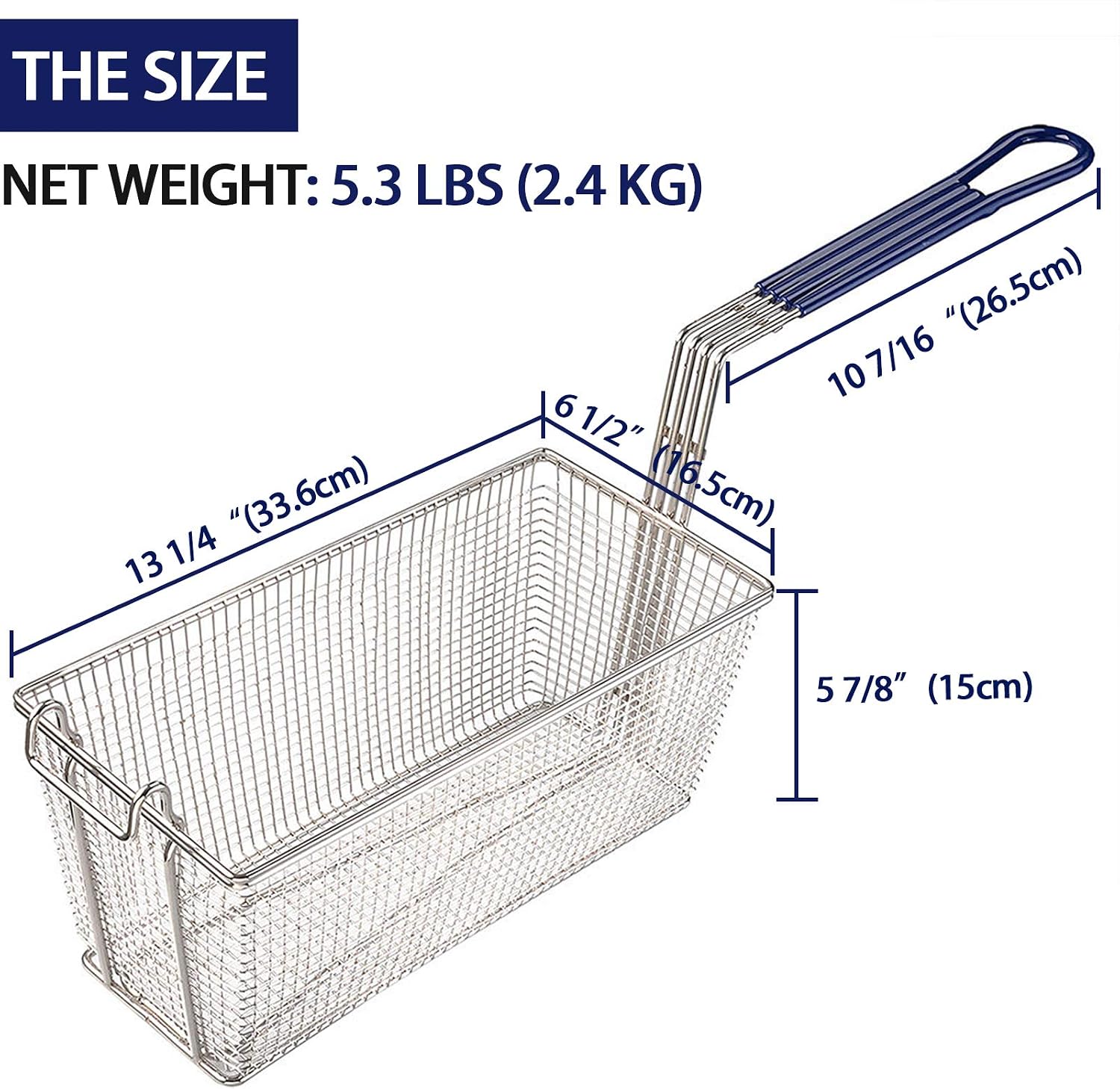
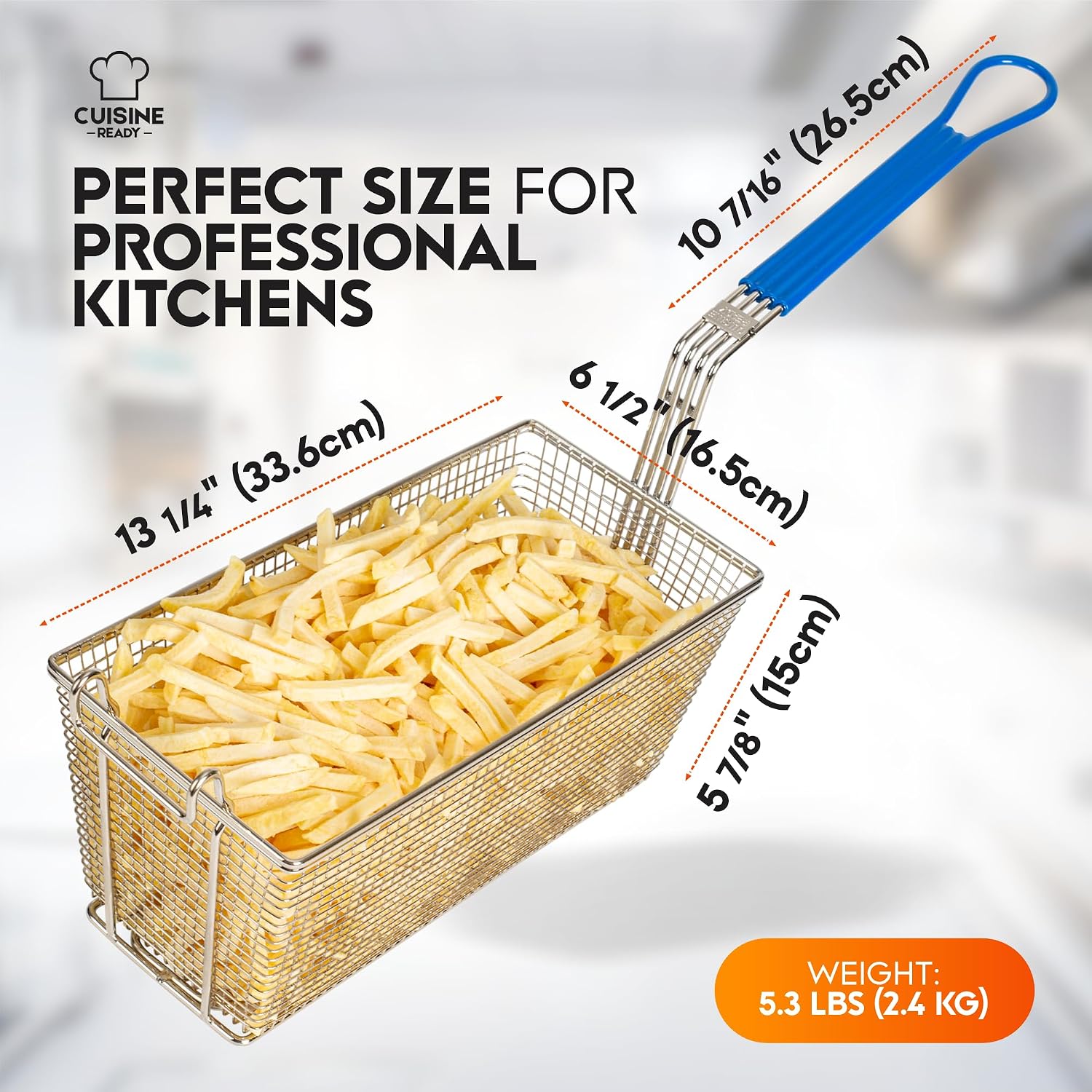
Multiple buyers of 13.25 × 6.5-inch baskets report a consistent problem: the basket was too long for their countertop fryer, but they “made it work” by leaving the basket partially out of the oil bath or propping it at an angle.
Let’s be direct about what “making it work” means in practice:
- Uneven cooking. Food at the shallow end of a tilted basket fries at a different rate than food at the deep end, because oil depth and temperature consistency vary across the basket’s length.
- A stability hazard. A basket balanced at an angle is a tip-over risk with a vat of 350°F+ oil below it.
- Disrupted thermostat geometry. Your fryer’s heating element and thermostat are calibrated to a specific oil volume at a specific depth. A misfit basket disrupts that geometry and can cause inconsistent temperature regulation.
The 13.25-inch basket is a standard size for commercial countertop fryers — specifically, full-size tanks on units designed for professional or semi-professional use. Most home fryers in the $80–$200 consumer range have tanks in the 10–12-inch interior length range. Serious Eats, in its deep fryer buyer guide, emphasizes measuring your fryer’s inner tank length before purchasing any replacement basket — a step most buyers skip when a listing says “universal.”
Sizing rule: If your fryer’s inner tank is shorter than the basket’s listed length, there is no safe workaround. You need either a larger fryer or a shorter basket.
Frequently Asked Questions
How can I tell if a basket is actually 304 stainless or something cheaper?
The magnet test is the fastest field method: hold a kitchen magnet to the wire mesh, not the handle. Strong attraction suggests nickel-plated iron or 201 stainless; weak or no attraction is more consistent with 304. Cook’s Illustrated’s equipment notes on deep fryer basket materials and durability identify this as a recurring issue in the category — listings frequently omit the alloy grade, and some are inaccurate. If a listing doesn’t state 304 or 316 explicitly and the price is under $30 for a multi-pack, treat the material as unconfirmed until tested.
How long do welds on budget baskets typically last with regular home use?
Aggregated owner review data suggests weld failures can begin within one year under regular home use. At higher frequency — daily frying — failures appear sooner. Heavier-gauge baskets at 3.0 mm wire and above consistently show longer weld life in owner reports. No independent lab data is publicly available for consumer-tier baskets; the NSF/ANSI 2 standard, administered by NSF International, sets durability requirements for certified commercial equipment, which is why certified OEM baskets carry a per-unit cost premium.
Will a 13.25 × 6.5-inch basket fit my countertop home fryer?
Only if your fryer’s inner tank is at least 13.25 inches long. Most consumer-market countertop fryers have tanks under 13 inches. Measure the interior of your tank before ordering. A basket that overhangs the tank cannot be safely used — it is a stability risk and a cooking-quality issue, not just an aesthetic mismatch.
Why does the handle feel loose on a brand-new basket?
On field-assembled baskets, a loose handle typically means the set screw or attachment mechanism was not fully tightened during assembly — easy to miss if you’re not expecting assembly to be required. Tighten all points before first use and re-check after the first heat cycle. On fully factory-welded baskets, a loose handle on arrival suggests a weld failure at the factory; that unit should be returned.
Is a four-pack worth it for home use?
For a typical home kitchen frying one to three times per week, a two-pack is operationally sufficient — one basket in use, one draining or cooling. A four-pack makes economic sense for food truck or ghost-kitchen setups where simultaneous multi-basket frying is the norm, or as a hedge against weld failure rates on budget baskets by keeping spares on hand. The cost savings of a four-pack are real only if the baskets last long enough to use them all.
The Decision Rule
A6 addressed: This commercial-comparison article contains three H3-level subsections — Budget-Tier Baskets, Mid-Tier Baskets, and Premium and NSF-Certified Baskets — each terminated by a tier marker (<a class="product-link" href="https://www.amazon.com/dp/B0CGBKL2F2?tag=greenflower20-20" rel="sponsored nofollow noopener" target="_blank" title="Affiliate link — we may earn a commission.">King — $19.99</a>, <a class="product-link" href="https://www.amazon.com/dp/B07Y1QD22C?tag=greenflower20-20" rel="sponsored nofollow noopener" target="_blank" title="Affiliate link — we may earn a commission.">2PCS — $52.29</a>, <a class="product-link" href="https://www.amazon.com/dp/B0CK588QZ1?tag=greenflower20-20" rel="sponsored nofollow noopener" target="_blank" title="Affiliate link — we may earn a commission.">Deep — $54.99</a>) on its own line, satisfying the A6 comparison-block requirement for intent=‘commercial-comparison’.
If you’re a home cook frying fewer than three times per week and your fryer tank measures under 13 inches interior length: a confirmed 304-stainless two-pack with a factory-welded handle is the right call. Spend toward the middle of the range rather than the floor, and run the magnet test when it arrives.
If you’re a food truck operator or ghost-kitchen manager frying daily: the reweld math makes budget four-packs a false economy at scale. The per-unit premium on NSF-certified baskets from OEM-adjacent suppliers is recoverable inside six months of avoided downtime and repair costs, as reflected in operator sourcing patterns documented by Restaurant Business Online. Verify the alloy grade, confirm any claimed NSF certification number against the NSF International listings database at nsf.org, and treat any listing that omits the grade designation as unconfirmed.
The phrase “heavy duty” in this category is decoration until a spec sheet backs it up. Wire gauge, alloy grade, and weld method are the numbers that actually matter — and they are available if you know to ask for them.