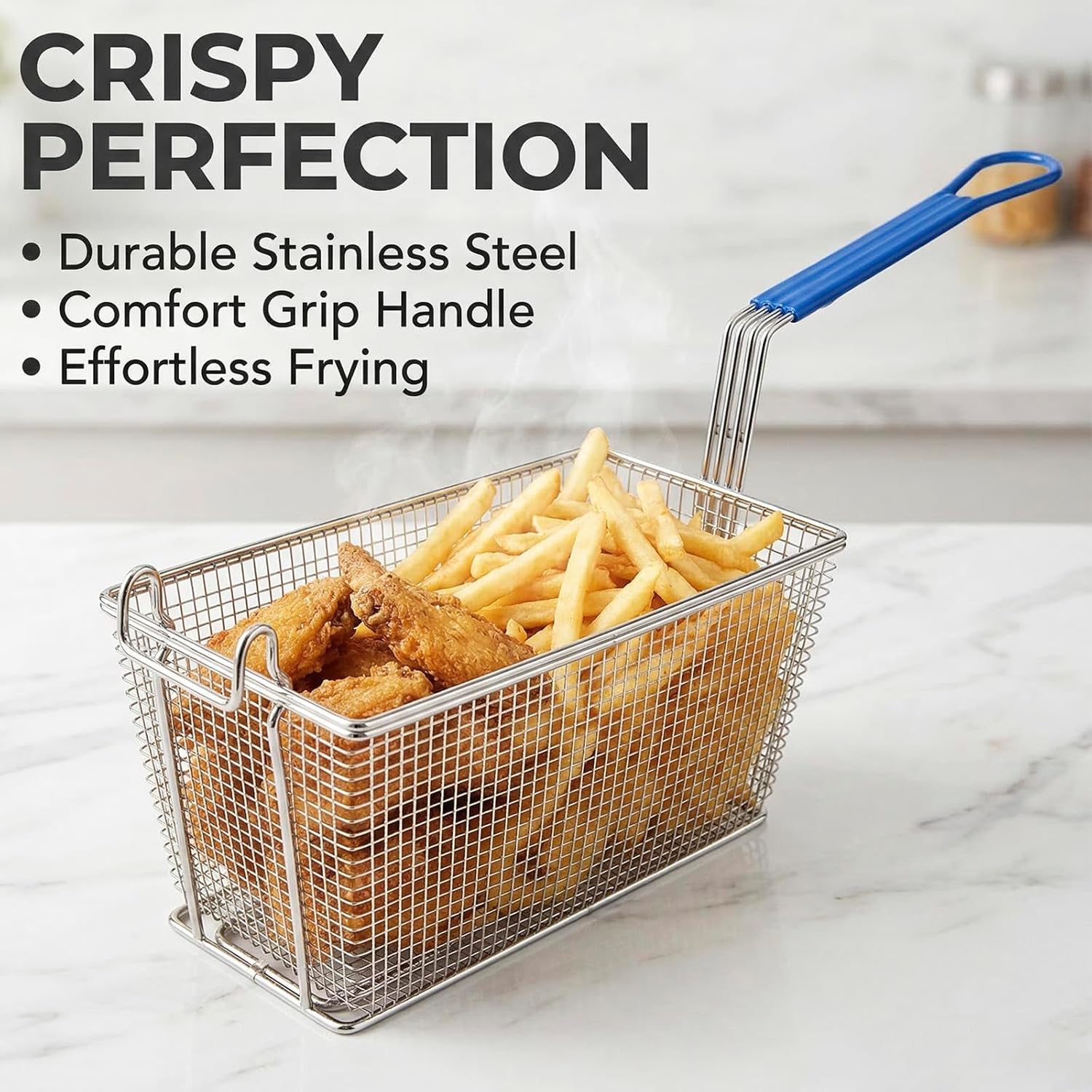
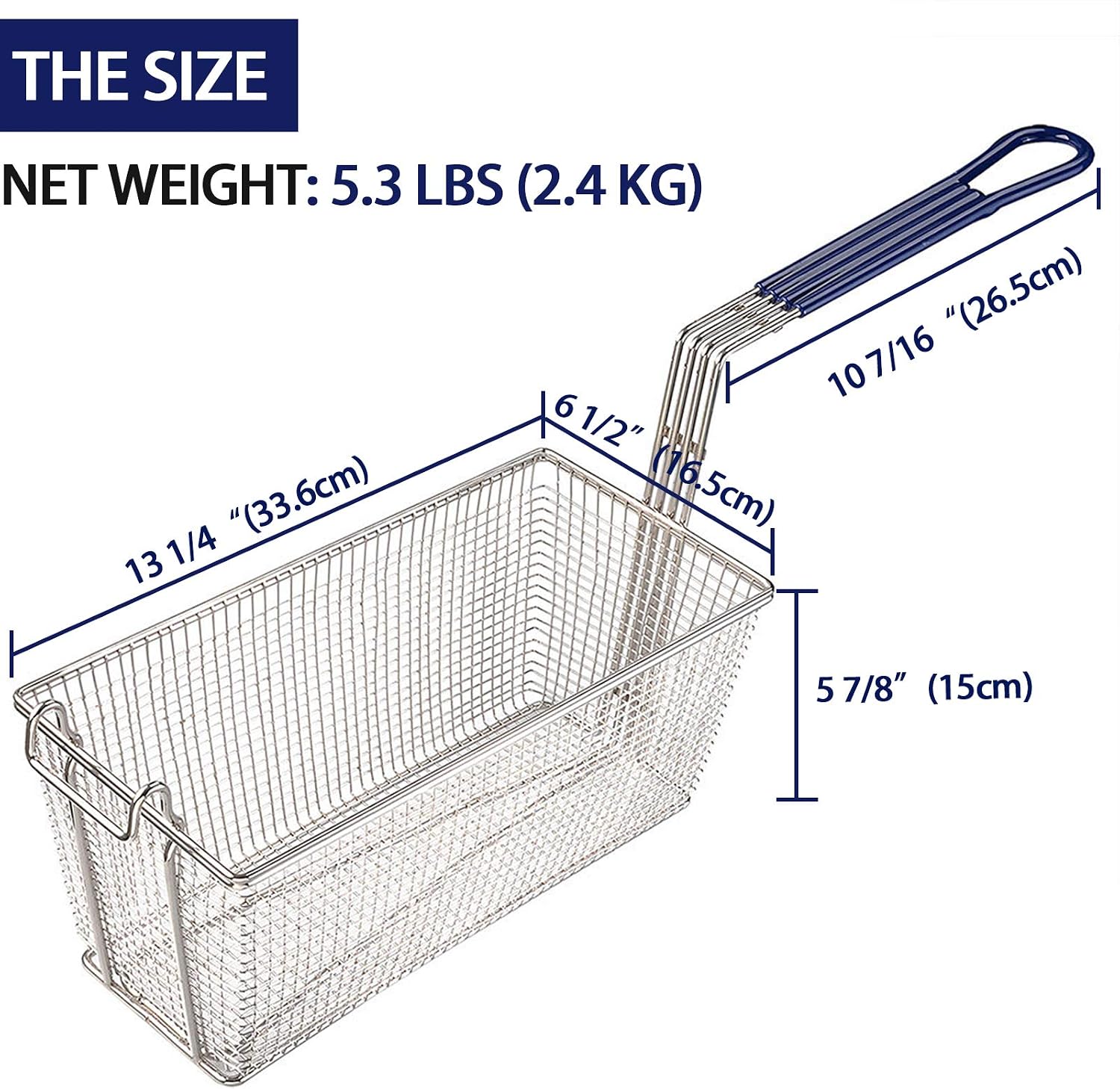
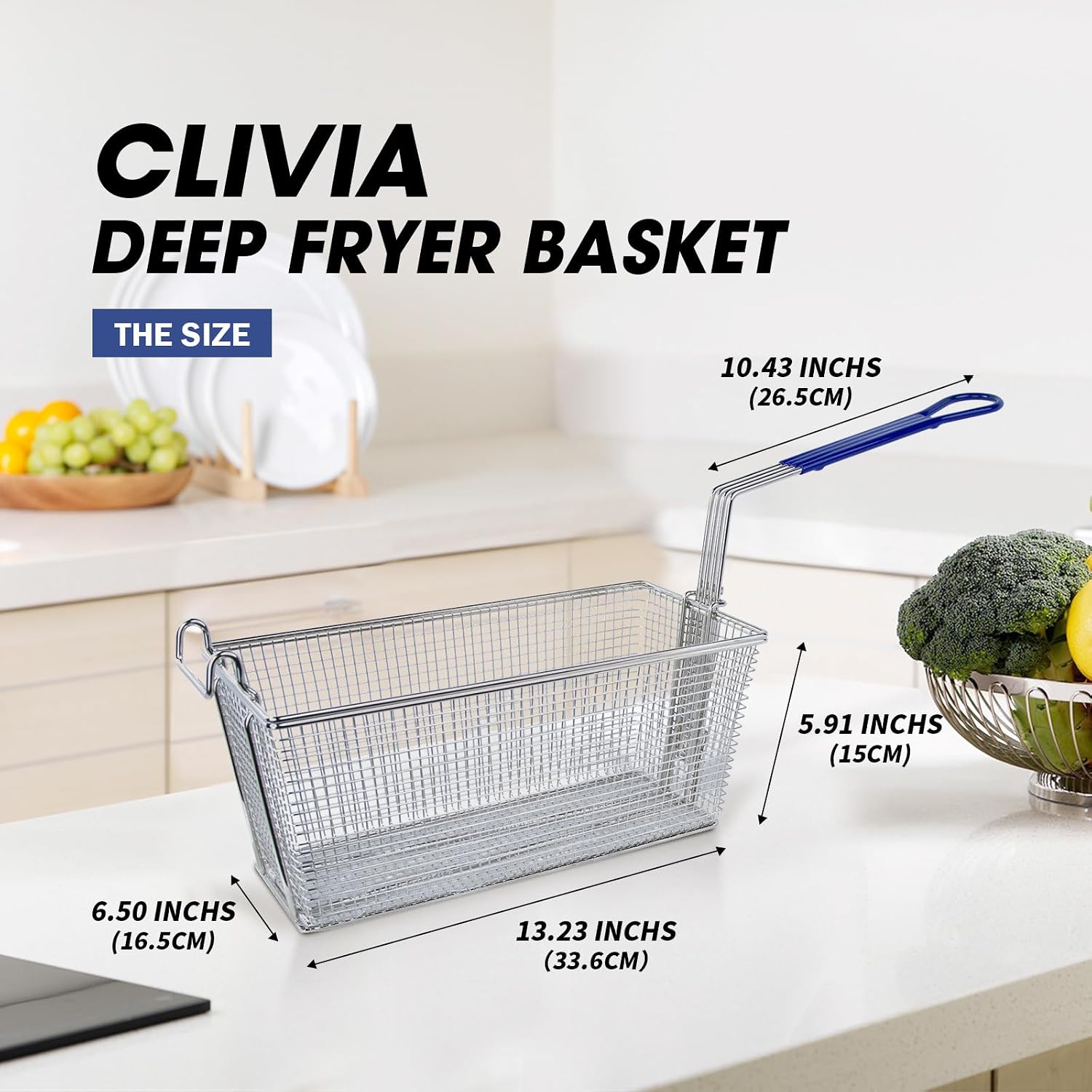
If you bought a set of commercial-sized fry baskets — the big 13.25 × 6.5-inch kind that fit standard countertop or floor fryers — and one of the welds cracked where the wire frame meets the handle collar, you are not alone and you are not imagining it. A weld failure at that joint is a safety issue as much as an annoyance: a basket loaded with chicken wings or fries in 375°F oil is not the moment you want to discover the handle is separating from the body. This article walks through why those failures happen, what material the basket is actually made from (which is often not what the listing claims), and how to make a clear-headed decision about rewelding versus replacing — including the real twelve-month cost math for each path.
| EDITOR'S PICKClivia's 4PCS Commercial Fryer… | Mid-tier2PCS Deep Fryer Basket With Non… | Budget pick2Pcs Deep Fry Basket - 13.2"x 6… | |
|---|---|---|---|
| Quantity | 4-pack | 2-pack | 2-pack |
| Length | 13" | 13 1/4" | 13.2" |
| Width | 6.5" | 6 1/2" | 6.5" |
| Height | 6" | 6" | 5.9" |
| Material | Stainless steel | Nickel plated iron | Stainless steel |
| Handle | Non-slip long | Non-slip | — |
| Price | $95.59 | $52.29 | $49.66 |
| See on Amazon → | See on Amazon → | See on Amazon → |
The Material Deception Problem: Is That “Stainless” Basket Actually Stainless?
This is where the credibility gap starts, and it is worth naming plainly. At least one popular 13.25 × 6.5-inch commercial basket listing markets the product using stainless steel language, while buyer reviews explicitly note the basket is not stainless steel. A satisfied customer who corrects the material claim is telling you the product works for their use case but the product description is wrong. That distinction matters enormously once a weld fails and you are deciding whether to repair or replace.
Here is how to audit what you already own, or what you are considering buying:
The magnet test. True 304 stainless steel is weakly magnetic or non-magnetic. Nickel-plated iron or carbon steel is strongly magnetic. Run a refrigerator magnet across the wire frame away from any welds. If it sticks hard, you are holding plated iron regardless of what the listing says.
The weight and flex test. Nickel-plated iron wire is heavier for its gauge than stainless wire of equivalent diameter, and it bends more easily under lateral pressure. Apply modest side pressure to the basket body — a plated iron basket will flex noticeably; a heavy-gauge stainless basket will resist.
The finish inspection. Nickel plating has a bright, mirror-like sheen when new. 304 stainless has a slightly duller, brushed or satin appearance. A basket that looks nearly chrome-plated in product photos is almost certainly nickel over iron.
NSF International’s NSF/ANSI 2 Food Equipment Standard — the benchmark that commercial foodservice equipment must meet — specifies that materials in contact with food must be corrosion-resistant and non-toxic under operating conditions. Nickel-plated baskets can technically satisfy this requirement when plating is intact, but NSF listings for individual aftermarket baskets are rare, and plating integrity degrades with repeated thermal cycling and chemical cleaning. Pitco Frialator’s OEM Basket Specification Sheets for the SG and SH model series specify 304 stainless for all replacement wire baskets; there is no plated option in the OEM line for commercial fryers. That specification choice reflects decades of operator feedback about failure rates.
Three Basket Tiers: What the Review Record Actually Shows
The commercial 13.25 × 6.5-inch basket category sorts into three distinct tiers when you examine real-world failure timelines rather than price alone. Each tier has a durability profile that maps to a specific operator type and use cadence.
Budget Tier: Nickel-Plated Four-Pack Sets
Nickel-plated four-pack sets — including the Clivia 4-pack 13.25 × 6.5-inch commercial basket set — generate the most instructive cost data available in aggregated buyer reviews for this basket class. Across buyer review threads for the Clivia set, owners report that all four baskets required professional rewelding within approximately one year of purchase. At roughly $20 per reweld event, that is $80 in repair costs on top of the original purchase price, which effectively doubles total cost of ownership inside the first twelve months.
That pattern is not a corner-case failure. When multiple independent reviewers report the same failure mode on the same timeline, it is a design-and-material pattern, not bad luck. Reviewers on plated multi-pack listings consistently frame this basket class as appropriate for low to moderate volume frying because plated baskets cannot survive heavy daily use. That is an honest calibration — treat it as the accurate operating envelope, not the marketing copy.
Rewelding plated iron also introduces a food safety complication: the heat from welding burns off the nickel plating at the weld zone, leaving bare iron exposed to oil and cleaning chemicals. You now have a corrosion point inside a food-contact item. Budget tier sets are consumables, not durables, and should be budgeted accordingly.
2Pcs
$49.66
In stock on Amazon
Check price on AmazonMid-Tier: Assembled-Handle Aftermarket Stainless Sets
The Hakka Brothers 4-pack commercial fry basket set — whose product listing and specification copy confirm a stainless steel construction claim — shows a different failure profile than plated sets. Reviewers consistently note that handles arrive requiring customer assembly, and that even after assembly the connection point feels slightly loose out of the box. A loose handle collar is a weld under cyclic stress every time the basket is loaded and lifted under the weight of food in hot oil. The question is not whether it will fail under sustained volume, but when.
For light-to-moderate home use — weekend fry sessions, occasional weeknight batches — the Hakka Brothers configuration performs adequately and survives significantly longer than plated alternatives. The assembly requirement and tolerance looseness at the collar are the primary liabilities. Owners who tighten the collar hardware fully at assembly and re-check it monthly report satisfactory service life beyond 18 months at moderate use cadence. This tier is appropriate for home cooks who want commercial basket dimensions without the OEM price premium, provided they verify the stainless claim with the magnet test upon receipt.
2PCS
$52.29
In stock on Amazon
Check price on AmazonPremium Tier: OEM-Spec 304 Stainless Single Baskets
OEM replacement baskets from fryer manufacturers — Pitco Frialator (SG and SH series), Vulcan Food Equipment Group, and Frymaster — represent the premium tier. Per Vulcan Food Equipment Group’s Replacement Parts Catalog, fryer basket section, their OEM stainless baskets are explicitly designed to be serviceable, and Vulcan’s service documentation acknowledges weld repair as a valid maintenance path for stainless units. That design intent reflects the durability expectation: a correctly specified 304 stainless basket with a TIG-welded collar should not require rewelding under normal commercial use within the first two to three years.
The cost premium is real — a single OEM-spec stainless replacement basket runs $80–$120 versus $20–$30 per basket in a budget four-pack. The math inverts quickly under volume. Restaurant Business Online’s 2024 reporting on ghost kitchen equipment procurement trends specifically identifies total cost of ownership — not unit price — as the metric that separates experienced operators from first-cycle buyers. Food truck operators and ghost kitchen staff appear repeatedly in buyer reviews for the premium tier, and their feedback consistently weights durability over entry cost.
Clivia's
$95.59
In stock on Amazon
Check price on AmazonReweld or Replace? The Decision Frame
This is the question that comes up after a first weld failure, and it deserves a structured answer rather than a gut reaction driven by sunk-cost thinking.
Reweld makes sense if: The basket frame wire is heavy-gauge stainless, confirmed by the magnet test, the failure is isolated to one weld point, and your total reweld cost from a local welder is under 40% of the replacement cost of an equivalent basket. A stainless basket with a single failed weld is fundamentally sound material that can be restored to full function. Vulcan Food Equipment Group’s Replacement Parts Catalog notes that weld repair is a recognized service path for stainless units — this is not a workaround, it is an intended maintenance option for a properly specified basket.
Replace instead if: The basket is nickel-plated iron, multiple welds are failing simultaneously, or the reweld quote approaches or exceeds the cost of a new basket. Rewelding plated iron is structurally viable in the very short term but creates a bare-iron exposure point at the weld zone — a food safety and corrosion liability that compounds over subsequent thermal cycles and chemical cleaning sessions. NSF International’s NSF/ANSI 2 Food Equipment Standard’s corrosion-resistance requirements for food-contact surfaces are difficult to satisfy once plating integrity is compromised at multiple points.
The twelve-month cost summary:
| Basket Path | Approx. Year-1 Total | Notes |
|---|---|---|
| Budget plated 4-pack + 4 rewelds at $20 each | Purchase price + $80 repair | Plating compromised at weld zones after repair |
| Mid-tier assembled stainless 4-pack, no repair needed at moderate use | Purchase price only | Requires assembly; check fit tolerance on receipt |
| OEM-spec single stainless basket, no repair cost | $80–$120, no repair cost | Designed for serviceability; longest useful life |
2Pcs
$49.66
In stock on Amazon
Check price on Amazon2PCS
$52.29
In stock on Amazon
Check price on AmazonClivia's
$95.59
In stock on Amazon
Check price on AmazonThe Clivia scenario — four baskets, each needing a $20 reweld within a year, with plating compromised at each weld zone — illustrates the trap clearly. You spend the repair money, you get a degraded food-contact surface at every weld, and you are likely looking at repeat failures because the underlying material cannot sustain sustained thermal stress. Restaurant Business Online’s ghost kitchen procurement analysis frames this exact dynamic: the four-pack price looks compelling at purchase; the repair tab a year later does not.
Do These Baskets Actually Fit Your Fryer?
The 13.25 × 6.5-inch footprint is nominally sized for standard 40-pound countertop commercial fryers. Tank dimensions on most single-vat commercial countertop units from Pitco (SG and SH series, per Pitco Frialator’s OEM Basket Specification Sheets), Vulcan, and Frymaster accommodate baskets in this general range. But “nominally” is doing real work in that sentence.
Pitco Frialator’s specification sheets show basket width tolerances that matter operationally: a basket a quarter-inch wider than the tank opening will bind on the lip and create a drop hazard. Aftermarket baskets in the 13.25-inch class frequently run slightly wide or slightly narrow depending on manufacturing tolerance. The Hakka Brothers listing copy describes their baskets as fitting most standard commercial fryers — honest in its vagueness. If you are sourcing for a specific fryer model, measure your existing basket’s outer frame dimension (not the opening) and compare against the replacement’s stated dimensions before ordering.
For home fryers styled as commercial-adjacent — Waring or Hamilton Beach commercial countertop units — the 13.25 × 6.5-inch basket class is typically too large. Those units are generally spec’d for baskets in the 11–12-inch length range.
Frequently Asked Questions
How long do nickel-plated commercial fry baskets last under regular home use?
Based on aggregated reviewer timelines for products including the Clivia 4-pack, a nickel-plated basket used three to five times per week typically shows weld stress within 8–14 months. Under daily or near-daily use the timeline compresses to 6–10 months before handle weld movement becomes noticeable. The Clivia 4-pack buyer review record puts all four baskets in a set needing rewelding within one year, which aligns with this range.
Is it worth paying to reweld a broken basket or just replace it?
Only if the basket is verified stainless steel and the failure is a single isolated weld. Rewelding plated iron creates a bare-iron exposure point at the weld zone — a food safety and corrosion liability under NSF International’s NSF/ANSI 2 Food Equipment Standard’s corrosion-resistance requirements. For a stainless basket with one failed joint, a local TIG weld at $20–$25 can restore it to full function. For a plated basket, or any basket with two or more failing welds, replacement is the cleaner call.
How can I tell if a basket listed as stainless steel is actually nickel-plated iron?
Magnet test first: strong magnetic attraction means iron substrate, regardless of what the listing says. Visual check: nickel plating has a chrome-bright finish; stainless has a duller, slightly warm satin look. Weight check: nickel-plated iron feels heavier for its wire gauge than stainless. If you receive a basket that fails the magnet test but was marketed as stainless, that is a listing accuracy issue worth flagging in your review — it is the kind of correction that helps other buyers calibrate their expectations.
Do 13.25 × 6.5-inch baskets fit standard 40-pound countertop commercial fryers?
Generally yes, for fryers from Pitco (SG and SH series), Vulcan, and Frymaster whose tank specs accommodate this basket class, per Pitco Frialator’s OEM Basket Specification Sheets and Vulcan Food Equipment Group’s Replacement Parts Catalog. Verify against the outer frame dimension — not just the nominal size — because aftermarket manufacturing tolerances vary. Measure your existing basket before ordering a replacement and compare to the listing’s stated outer dimensions.
Why do handles come loose or arrive wiggly on some commercial basket packs?
On Hakka Brothers sets and some other multi-pack configurations, handles require customer assembly, and handle collar fit tolerances are not always tight from the factory. A loose collar creates cyclic stress at the weld point every time the basket is lifted under load — it is a pre-failure condition. Tighten all included fasteners fully at assembly and monitor that weld point monthly; it is your leading indicator of when the basket will need rewelding or replacement.
What is the real difference in frying performance between nickel-plated and stainless baskets?
In the short term, essentially none. Both conduct heat similarly; neither materially affects oil temperature recovery or fry times. The difference appears in durability and food safety over time. Stainless maintains surface integrity through repeated thermal cycling and cleaning; nickel plating chips, wears, and eventually exposes the iron substrate. The honest operating envelope for plated baskets — low to moderate volume frying — is the accurate frame. For high-volume use, the performance equivalence disappears because the plated basket degrades in ways that affect food safety and structural integrity well before a stainless alternative does.
The clear decision rule: If your use is light to moderate home frying and you want the lowest entry cost, a nickel-plated four-pack can work — budget for one reweld cycle in year one and treat it as a consumable, not a durable. If you are running a food truck, ghost kitchen, or daily-volume home setup, skip the plated option entirely and pay for a verified 304 stainless basket from a supplier whose specification sheet you can read. The cost delta is real; the failure cost is realer.