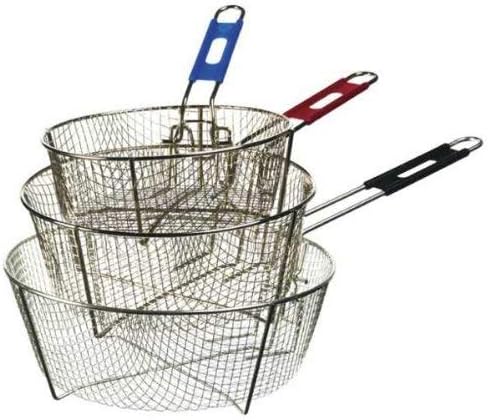
If you’ve ever tried frying in a cast iron dutch oven — a thick-walled, heavy pot designed for both stovetop and outdoor cooking — you’ve probably discovered that most standard deep-fryer baskets don’t fit. A “deep fryer basket” (the wire or mesh insert that holds food in hot oil and lifts it out cleanly) is engineered for rectangular commercial fryer vats, not the round, steep-sided profile of a 5- or 7-quart cast iron pot. The result: baskets that won’t seat, tilt sideways, dump food, or hang so crooked that draining becomes a two-handed juggling act over 375°F oil. This guide cuts through the diameter confusion, flags the real ergonomic gotchas that reviewers keep surfacing, and gives you a clear decision framework — whether you’re frying wings in your backyard on a propane burner or running a ghost-kitchen test batch.
Why Round Basket Sizing Is Almost Always Misread
This is where most purchases go wrong, and it’s worth spending real time here before touching any other spec.
A cast iron dutch oven has three relevant measurements: the inner diameter at the base, the inner diameter at the rim (these differ on slightly tapered pots), and the usable oil depth at your working fill level. A round fry basket has its own three measurements: outer diameter at the widest point, inner diameter at the basket floor, and basket depth. Buyers consistently match only one number — usually the advertised basket diameter against their pot’s rim opening — and get a basket that either falls straight to the bottom or wedges too tight to lift safely.
The practical rule, drawn from published product specs and aggregated buyer Q&A across Lodge and Winco listings: target a basket outer diameter 1–1.5 inches smaller than your pot’s inner rim diameter. That clearance lets the basket’s hook or handle rest on the pot wall without the basket body contacting the sides, which is what allows proper oil drainage when you lift.
By the numbers — common Lodge cast iron fits:
| Dutch Oven Size | Inner Rim Diameter (approx.) | Target Basket OD | Notes |
|---|---|---|---|
| Lodge 5 qt (L8DOL3) | ~9.5 in | 8–8.5 in | Most 8.5 in round baskets seat correctly |
| Lodge 7 qt (L10DOL3) | ~10.75 in | 9.5–10 in | Verify hook length — longer hooks needed |
| Lodge 12 qt camp oven | ~12 in | 10.5–11 in | Propane burner use; confirm flat-bottom profile |
Figures derived from Lodge Manufacturing’s published product dimensions. Measure your specific pot — tolerances vary between casting runs.
The Taper Problem: Why Some Baskets Hang Wrong
Here’s a design issue that doesn’t show up in product photos but surfaces consistently in owner reviews: tapered-side baskets hang incorrectly in straight-sided pots.
The HIC Harold Import Co. stainless mesh basket is the clearest documented case. Its sides angle outward from base to rim, which works fine in a flared mixing bowl but causes a functional problem in a straight-sided or only-slightly-tapered dutch oven — the widest point of the basket catches the pot wall partway down, leaving the basket riding high and tilted rather than centered. HIC’s own product documentation doesn’t flag this, but the pattern emerges clearly across aggregated purchase reviews: buyers using HIC baskets in Lodge dutch ovens consistently report the basket “doesn’t hang level” and “tips toward one side.”
The implication for your decision: in a straight-sided cast iron pot, prioritize baskets with vertical or near-vertical sidewalls. Cylindrical baskets — where the diameter is consistent from floor to lip — seat and drain predictably. The Lodge fry basket, designed with its own cast iron cookware line in mind, uses this geometry. So do the Winco round baskets that buyers across Q&A threads specifically cite for dutch oven use — one Winco buyer’s review notes, verbatim, that they purchased the basket “for use in cast iron dutch oven for frying with an outdoor propane burner,” and found it seated cleanly without the tilt problem.
The Side-Hook Drain System: Real Advantage, Real Limitation
Lodge’s fry basket earns consistent praise for one specific design feature: a side-hook system that lets you prop the basket on the pot rim and walk away while oil drains back into the pot. For home fryers and small-batch operators, this solves a genuine ergonomic problem — holding a heavy, oil-laden basket over a hot pot while trying to plate food is a burn waiting to happen.
But there’s a real limitation that a 4-star Lodge basket reviewer flags, and it’s worth naming directly: the basket tilts downward rather than upward when resting on the pot edge via the hook. That means food can slide toward the basket’s low side during drain time. For dense items — bone-in chicken, thick-cut fish — this is manageable. For delicate items like fried shrimp, calamari, or thin-sliced vegetables, the tilt can cause pieces to bunch and stick together, undoing the even-fry work you just did.
The workaround that experienced cast iron fryers describe: use a secondary resting rack or sheet tray positioned to catch drips, and plan to gently redistribute food with tongs during the 15–20 second drain rather than leaving it fully unattended.
Detachable-handle round baskets earn their own strong reviews for cast iron applications specifically because of cleanup ease — without a fixed handle, the basket fits flat in a sink or dishwasher. Owners consistently rate this as a meaningful quality-of-life win over fixed-handle designs, especially when cleaning cast iron residue from fine mesh after high-temp frying.
Mesh Size and the Shrimp-Calamari Problem
Fine-textured seafood — shrimp, calamari rings, small scallops — will fall through coarse mesh. This is not a debate; it’s physics. The question is which mesh specification actually contains small pieces under fry conditions.
Published spec sheets and product documentation show most round fry baskets use mesh openings in the 3/8-inch to 1/2-inch range — adequate for french fries, chicken tenders, and most wing formats, but too large for smaller seafood pieces, especially calamari rings that can deform and squeeze through under their own weight in hot oil.
For shrimp and calamari applications in a dutch oven setup, the relevant spec threshold, per aggregated owner guidance and Serious Eats’ dutch oven frying technique documentation, is mesh openings of no larger than 1/4 inch (approximately 6mm). Most standard round fry baskets don’t hit this — you’re looking at fine-mesh or perforated-plate designs. The HIC stainless mesh basket, despite its taper problem in straight-sided pots, does use finer mesh than average and is noted by reviewers as better for small seafood — provided you’ve confirmed the fit in your specific pot before committing.
If your primary use case is small-item seafood in a cast iron dutch oven, the honest answer is that most standard round fry baskets are the wrong tool. A fine-mesh spider strainer (a flat, long-handled skimmer designed for exactly this) or a perforated basket with smaller openings is the correct pairing. Cook’s Illustrated’s dutch oven frying documentation consistently recommends spider strainers alongside or instead of baskets for small-piece proteins — worth reading if this is your primary application.
Propane Burner Use: What Changes
If you’re running a cast iron dutch oven on an outdoor propane burner — the setup several Winco basket reviewers describe — a few variables shift:
Heat flux is higher and less even than a kitchen range, which means oil temperature swings are larger between batches. This doesn’t change basket selection directly, but it raises the stakes on heat-resistant handling. Wire-handle baskets get hot faster and retain heat longer over a high-BTU propane burner than over a standard electric or gas range. NSF International’s foodservice equipment material standards note that stainless steel handles above 18-gauge can reach unsafe contact temperatures rapidly in high-heat environments — a reminder that heat-resistant gloves are not optional in this setup, they’re required.
Stability matters more outdoors. A round basket with a longer side-hook that extends well past the pot rim creates a lever effect that can be destabilized by wind or an uneven surface. Shorter hooks — or baskets designed to be lifted straight out rather than hooked — are more stable in outdoor propane setups.
Frequently Asked Questions
How do I measure my cast iron pot to find the right basket diameter? Measure the inner rim diameter (the opening at the top, not the base) with a flexible tape or a rigid ruler across the widest point of the inside wall. Then subtract 1 to 1.5 inches — that’s your target basket outer diameter. Also check your pot’s interior depth against your planned oil fill line; you want at least 2 inches of oil clearance below the basket floor for safe immersion frying.
Will a Lodge fry basket fit a non-Lodge cast iron pot? Not reliably, without measuring. Lodge fry baskets are designed around Lodge pot inner dimensions. A Lodge basket in a non-Lodge dutch oven may be too wide, too narrow, or hang incorrectly if the pot’s profile differs. Per Lodge’s published product documentation, they spec their basket to their own 5-qt round dutch oven line. Treat it as a starting point, not a universal fit.
Do I need heat-resistant gloves when using a wire-handle fry basket on a stovetop or propane burner? Yes. Full stop. Wire and stainless handles conduct heat quickly, and NSF International’s material guidelines for commercial foodservice make clear that bare metal handles in sustained high-temperature environments reach burn-risk temperatures in under two minutes. Silicone-grip or wrapped handles reduce but don’t eliminate this — gloves are the correct answer, not optional PPE.
What mesh size is fine enough to fry shrimp and calamari without items falling through? Target mesh openings of 1/4 inch or smaller (approximately 6mm or less). Most standard round fry baskets sold for dutch oven use run 3/8 to 1/2 inch mesh — too coarse for small seafood under frying conditions. Verify the mesh specification in the product documentation before purchase, not just the photo.
Is the side-hook drain system on Lodge baskets safe for long drain times? For 15–30 second drains, yes — owners generally report it as stable. For extended holds (over a minute), the downward tilt of the basket means food redistributes toward the low side, and there’s a risk of the hook slipping if the pot rim has any residual oil on it. Lodge’s own product guidance doesn’t define a maximum drain hold time; treat anything beyond 30 seconds as needing a secondary support.
Can I use a round fry basket in an outdoor propane dutch oven setup? Yes, and multiple buyers report doing exactly this with good results — provided the basket fits the pot correctly (see sizing guidance above), you’re using heat-resistant gloves, and your propane burner is on a stable, level surface. Wind-guard frames are worth using around the burner to reduce temperature fluctuation between batches.
The Decision Framework
If your pot is a named Lodge dutch oven and the Lodge fry basket’s published outer diameter falls within 1–1.5 inches of your pot’s inner rim: start with the Lodge basket. The side-hook system solves the real ergonomic problem, and the design is built around the pot geometry you’re working with. Accept the downward-tilt drain limitation and plan your plating workflow around it.
If your pot is non-Lodge, or if you’re working with a larger camp oven or commercial-adjacent cast iron vessel: measure first, then filter for cylindrical (non-tapered) sidewalls. The Winco round basket line, per documented buyer experience in cast iron dutch oven applications, offers the cylindrical profile that seats correctly in straight-sided pots — confirm the outer diameter against your specific pot measurement before purchasing.
If your primary application is small-piece seafood — shrimp, calamari, small-cut vegetables: a standard round fry basket is probably the wrong tool. Look for fine-mesh or perforated designs with sub-6mm openings, or plan to use a spider strainer alongside your basket rather than relying on the basket alone. Serious Eats’ dutch oven frying documentation is the most actionable public reference for technique-side decisions in this category.
The basket-to-pot fit problem is solvable. It just requires treating the manufacturer’s diameter claim as a starting number, not the answer.